Nexity_URD 2025
-

-
Introduction
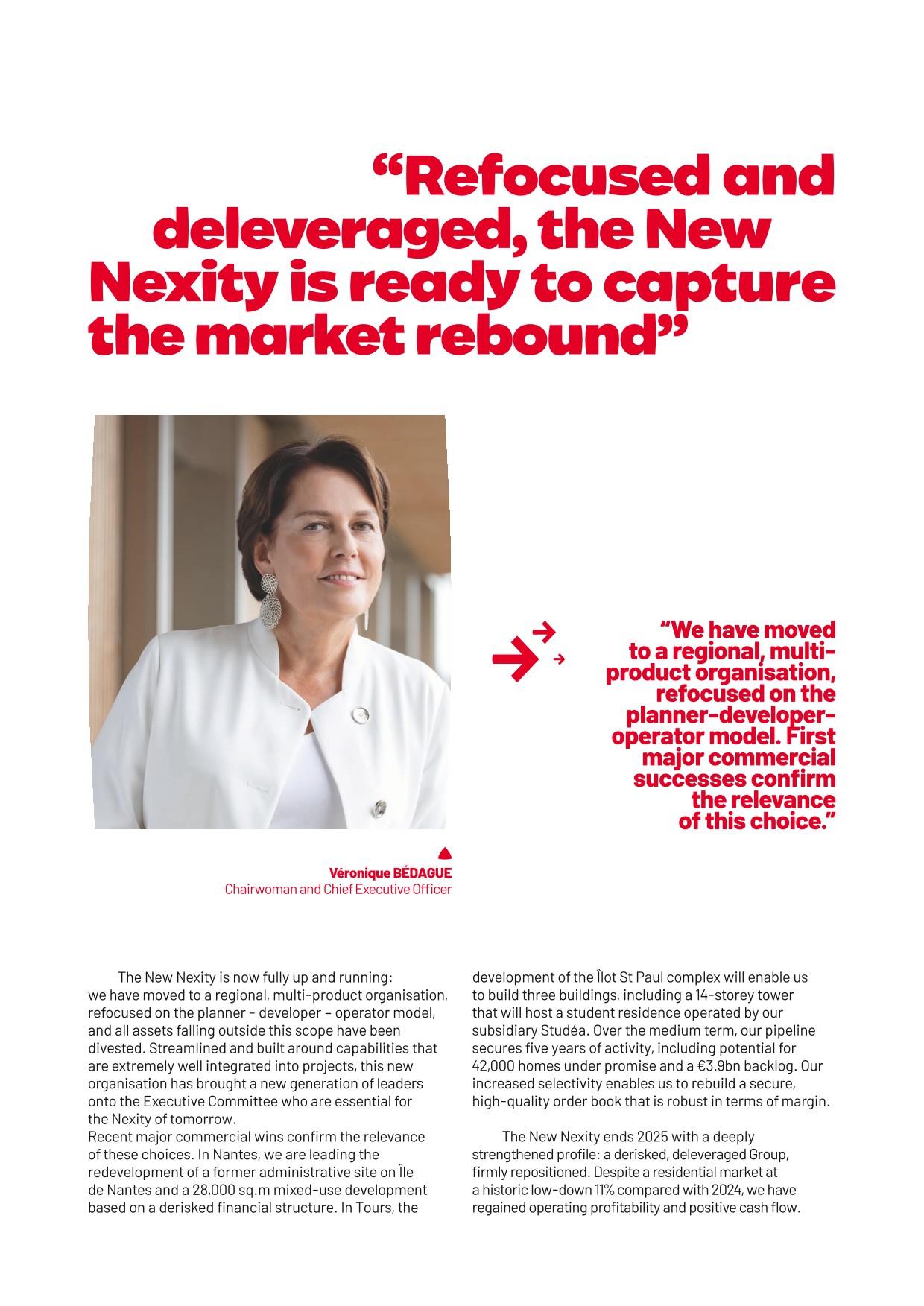 Opening double-page spread of the report with, on the left, a large headline “Refocused, deleveraged, the New Nexity is ready to capture the market rebound”, a portrait of Véronique Bédague (Chairwoman and Chief Executive Officer) and a quote highlighting the shift to a territorial, multi-product organisation, refocused on the developer–promoter–operator model. The left-hand text explains that the “New Nexity” is now operational: non-core assets sold, organisation simplified and strengthened, and a new generation of leaders on the Executive Committee. It highlights commercial successes in Nantes (rehabilitation of a former administrative site on Île de Nantes and a mixed-use 28,000 sq.m development with a de-risked financial structure) and in Tours (Îlot Saint Paul district, three buildings including a 14-storey tower hosting a student residence operated by Studéa). It states that the pipeline represents around five years of activity, including 42,000 homes under promise and a €3.9 billion backlog, and a strengthened 2025 profile (a de-risked, deleveraged group, operating profitability restored and positive cash flow despite a residential market down 11% vs 2024).
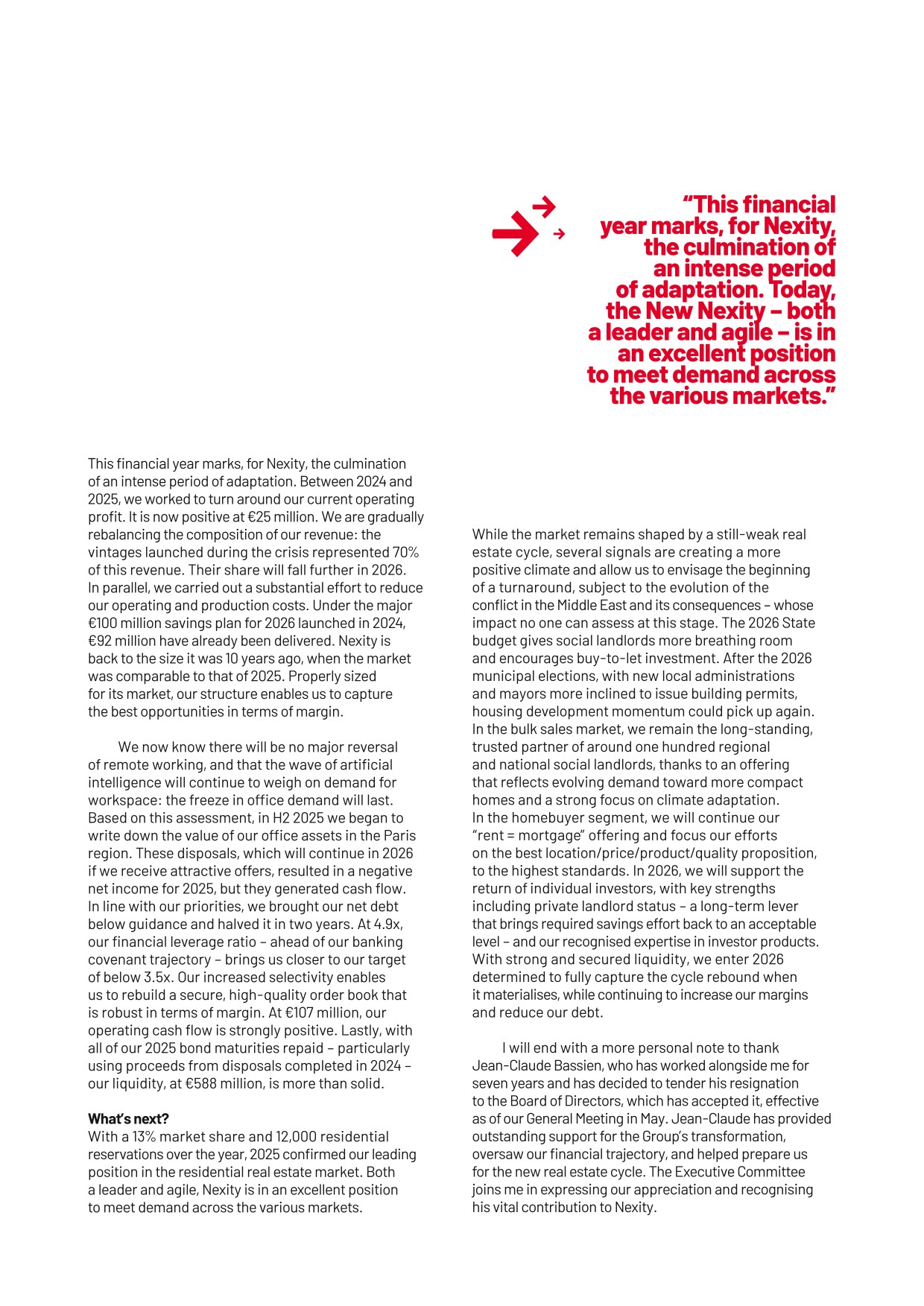 On the right, the Chairwoman and CEO details the 2024–2025 adjustment period and the financial turnaround: recurring operating income back in positive territory (€25 million), a €100 million savings plan targeted by 2026 (€92 million already achieved), continued cost reductions and a structure adjusted to market levels. The text mentions the lasting decline in office demand (remote work and AI), the impairment and disposal of office assets in the Île-de-France region (net result negative in 2025 but cash flow generated), then deleveraging (net debt halved in two years), a leverage ratio at 4.9x on a path toward a target below 3.5x, positive operating cash flow (€107 million) and liquidity of €588 million. A section “And now?” sets out the 2026 priorities: consolidate leadership in residential (13% market share, 12,000 reservations), capture a possible market rebound, continue the “rent = mortgage” offer, support the return of individual investors, remain a major partner for social landlords and continue increasing margins and reducing debt. A second quote states that this year marks the culmination of an intense adjustment period for Nexity and that today the New Nexity is both leader and agile, in an excellent position to meet demand in the various markets. The spread ends with a thank-you note to Jean-Claude Bassien for his contribution to the Group’s transformation and for overseeing the financial trajectory; she expresses the Group’s recognition and salutes his decisive contribution to the New Nexity.
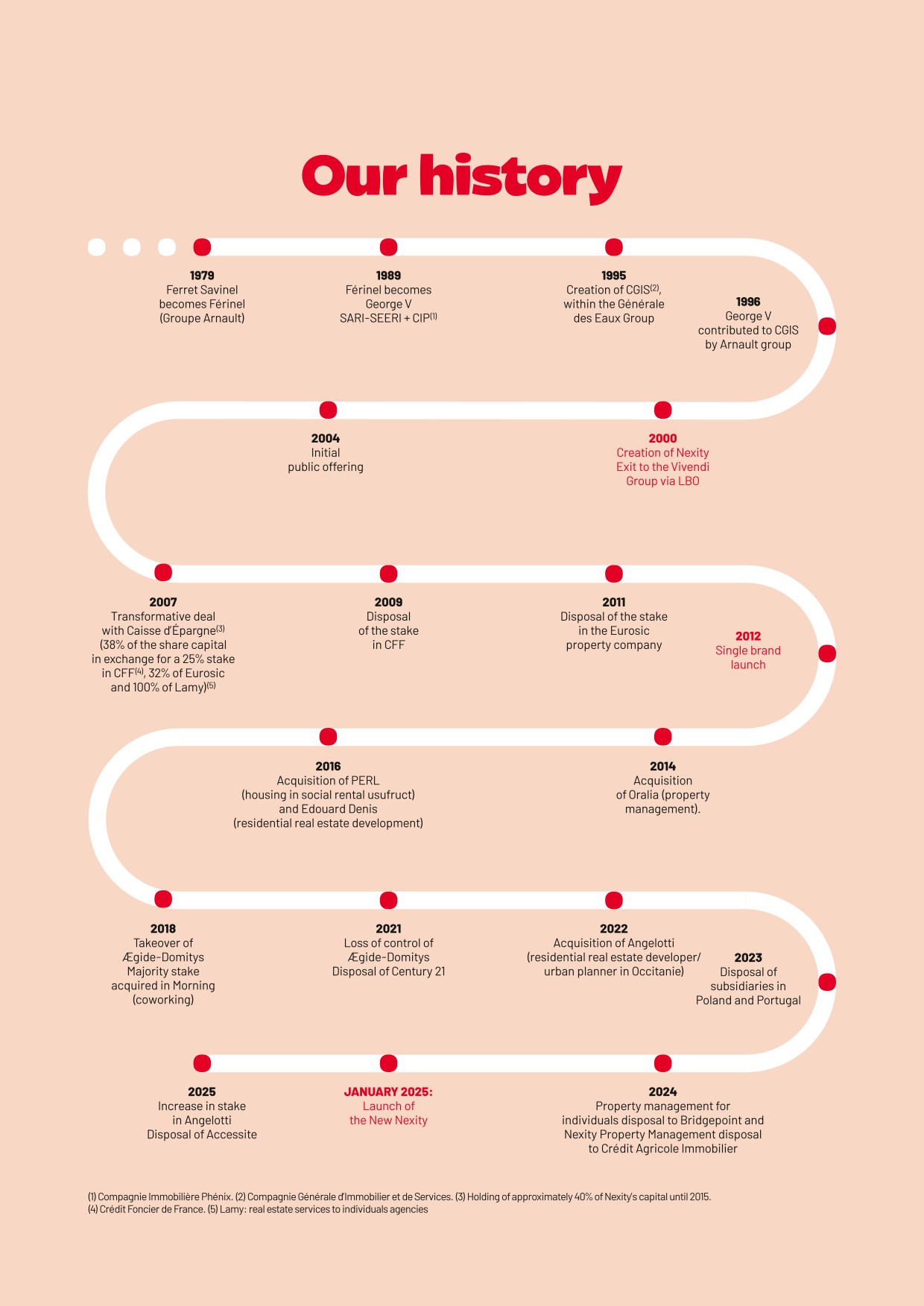 Image in the form of a timeline titled “Our history”, tracing the key milestones in the building of the Nexity Group. Milestones shown: 1979, Ferret Savinel becomes Férinel (Arnault Group); 1989, Férinel becomes George V; SARI SEERI + CIP (Compagnie Immobilière Phénix); 1995, creation of CGIS (Compagnie Générale d’Immobilier et de Services) within the Générale des Eaux Group; 1996, contribution of George V to CGIS by the Arnault Group; 2000, creation of Nexity and exit from the Vivendi group via an LBO; 2004, IPO; 2007, transformative transaction with Caisse d’Épargne (holding around 40% of Nexity’s capital until 2015) in exchange for 25% of CFF (Crédit Foncier de France), 32% of Eurosic and 100% of Lamy; 2009, sale of the stake in CFF; 2011, sale of the stake in the Eurosic REIT; 2012, launch of a single brand; 2014, acquisition of Oralia (property management); 2016, acquisitions of PERL (social rental usufruct) and Edouard Denis (residential development); 2018, taking control of Ægide Domitys and acquiring a majority stake in Morning (coworking); 2021, loss of control of Ægide Domitys and sale of Century 21; 2022, acquisition of Angelotti (residential developer/land developer in Occitanie); 2023, disposals of subsidiaries in Poland and Portugal; 2024, sale of property management activities to Bridgepoint and of Nexity Property Management to Crédit Agricole Immobilier; January 2025, launch of “New Nexity”; 2025, increase in Angelotti stake and sale of Accessite.
 Manifesto-style page visual titled “For a city that loves life: our manifesto”. The content expresses Nexity’s commitment as an urban operator alongside cities and their inhabitants, with territorial impact as its compass. The manifesto emphasizes a locally anchored approach, led with elected officials and partners, to meet the needs of residents, businesses and local authorities. It highlights solutions tailored to uses thanks to Nexity’s expertise as a land developer, property developer and operator, addressing real estate, urban comfort and climate resilience. It stresses orchestrating the value chain and mobilizing an ecosystem toward more sustainable practices, with the ambition to decarbonize the sector and develop projects that are resource-efficient, greener and better adapted to new uses. The purpose statement “living together” guides these commitments to people, the collective and the planet.
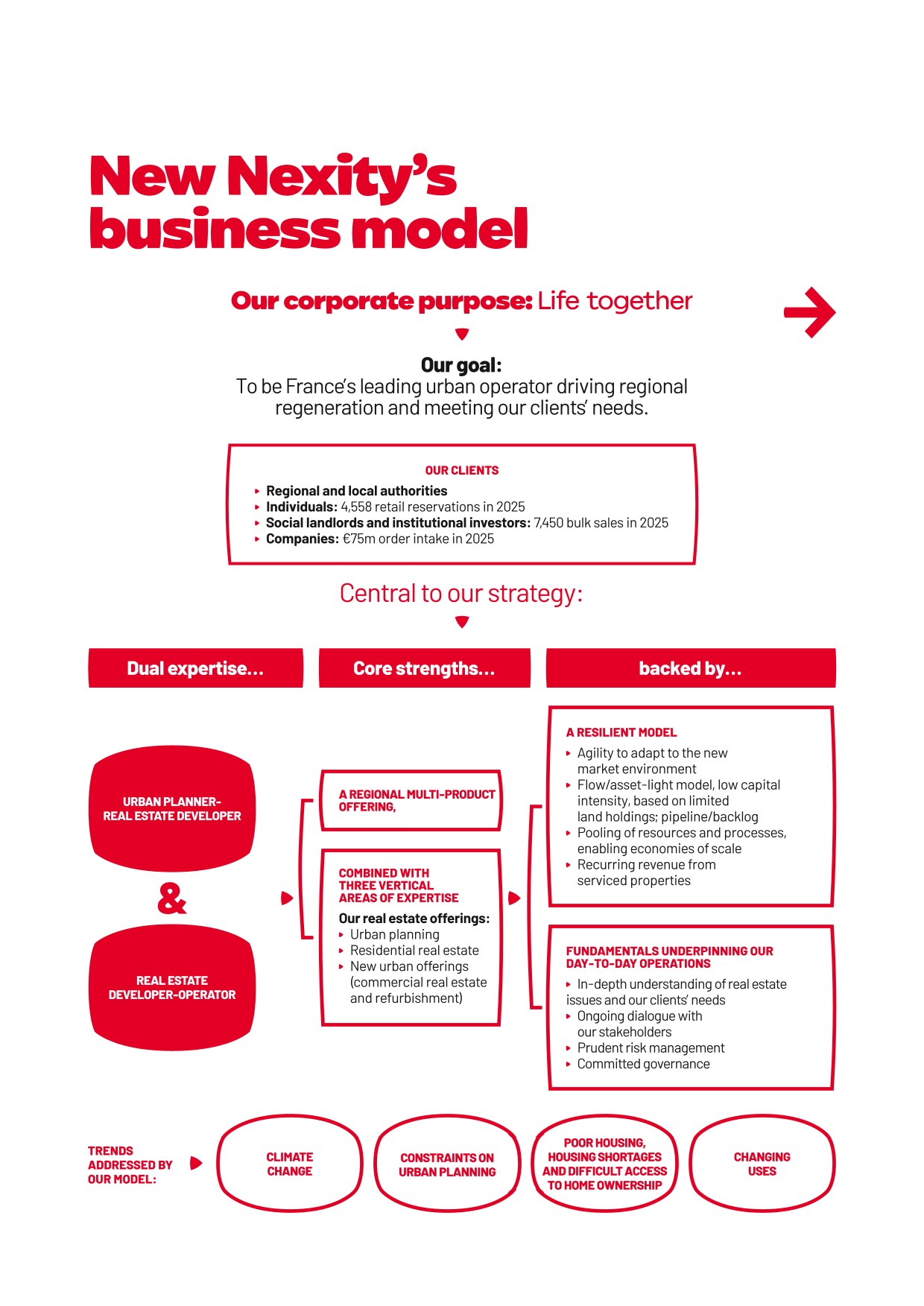 Double-page diagram presenting “The business model of the New Nexity”. The left page recalls the purpose “Living together” and the ambition to be the leading urban operator serving territorial regeneration. The diagram lists customers: territories and local authorities; individual customers (4,558 retail reservations in 2025); social landlords and institutional clients (7,450 block sales in 2025); companies (€75 million of order intake in 2025). At the heart of the strategy: a dual expertise (land developer–promoter and developer–operator) supported by a territorialized multi-product offering, combined with three vertical areas of expertise (land development, residential, new urban services and solutions: tertiary and rehabilitation), and backed by a resilient model (agility, flow/asset-light model, resource pooling, recurring operating revenues), plus action levers (understanding customer needs, stakeholder dialogue, risk management, engaged governance). The model also shows the addressed trends (climate, urban planning constraints, poor housing and difficulties accessing ownership, new uses).
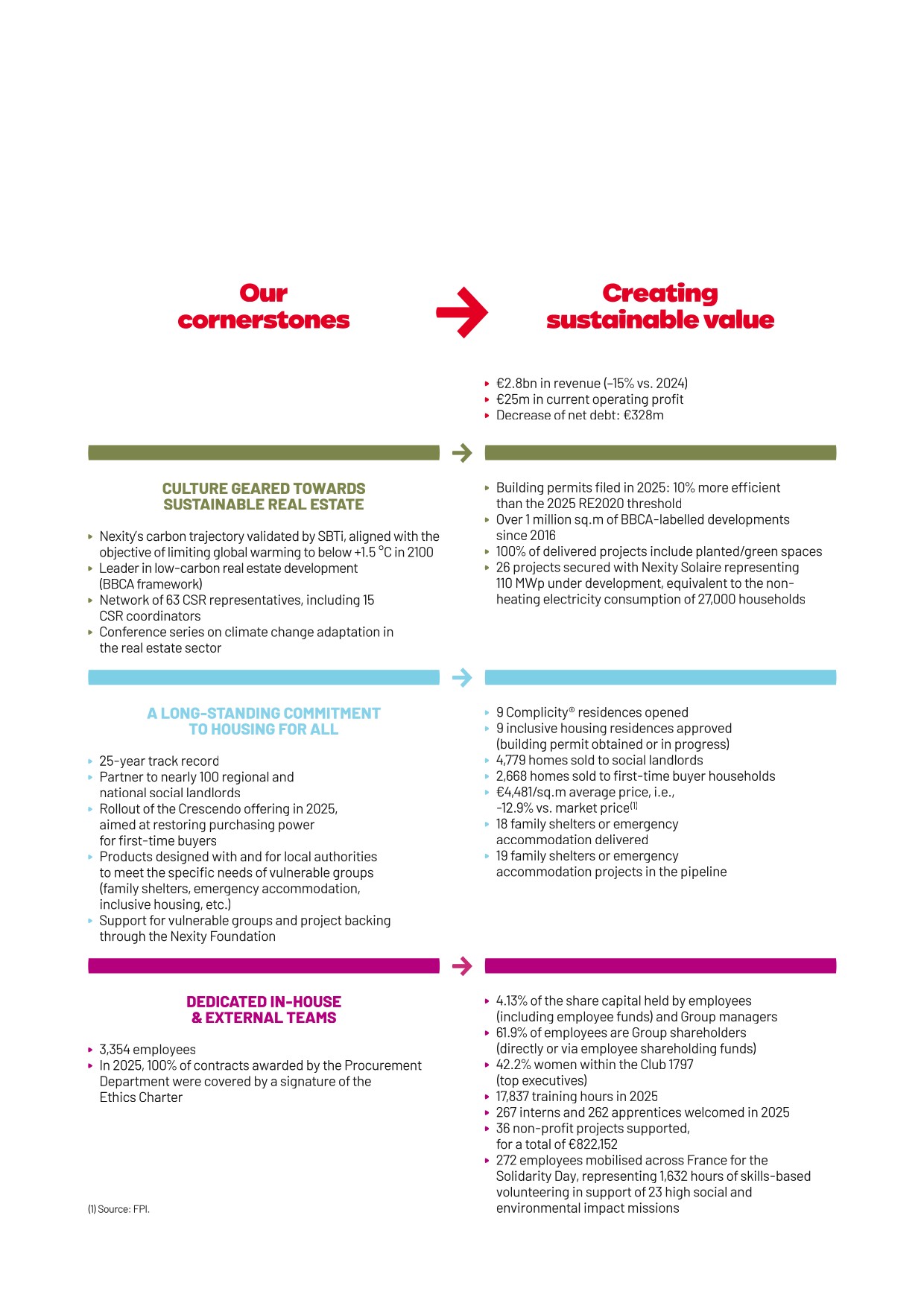 The right-hand page presents the foundations and the sustainable value created in 2025 by Nexity around three pillars: The first pillar is a “culture of sustainable real estate”: the foundations are the SBTi-validated carbon trajectory aligned with 1.5°C (building permits filed in 2025, 10% more efficient than the 2025 RE2020 threshold); low-carbon leadership (BBCA) (more than 1 million sq.m BBCA-labeled since 2016, 100% of delivered projects include vegetated areas and 26 projects underway with Nexity Solaire representing 110 MWp under development, equivalent to the non-heating consumption of 27,000 households); 63 CSR ambassadors including 15 coordinators and conferences on climate adaptation. The second pillar is the “historic commitment to housing for all”, stating that the Group has been acting for 25 years and partners with nearly 100 social landlords. It rolled out the Crescendo offer in 2025 to support first-time buyers; provides solutions for vulnerable groups, notably through the Nexity Foundation. In 2025: 9 Complicity® residences opened; 9 inclusive-housing residences authorized; 4,779 homes sold to social landlords; 2,668 to first-time buyers; average price €4,481/sq.m, i.e., -12.9% versus the market; 18 family pensions/emergency centers delivered and 19 in progress. The last pillar is an “engaged internal and external collective” with indicators: 3,354 employees; 100% of contracts committed by the Purchasing Department in 2025 were signed under the ethics charter. In terms of value created: 4.13% of capital held by employees and managers (including employee share funds); 61.9% employee shareholders; 42.2% women in Club 1797; 17,837 training hours; 267 interns and 262 apprentices; 36 community projects supported for €822,152; 272 employees mobilized during Solidarity Day for 1,632 hours across 23 missions. Finally, at Group level, the global indicators of sustainable value creation are shown: €2.8 billion revenue (-15% vs 2024), €25 million recurring operating income, and net debt down to €328 million.
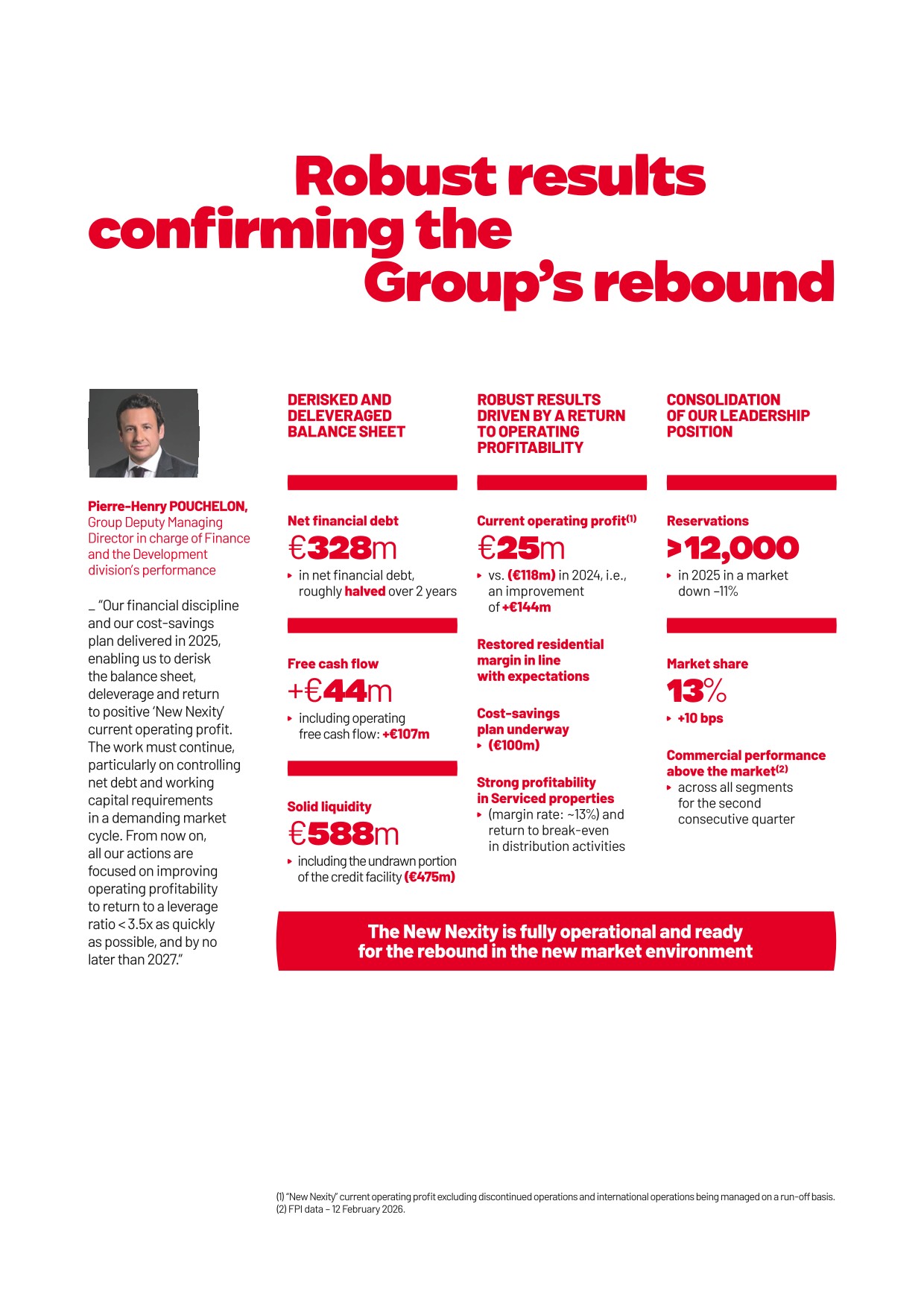 Results box presenting three key messages. (1) “De-risked and deleveraged balance sheet”: net financial debt of €328 million, roughly halved in two years; free cash flow +€44 million including +€107 million of free operating cash flow; liquidity of €588 million including €475 million of undrawn credit line. (2) “Robust result”: recurring operating income €25 million (versus -€118 million in 2024, i.e., +€144 million), with residential margin recomposition, the savings plan activated (€100 million) and strong profitability of operating activities (margin ~13%) with distribution back to break-even. (3) “Consolidation of our leadership position”: more than 12,000 reservations in 2025 in a market down 11%, 13% market share (+10 bps) and commercial performance above the market for the second consecutive quarter. A concluding box states: “The New Nexity is fully operational and ready for the rebound.” Pierre-Henry Pouchelon (Deputy CEO in charge of Finance and the “Residential Real Estate Performance” division) stresses that financial discipline and the savings plan enabled Nexity in 2025 to de-risk the balance sheet, reduce debt and return to positive “New Nexity” recurring operating income. He adds that the effort must continue in a demanding market cycle, particularly on controlling net debt and working capital requirements. He concludes that actions are now primarily aimed at improving operating profitability to regain a financial leverage ratio below 3.5x as quickly as possible, and by no later than 2027.
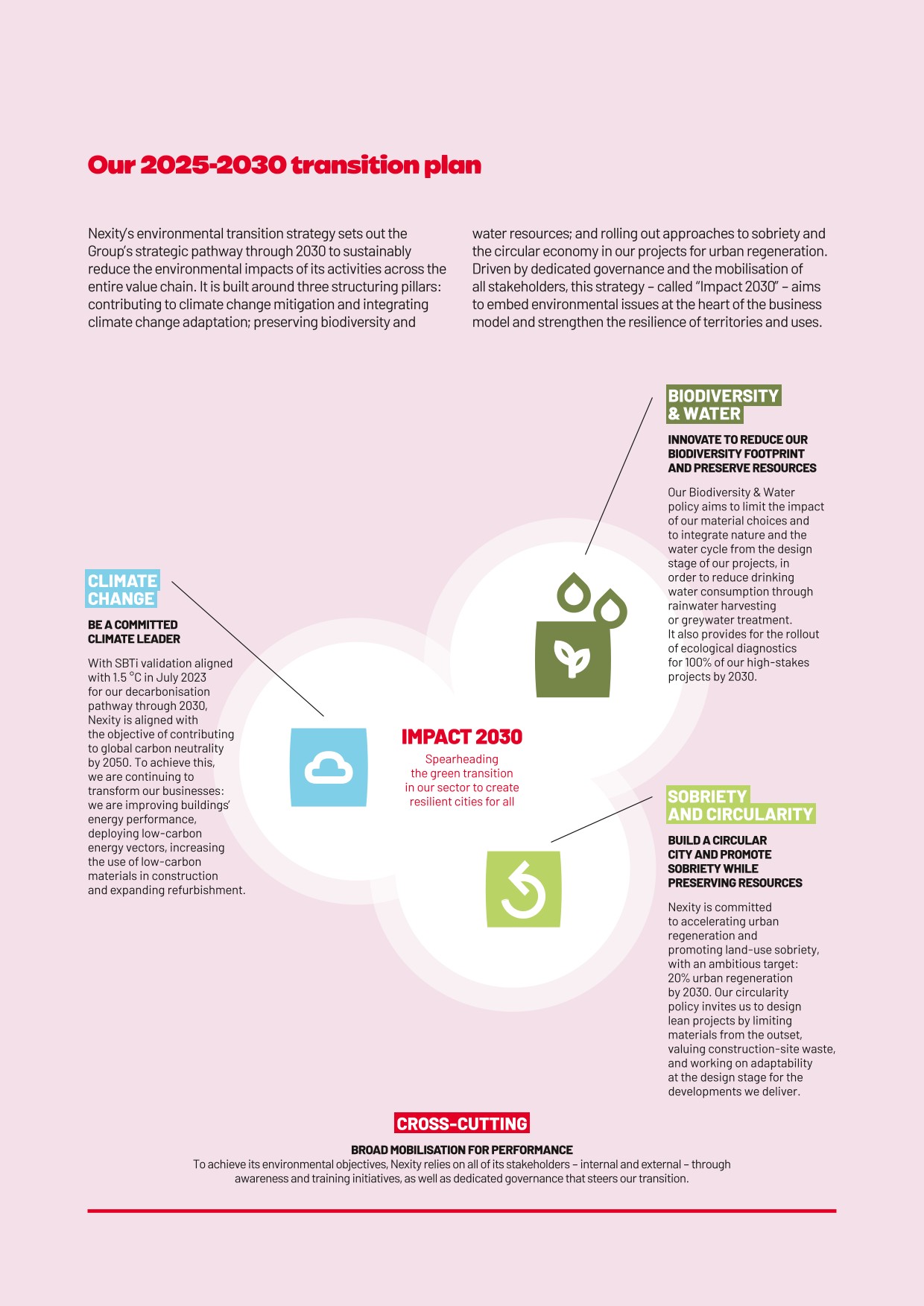 Page presenting Nexity’s environmental transition strategy to 2030, described as the Group’s trajectory to sustainably reduce environmental impacts across the entire value chain. The text states that the “Impact 2030” plan is built around three pillars: (1) contribution to climate change mitigation and integration of adaptation; (2) preservation of biodiversity and water resources; (3) sobriety and circular-economy approaches in urban regeneration projects. The approach is presented as being driven by dedicated governance and stakeholder mobilization, to embed environmental issues at the heart of the business model and strengthen the resilience of territories and uses. Diagram captions specify, for each pillar: “Climate change – Be an engaged climate leader” (SBTi-validated decarbonization trajectory aligned with 1.5°C; improved energy performance, decarbonized energy, low-carbon materials and increased share of rehabilitation); “Biodiversity & water – Innovate to reduce our biodiversity footprint and preserve the resource” (integrating nature and the water cycle from design, rainwater harvesting and greywater treatment, ecological diagnostics generalized for 100% of high-stakes projects by 2030); “Sobriety and circularity – Work on a circular city and sobriety” (target of 20% urban regeneration in 2030, limiting materials, valuing construction waste and making projects adaptable). A cross-cutting pillar “Broad mobilization for performance” mentions awareness-raising, training and steering through dedicated governance.
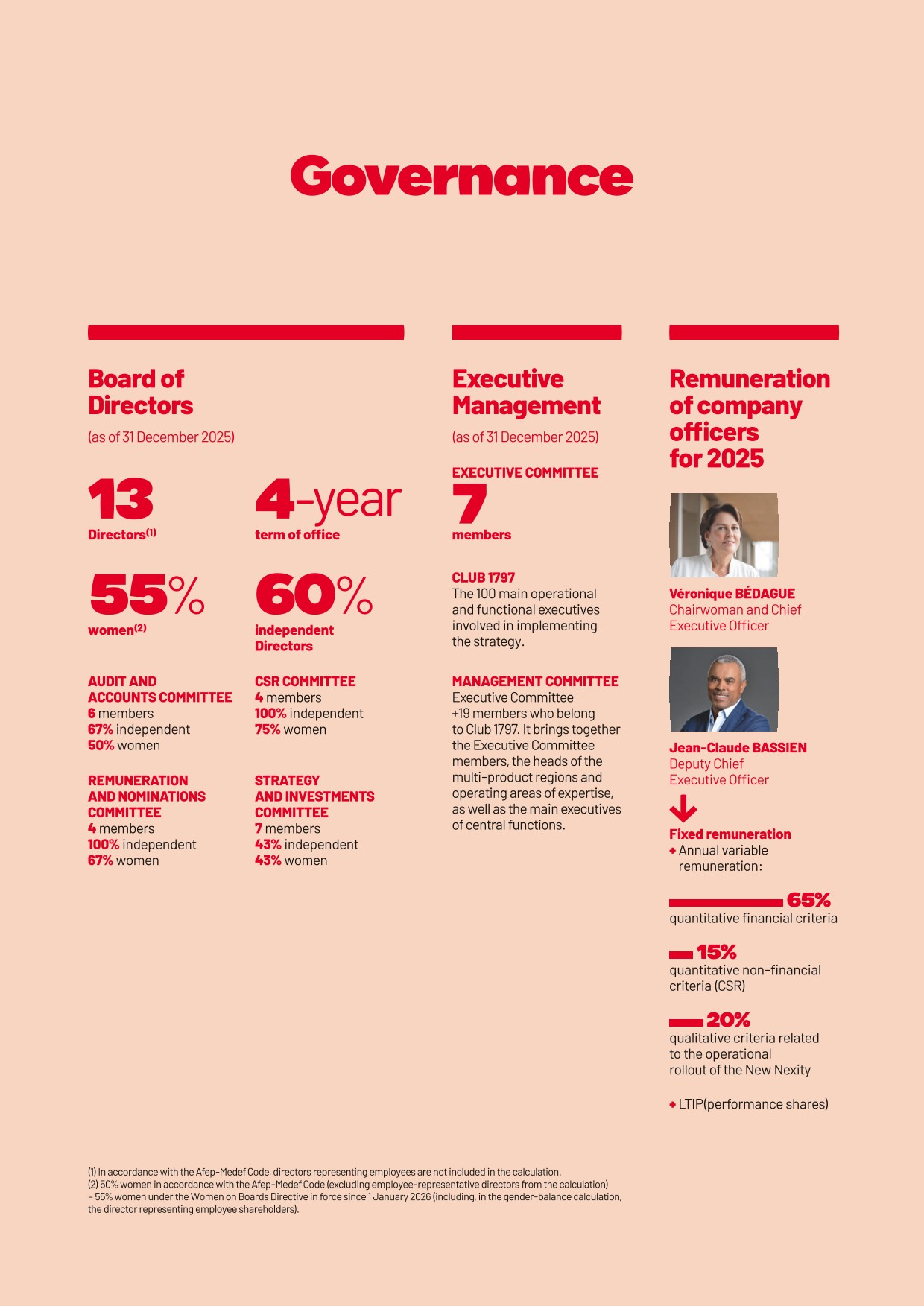 Double-page spread presenting the Group’s governance. On the left page, the key indicators of the Board of Directors as of 31 December 2025 are presented: 13 directors (including 2 employee directors and 1 employee shareholder director), 55% women, 60% independent directors and a 4-year term of office. The composition of the committees is detailed: Audit and Accounts Committee (6 members, 67% independent, 50% women), Remuneration and Appointments Committee (4 members, 100% independent, 67% women), CSR Committee (4 members, 100% independent, 75% women) and Strategy and Investments Committee (7 members, 43% independent, 43% women). A note states that under the Afep-Medef Code, employee directors are excluded from the calculation, and recalls the “Women on Boards” indicator (55% women) in force since 1 January 2026. The page then presents the executive management as of 31 December 2025: Executive Committee (7 members), Club 1797 (100 top executives) and Management Committee (ExCom + 19 members, i.e., 25 members from Club 1797). The components of remuneration for corporate officers for 2025 (Véronique Bédague and Jean-Claude Bassien) are also shown: fixed salary + annual variable (65% financial criteria, 15% CSR criteria, 20% qualitative criteria linked to the rollout of New Nexity) + long-term performance share plan.
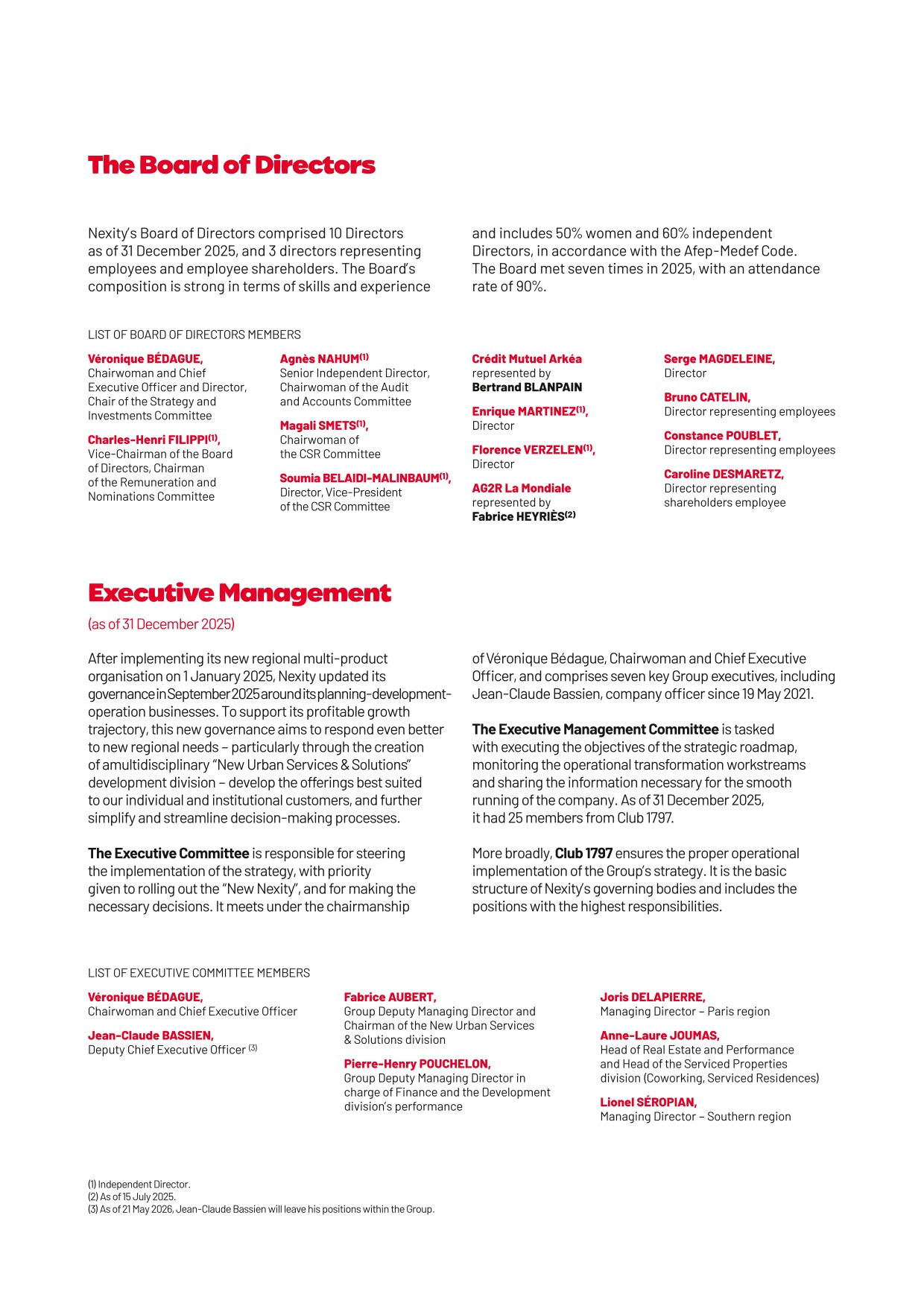 The right-hand page is split into two parts: The first part is devoted to the Board of Directors. It states that the Board met 7 times in 2025 with 90% attendance. The list of Board members is presented: Véronique BÉDAGUE, Chairwoman and CEO and Director, Chair of the Strategy and Investments Committee; Charles-Henri FILIPPI, Vice-Chairman of the Board, Chair of the Remuneration and Appointments Committee; Agnès NAHUM, Lead Independent Director, Chair of the Audit and Accounts Committee; Magali SMETS, Director, Chair of the CSR Committee; Soumia BELAIDI-MALINBAUM, Director, Vice-Chair of the CSR Committee; Crédit Mutuel Arkéa represented by Bertrand BLANPAIN; Enrique MARTINEZ, Director; Florence VERZELEN, Director; AG2R La Mondiale represented by Fabrice HEYRIÈS; Serge MAGDELEINE, Director; Bruno CATELIN, employee director; Constance POUBLET, employee director and Caroline DESMARETZ, employee shareholder director. The second part is devoted to the executive management as of 31 December 2025. It states that Nexity changed its governance in September 2025, following the implementation on 1 January 2025 of a multi-product regional organization, to align it with its land development–promotion–operation businesses. This new governance aims to better meet the needs of territories (notably through the creation of a multidisciplinary “new urban services and solutions” division), adapt the offering to individual and institutional customers, and simplify decision-making. The Executive Committee drives the strategy and the rollout of “New Nexity”, chaired by Véronique Bédague, with 7 executives including Jean-Claude Bassien. The Management Committee executes the roadmap, monitors the transformation and shares information; it has 25 members from Club 1797, which brings together the highest-responsibility positions and forms the base of leadership bodies. The Executive Committee members are: Véronique BÉDAGUE, Chairwoman and CEO; Jean-Claude BASSIEN, Deputy Chief Executive Officer; Fabrice AUBERT, Deputy managing director – President of the “new urban services and solutions” division; Pierre-Henry POUCHELON, Deputy managing director in charge of Finance and the “Residential Real Estate Performance” division; Joris DELAPIERRE, managing director – Paris Region; Anne-Laure JOUMAS, Head of Real Estate and Performance and Head of the Serviced Properties division (Coworking, Serviced Residences); Lionel SÉROPIAN, managing director – Southern Region. A footnote notes that Jean-Claude Bassien will leave his duties as of 21 May 2026.
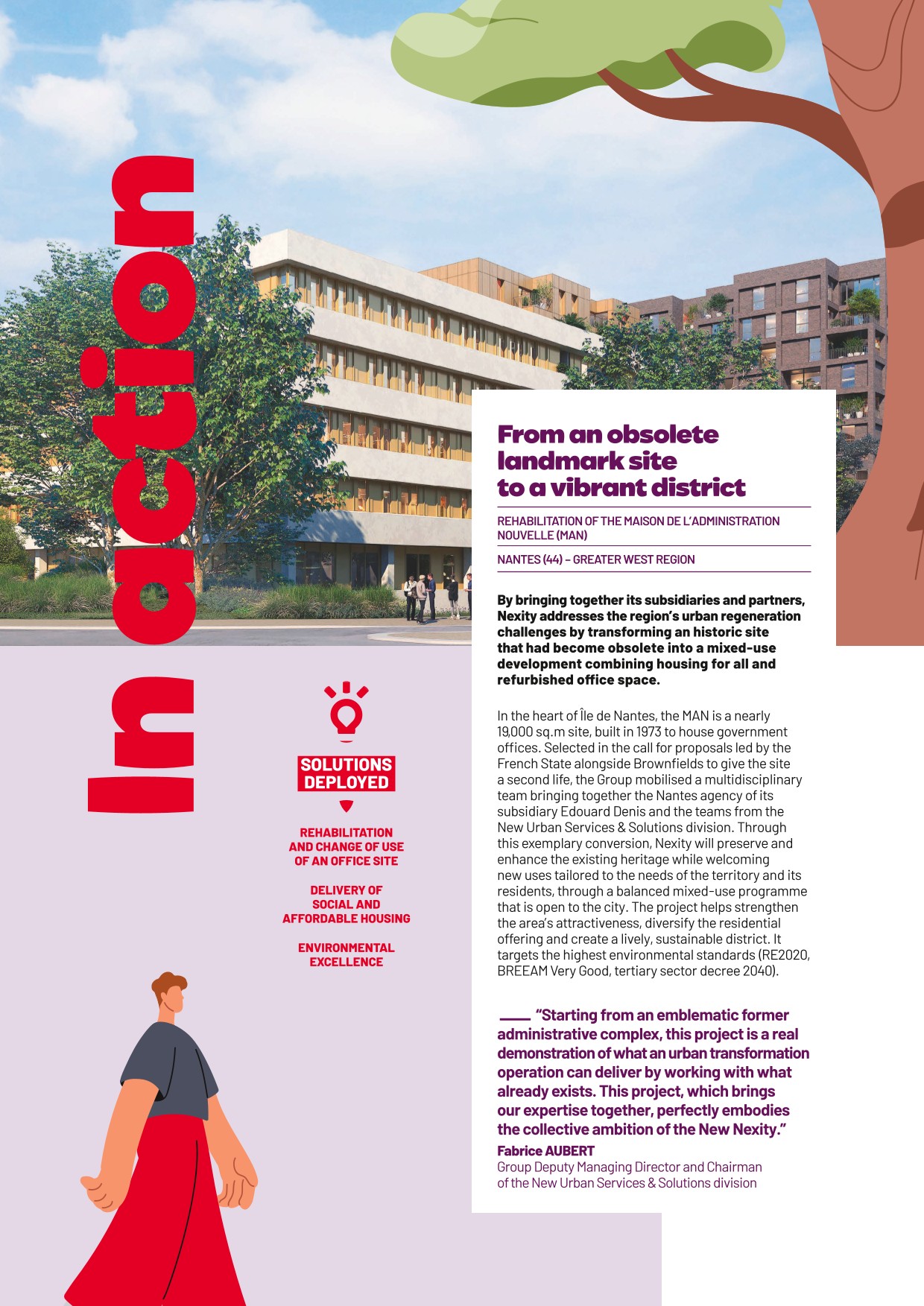 Page titled “In action” presenting the rehabilitation project of the Maison de l’Administration Nouvelle (MAN), located on Île de Nantes (Loire-Atlantique) in the Greater West region, which will transform an emblematic obsolete site into a lively neighborhood. The text explains that this office site of around 19,000 sq.m, built in 1973 to house government departments, is being converted following a consultation led by the French State alongside Brownfields. Nexity mobilized a multidisciplinary team (Edouard Denis subsidiary and the new urban services and solutions division) to preserve and enhance the existing heritage and develop a mixed-use program combining housing “for all” and rehabilitated offices, with programming open to the city. The section states that the project aims to strengthen the area’s attractiveness, diversify the residential offer and create a sustainable district, with high environmental targets (RE2020, BREEAM Very Good, tertiary decree 2040). A “Solutions mobilized” box lists: rehabilitation and change of use of an office site; production of social and affordable housing; environmental excellence. A quote from Fabrice Aubert presents the project as a demonstration of urban transformation “of what already exists” and an illustration of the collective ambition of the New Nexity.
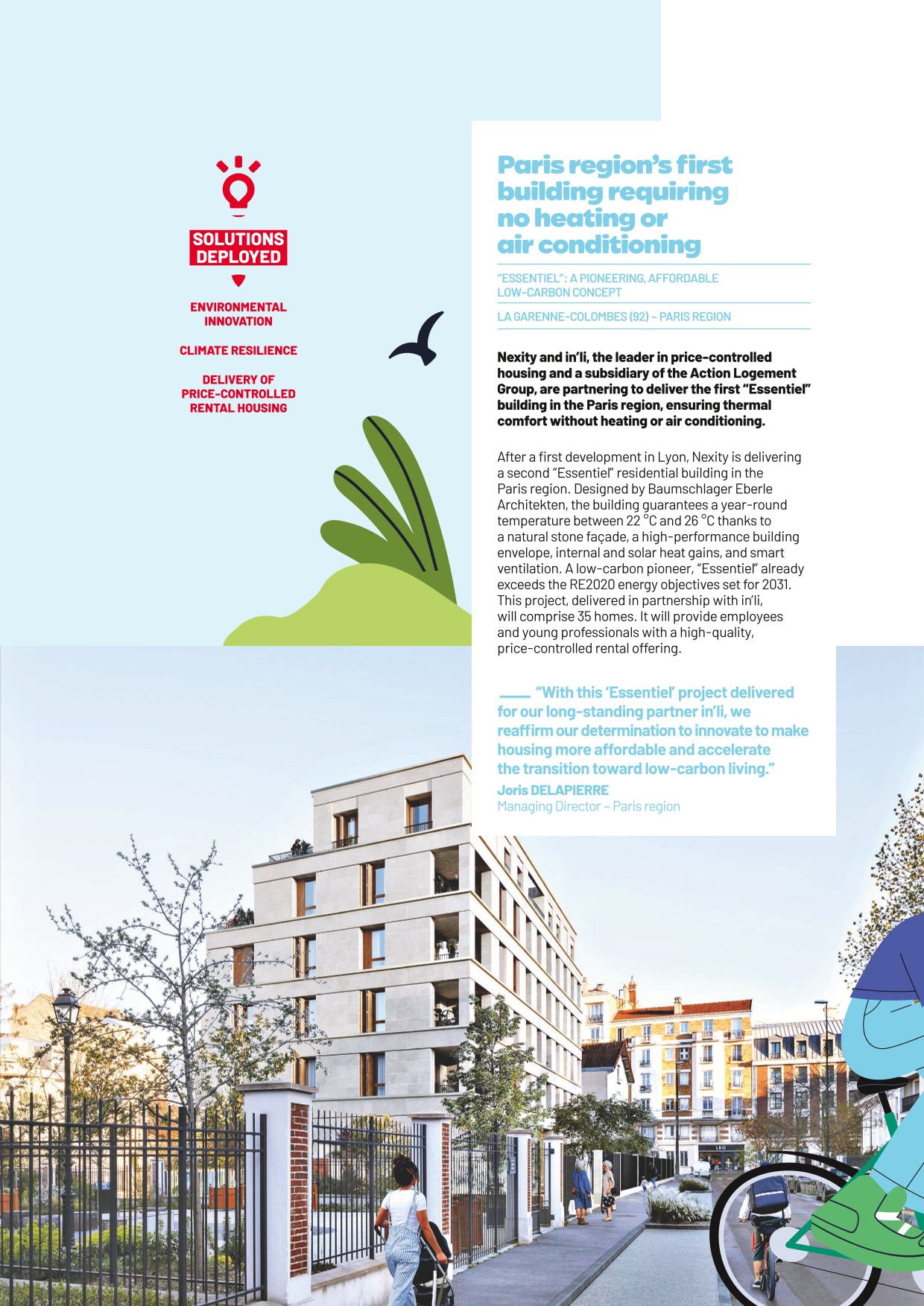 Page presenting a low-carbon residential project titled “The first building with no need for heating or air conditioning in Île-de-France”. The “Essentiel” project, located in La Garenne-Colombes (Hauts-de-Seine) in the Île-de-France region, is developed by Nexity in partnership with in’li (Action Logement group) to offer 35 rent-controlled homes, intended notably for employees and young working people. The text explains that the building, designed by Baumschlager Eberle Architekten, aims for year-round thermal comfort between 22°C and 26°C without heating or cooling systems, thanks to a highly efficient envelope, a natural-stone façade, solar and internal gains, and smart ventilation. It states that this concept already exceeds the RE2020 energy targets for 2031. A “Solutions mobilized” box highlights: environmental innovation, climate resilience and production of affordable housing. A quote from Joris Delapierre underlines the desire to innovate to make housing affordable and accelerate the transition to low-carbon housing with partner in’li.
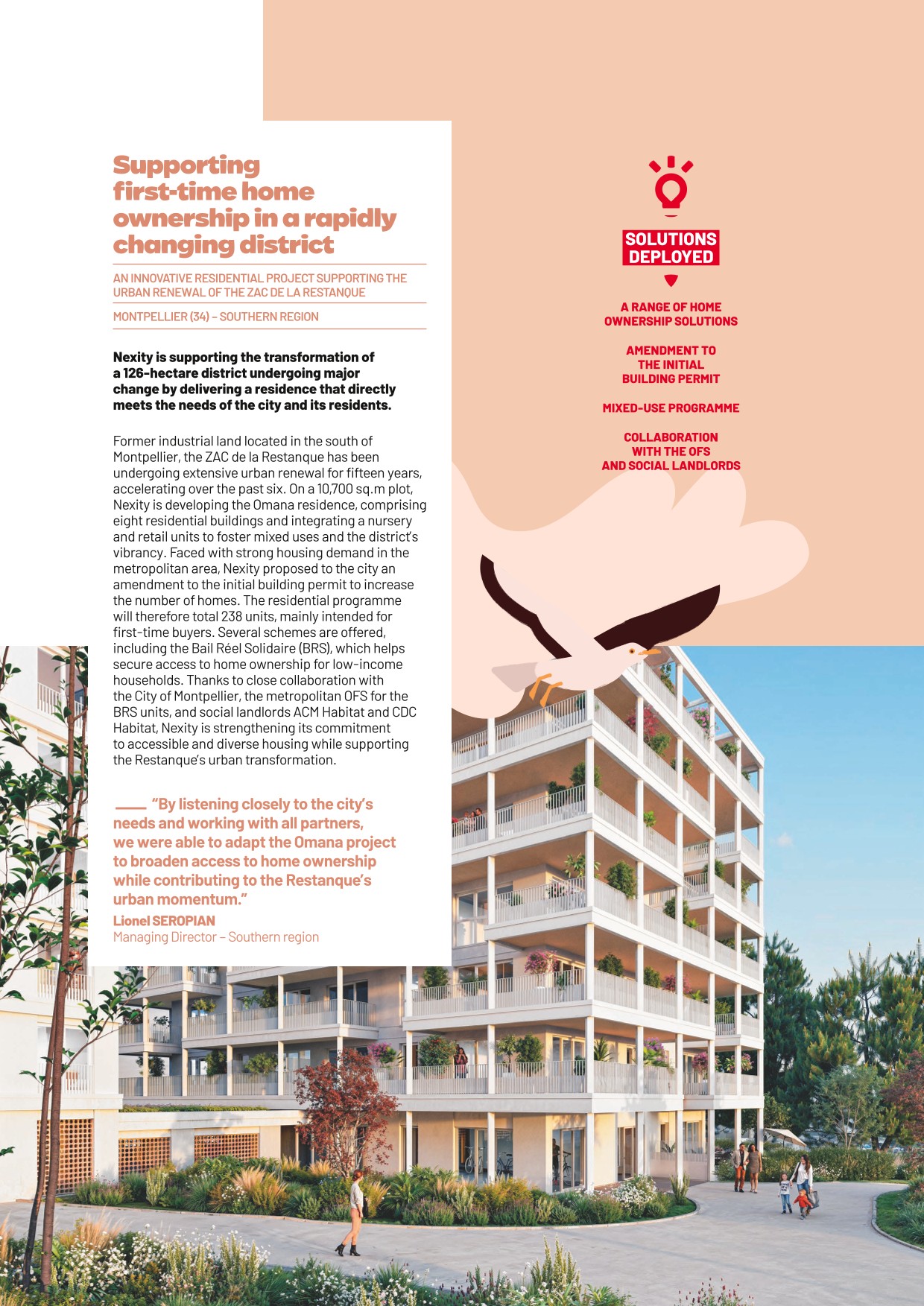 Page presenting a project aimed at promoting first-time home ownership in a transforming district. The project concerns the Omana residence, developed by Nexity in the Restanque ZAC, south of Montpellier (Hérault), on a 126-hectare urban renewal area. The text states that the development is located on a 10,700 sq.m plot and includes eight residential buildings, with a day-care center and shops to support mixed uses and neighborhood vitality. To meet strong housing demand, Nexity proposed a modification to the initial building permit to increase the program to 238 units, mainly intended for first-time buyers. Several home-ownership schemes are mentioned, including the “bail réel solidaire” (BRS) to secure access to ownership for low-income households. The project is carried out in collaboration with the City of Montpellier, the metropolitan OFS (for BRS units) and social landlords ACM Habitat and CDC Habitat. A “Solutions mobilized” box highlights: diversity of home-ownership solutions, permit adaptation, mixed uses, and partnership with the OFS and social landlords. A quote from Lionel Séropian highlights adapting the project by listening to the City’s needs and working with all partners.
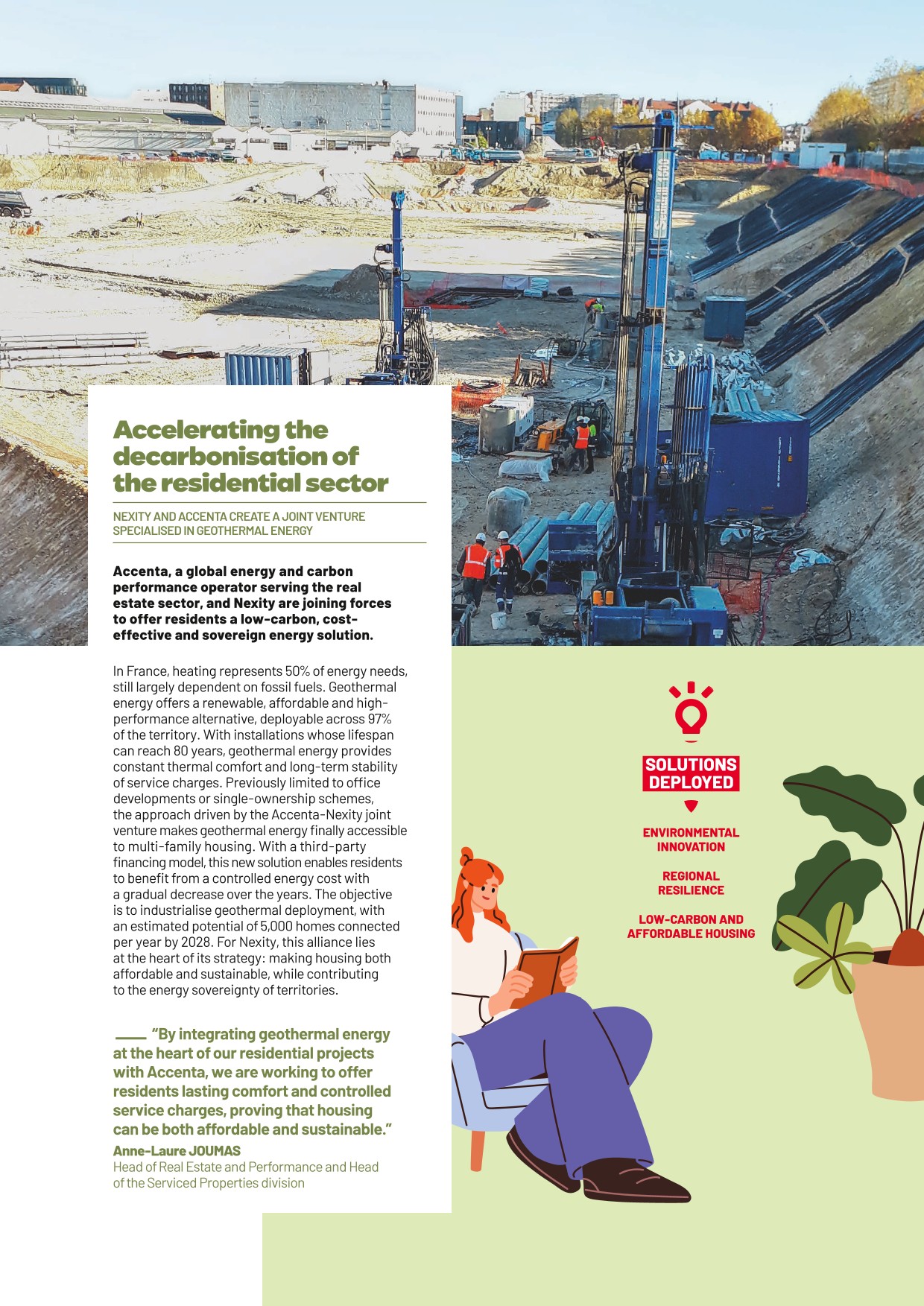 Page presenting an initiative aimed at accelerating the decarbonization of residential housing through geothermal energy. The title reads: “Accelerating the decarbonization of the residential sector” and the subheading: “Nexity and Accenta create a joint venture specialized in geothermal energy”. The introductory text explains that Accenta, an energy-carbon performance operator, and Nexity are joining forces to offer residents a low-carbon, economical and sovereign energy solution. The text notes that heating represents around 50% of energy needs in France and remains largely dependent on fossil fuels; it presents geothermal energy as a renewable alternative deployable across 97% of the territory, with installations that can last up to 80 years, providing thermal comfort and stable charges. The page states that, previously mainly reserved for tertiary buildings or single ownership, this solution is becoming accessible to collective housing via a third-party financing model, with controlled energy costs and a gradual decrease over time. The stated objective is to industrialize deployment, with an estimated potential of 5,000 homes connected per year by 2028. A “Solutions mobilized” box mentions: environmental innovation, territorial resilience, low-carbon and affordable housing. A quote from Anne-Laure Joumas emphasizes the ambition to deliver lasting comfort and controlled charges, and to show that a home can be both affordable and sustainable.
 -
1Information on the Group
-
1.1Nexity's history
Created in June 2000, the Nexity group(1) is the result of the combination of the historical real estate activities of Compagnie Générale des Eaux (now Vivendi), and in particular the business lines of SEERI and SARI (developer of the La Défense district in Paris), and the historical real estate activities of the Arnault group, a housing developer for the middle classes.
The exit of the Vivendi group was carried out in the form of a leveraged buyout(2) by the executives (Stéphane Richard, Jean-Louis Charon and Alain Dinin), supported by financial investors including LBO France and Caisse des Dépôts.
The Nexity group was then listed on the stock exchange in October 2004 at the initiative of its executives, who believed that the short time frame of leveraged buyouts was no longer compatible with the development and urban planning business lines.
In June 2007, Nexity formed an alliance with the Caisse d’Épargne group (which later became the BPCE group), which has provided it with services and property management activities (Lamy) and non-controlling interests in non-strategic activities (21% stake in Crédit Foncier de France, 33% in the real estate company Eurosic and 40% in Ciloger, an SCPI management company). The aim of this alliance was to develop a service platform dedicated to the various clients: individuals, businesses and local authorities.
Following the 2008 financial crisis, Nexity sold the non-controlling interests mentioned above, and strengthened its geographical presence and market share across all of its historical business lines. The Group also further developed its services activities through external growth, notably with the acquisition in 2014 of Oralia (property management), in 2016 of Perl (social rental usufruct) and of Edouard Denis group (residential development), in 2022 of Angelotti (residential real estate developer in Occitanie), and the acquisition of majority stakes (coworking company Morning in 2018).
To cope with the unprecedented and enduring real estate crisis which began in 2022 and in light of new market conditions, Nexity made the strategic choice to refocus on its domestic activities by selling its Polish and Portuguese subsidiaries, respectively in July and September 2023 (the remaining countries, Belgium, Italy and Germany, being in managed on a run-off basis).
Throughout 2024, Nexity implemented a transformation plan allowing the Group to refocus on its planning, development and serviced properties business lines, notably carrying out the following transactions:
- •Sale of its property management activities to investment company Bridgepoint on 2 April 2024. The Group continues to offer its clients all of its products and services through the strategic partnership supported by this sale;
- •Sale of its subsidiary Nexity Property Management to Crédit Agricole Immobilier on 31 October 2024; and
- •Sale of 50% of the shares in real estate advertising platform Bien'ici to the Arche group. As a major player in the industry, Nexity retains a 6% stake in the platform.
- •Sale of the residual stake in Ægide-Domitys on 14 February 2025 (18%);
- •Sale of Accessite, a global operator specialising in the valuation of retail assets on behalf of third parties, on 1 October 2025; and
- •Increase in the share capital of the Angelotti group, from 55% to 80% as of 24 October 2025. In accordance with its commitments, Nexity will acquire the remaining 20% in 2026.
Véronique Bédague has been Chairwoman and Chief Executive Officer of the Company since 1 January 2023.
-
1.2General presentation of the Group
1.2.1Nexity: leading player in the French real estate market
Nexity operates in planning, development and serviced properties for all customers, whether they are individuals, companies, institutions or local authorities, and is among the market leaders in each of these activities.
With a nationwide presence, experience and expertise in urban planning and regeneration, recognised low-carbon know-how, privileged relationships with institutional investors and social housing operators, and a leading position in serviced real estate (coworking and student residences), Nexity defines itself as an urban operator serving urban regeneration and the new needs of regions and its clients.
A value creation model
Nexity’s unique model, combining its expertise as a planner-developer and developer-operator, creates strong value for its clients. Whatever their real estate needs and issues, Nexity has an appropriate response.
Since the sale of the Services to Individuals business in 2024, Nexity has continued to offer its products and services based on a 6-year strategic partnership entered into in 2024, renewable for 4 years, to perpetuate and amplify existing synergies with Nexity’s development activities.
Combined with a strong commitment to continually improving the client experience and client satisfaction, this model enables the Group to be present at every stage of its clients' real estate projects.
A low-capital-intensive flow model
Nexity’s model is primarily aligned with a flow model (services company, low capital-intensive) as opposed to a stock model (real estate company or asset holding company, highly capital-intensive).
The Group sells homes via reservation contracts and subdivisions through purchase agreements, followed by final sales contracts (signed before a notarial deed).
New homes are marketed under the VEFA off-plan sales regime, an original model resulting from the law of 3 January 1967 and gradually improved, which is characterised by a limited level of risk (compared to other models) for developers, clients and banks.
The VEFA off-plan sales model implies that a developer is not obliged to acquire the land until the administrative authorisations are obtained and the pre-sales rate has reached a certain threshold (60% for Nexity).
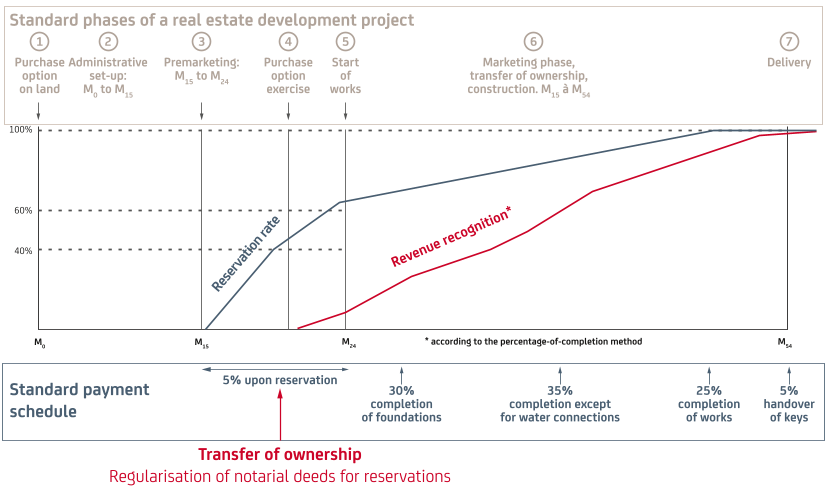 This diagram illustrates the main phases of a real estate development project under the "asset light" VEFA model, characterized by limited land ownership. It is presented as a timeline ranging from month 0 to month 54. The project begins with a purchase option on the land, followed by an administrative setup phase (months 0 to 15), and then pre-marketing starting from month 15. The transfer of ownership occurs during the notarial deeds. When the pre-marketing rate reaches 40% (as required by banks), the option is exercised. When the pre-marketing rate reaches at least 60%, construction work begins. Revenue recognition is done progressively, starting from the exercise of the option and as reservations are made, up until delivery, according to the following schedule: 5% at reservation, 30% at foundations, 35% at waterproofing, 25% at completion, 5% at key handover. A real estate development project lasts approximately 54 months in total.
Since 1 January 2024, the Group has been implementing financial discipline that includes optimising the length of time between the acquisition of land and the first calls for funds (through the simultaneous purchase of land, signing of deeds and calls for funds), thus offsetting the impact of the cost of the land.
For the urban regeneration model, which is more capital-intensive, the land, asset or wasteland to be converted must be managed up to the pre-sales stage and the obtaining of administrative authorisations. To this end, it opts for low-risk schemes, notably through financial partnerships.
A people-oriented model
Because the model involves little land and financial capital or intellectual property (little fundamental research, a lot of innovation, but generally not patentable), Nexity relies primarily on human capital, which the Group preserves and develops. Nexity is committed to its employees.
- •Nexity's share capital offers a substantial representation to the shareholding of employees and managers: 4.1% of the share capital as at 31 December 2025 is held by Group employees and managers; Nexity is thus included in the Euronext FAS-IAS stock market index(1).
- •Nexity was also recognised as one of the top 22 companies in the SBF 120 for sharing value with employees, according to the inaugural Challenges x Erès ranking.
- •Nexity regularly awards free shares, either specifically to members of the management team (linked to demanding performance criteria), but also through Group plans for all employees. This has increased employee shareholding and helped improve the alignment of interests.
- In 2025, 85 free shares were granted to each eligible employee. This was the 7th democratic action plan since the IPO in 2004; and
- •Nexity, as an open, diverse and inclusive company, is highly committed to young people through the Nexity Foundation, and occasionally allows its employees to get involved in causes outside the Company.
Quality of customer relations at the heart of the Group’s focus
Nexity considers its customers to be its most valuable assets. Nexity’s objective is to become the preferred real estate player in France by creating a more intense and lasting relationship with each of its clients, whether in its agencies or on its websites.
- •The best locations;
- •At affordable prices;
- •High-quality design;
- •Low-carbon construction; and
- •A focus on the quality of delivery.
With this objective in mind, Nexity is accelerating the development of its "phygital" and multi-channel model, in particular with the complete overhaul of its online client portal.
Nexity has once again been named in the Top 5 of the 2026 customer relations rankings produced by the Human Consulting Group (HCG) in partnership with Les Echos. The Group ranks 5th with a score of 15.97/20, confirming the priority given to customer satisfaction and support throughout their entire process.
This distinction highlights the importance of a hybrid customer relationship, combining artificial intelligence for better responsiveness, personalisation and fluidity, and emotional intelligence for listening and quality exchanges. Nexity group's presence in the Top 5 of this ranking is part of a structured approach to improving the customer experience, with one main objective: to be present, clear and useful at every stage.
- •The availability of local teams to support clients' projects;
- •The deployment of select artificial intelligence-related tools and uses to improve responses without ever replacing human relations; and
- •The cross-functional management of customer satisfaction and the after-sales service to standardise the level of requirements throughout the country.
-
1.3Market environment
This section presents the major market trends facing Nexity. Understanding these trends enables the Group to position its business lines so as to take advantage of their medium- and long-term growth potential. The market environments specific to each of the Group’s business lines are presented in Sections 1.6.1.1, 1.6.2.1 and 1.6.3.1 “Market environment” of this chapter.
Nexity operates in constantly changing markets, influenced by demographic, economic, social, societal and environmental trends. Nexity’s strategy is based on the fact that real estate needs are considerable in most regions: regions where urban regeneration and land recycling will be favoured in the context of healthy sobriety, and needs that relate and will relate to more diversified products, tailored to uses, more affordable, more resilient and specific to the regions.
Whereas from 2020, the impacts of these trends were reinforced by the consequences of the health crisis, the year 2023 marked a clear break and called into question previous development models. The sharp rise in central bank interest rates to combat inflation and the slowdown in construction led to a reversal of the market in terms of the marketing of new homes and commercial real estate. At the same time, pro-cyclical regulatory and tax changes accentuated the reversal (such as the end of the Pinel scheme, for example).
2024 and 2025 were two years of transition and stabilisation, with still-weakened real estate markets grappling with multiple uncertainties (political instability in France and an anxiety-inducing international geopolitical climate) and the impact of the end of the Pinel scheme on individual investors. Activity was relatively low, with limited mobility of economic players (households and companies). However, in the run-up to the 2026 municipal elections, housing, a key priority for the French, has appeared to be an increasingly unavoidable challenge. 2026 should therefore be a year of moderate recovery in the marketing of new homes, with the resale market having already gradually recovered in 2025. Stabilised interest rates, the continuation of the interest-free loan scheme, the status of the "private landlord" and the significant need for social housing should support this gradual recovery, which will however remain conditional on the confidence and solvency of households.
1.3.1Increasingly significant housing needs, both quantitatively (volume) and qualitatively (uses)
The need for housing (new or renovated) is very high in France and it is not being resolved. Several reasons are behind this phenomenon:
- •Demographic growth: the French population is expected to increase by 1.9 million inhabitants in 2044 compared to 2021, according to INSEE;
- •Downward trend in household size: from 2.6 people in 1990 to 2.2 people in 2020, the size of households is expected to fall to 2.07 by 2030 and 1.99 by 2050(1);
- •Challenges of poor housing conditions: 4.2 million French people live in poor conditions(2);
- •Insufficient social housing: 2.87 million people waiting for social housing in mid-2025 (+52% in 10 years, +6% year-on-year)(3);
- •Shortage of rental housing, particularly for young people moving out of home and students: tension on the rental market is increasingly acute, partly due to the impact of the French Climate and Resilience Act but also to the lower level of residential mobility in general. This tension has a particular impact on small and medium-sized homes, penalising students, young professionals and single-parent families. According to Bien'ici(4), after an explosion in 2022, the demand for rental properties increased again in 2025, (+2% compared to 2024) and pressure increased by 13.5% due to the low level of supply (halved since 2022); and
- •Low levels of construction: in 2025, 381,000 housing units were authorised, an increase of 16% compared to 2024, but this figure remains below the average of the past twenty years, which stands at around 453,000 units. Similarly, the number of housing starts increased by 7% between 2024 and 2025 to reach 280,000 units, compared to an average of 380,000 units recorded since 2006(5).
These various factors result in significant potential demand for new housing (new or renovated) by 2030, estimated at approximately 450,000 housing units minimum per year according to the CNH (French National Housing Board) and 518,000 according to the USH (French Social Housing Federation), far from recent construction levels. According to the central scenario of the SDES(6) published in 2025, the total estimate of housing needs for the period 2020-2050 amounts to 6.8 million units, a new projection that incorporates a data point that has long been underestimated: the improvement of poor housing(7).
However, this quantitative approach to needs on a national level conceals genuine disparities in local regional situations. Metropolitan areas and supply-constrained areas, particularly peri-urban areas, continue to attract people and jobs as part of the urban sprawl around large cities, while less proactive regions are losing their attractiveness, with the exception of certain, particularly coastal regions(8). The Atlantic Arc, the south of France and major cities appear to be the most attractive regions, polarising demand and raising serious questions regarding planning and territorial balance. At the same time, major national projects (reindustrialisation, urban regeneration, etc.) pose greater construction challenges in certain regions. Needs must therefore be considered in the light of local specificities.
In addition to needs, demand is changing and housing must adapt to new uses and meet the aspirations of residents:
- •Smaller housing due to the reduction in the size of households;
- •Flexible housing to evolve over time, support the changes in family sizes and/or the ageing of the French population;
- •Housing with services for specific populations, such as students or seniors: 29% of the French population will be over 65 in 2070, compared to 21.5% today;
- •Housing suitable for working from home: between 2019 and 2023, the proportion of employees working from home at least occasionally increased from 9% to 26%(9);
- •Sustainable, energy-efficient housing that can cope with the climate-related hazards;
- •Housing closer to nature: nature in urban areas is increasingly valued and indeed necessary for its impact on biodiversity, well-being and mental health. Projects systematically include green spaces to make cities more desirable and liveable; and
- •Affordable and accessible housing for all residents aligned with everyone’s financial resources.
Peripheral and secondary areas of major cities are those suffering the most from these structural changes. These regions are facing major challenges in terms of transforming their empty stock associated with significant urban changes (mixed use, changes in destination, facilities to be redesigned, etc.) aimed at preserving their attractiveness.
The future of major cities relies increasingly on the quality and contextualisation of urban projects, their attractiveness and their ability to adapt to needs, particularly in terms of housing and mixed uses. Partnerships between local authorities and private real estate operators like Nexity must provide innovative solutions thanks to their size, resources, expertise and wide range of products adapted to the regions and different categories of users.
-
1.4Strategy and objectives
2025: operational roll-out of New Nexity
Since 2022, the real estate sector has been facing an unprecedented crisis, both in terms of its intensity, its duration and its global nature, affecting supply and demand and leading to a historic slowdown in private residential and commercial investment. While this crisis confirms the market trends presented above, it has led the Group to adjust its roadmap with the roll-out in 2024 of an in-depth transformation plan notably designed to refocus on its planner-developer-operator positioning and the roll-out of New Nexity, a new simplified, multi-product regional organisation, fully operational at the end of 2025.
In 2024, the Group has thus accelerated the implementation of its proactive decisions in terms of deleveraging as part of its refocusing, reducing operating expenses to resize its cost base, and adapting its offering to new market conditions. It has also rolled out its new organisation, focused on the regions, to better meet the demand for urban operators.
- •Refocusing on planner-developer-operator core business lines
- The Group made three key disposals in 2024, the net proceeds from which (€435 million) were fully allocated to reducing the Group's debt:
- •Property management for individuals business sold to Bridgepoint,
- •Nexity Property Management sold to Crédit Agricole Immobilier, and
- •50% of the shares in the real estate advertising platform Bien'ici sold to the Arche group.
- In 2025, the Group finalised the disposal plan for its property management activities with the sale of its subsidiary Accessite.
- •Resizing: the Group has implemented an Employment Protection Plan which affected 500 jobs, and also significantly reduced, from 2024, its overheads and property expenses. In its 2025 annual results, the Group confirmed its target savings of €100 million by 2026, on a full-year basis, of which more than 90% effective from 2025;
- •Recalibration: the Group has adapted its supply for sale to new market conditions via proactive and deliberate measures: realignment of exit prices with the purchasing power of customers, abandonment of around a hundred projects designed during the previous cycle; and
- •Redeployment: the transformation plan also resulted in an overhaul of the organisational structure, so as to make it more operational, agile and perfectly adapted to the needs of an urban operator. New Nexity was launched on 9 January 2025, and has been fully operational since the end of 2025.
-
1.52025 Group performance
Since 1 January 2025, the Group has aligned its financial communication with the IFRS standards, in the interests of simplification.
The financial information published and presented below is therefore taken from the consolidated financial statements at 31 December 2025, prepared in accordance with IFRS as adopted by the European Union, appearing in Section 5.1 "Consolidated financial statements at 31 December 2025" of this Universal registration document. As a reminder, Nexity’s financial communications were until 31 December 2024 based on operational reporting, with joint ventures proportionately consolidated.
Nexity ready to bounce back: operational momentum engaged and financial discipline reflected in the results for 2025
- •Derisked and deleveraged balance sheet:
- •Net financial debt before the increase in the shareholding in Angelotti at €278 million, i.e. a €52 million reduction in debt (net financial debt of €330 million in 2024); Group net financial debt at the end of 2025 at €328 million, i.e. Group debt halved over two years;
- •Positive free cash flow for the year, including €107 million of operating free cash flow; and
- •Opportunistic decisions with accounting impacts on net profit reflected in the generation of free cash flow for the year.
- •Current operating profit(1) positive at €25 million vs. -€118 million in 2024: a return to operating profitability as expected, due to restored margins for the Planning and Development business, incorporating the effects of the cost-savings plan, and the improvement in the profitability of services (on serviced properties with a margin of approximately 13% and a return to breakeven in Distribution) → Leverage ratio at 4.9x, ahead of the anticipated trajectory(2); and
- •Solid liquidity of €588 million
- •After €321 million in bond redemptions in 2025, mainly using proceeds from disposals in 2024;
- •Undrawn portion of the credit facility: €475 million; and
- •Financing secured until 2028.
- •Derisked and deleveraged balance sheet:
-
1.6The Group's business lines
1.6.1Planning and Development – Residential Real Estate
1.6.1.1Market environment and competitive landscape
Market environment
Demographic changes are generating a structural need for new housing in France due to population growth, the increase in the number of households (children moving out) and migration phenomena, in addition to other macro-trends described in Section 1.3 “Market environment” of this chapter. Faced with this demand, the construction effort remains insufficient, making access to housing more complex for a growing number of households.
The new construction sector is going through an unprecedented crisis in France and the volumes of residential builds authorised and started fell in 2024 to its lowest levels for more than 20 years. In 2025, 381,000 housing units were authorised, an increase of 16% compared to 2024, but this figure remains below the average for the last twenty years, which stands at around 453,000 units. Similarly, the number of housing starts increased by 7% between 2024 and 2025 to reach 280,000 units, compared to an average of 380,000 units recorded since 2006(1). According to the Observatoire Crédit Logement / CSA, interest rates continued to fall in the first months of 2025, remained stable until the summer, then increased slightly to an average of 3.17% in December 2025. This relative stability in rates and the renewed confidence of buyers has allowed the resale market to show signs of recovery in 2025 (+13% to 951,000 units), after a three-year decline and a low point of 845,000 transactions in 2024.
On the other hand, the new construction market remains under strong pressure: production remains stalled, negatively impacted by a dearth of building permits, high construction costs and insufficient profitability for developers. This situation, aggravated by political uncertainty, means the sector remains depressed despite the regulatory adjustments announced.
The new housing market(2) is estimated at 92,400 sales in 2025 (-11% compared to 2024), compared to an average of 138,000 over the past 10 years. The non-renewal of the Pinel scheme led to a 50% decline in sales to individual investors over one year. These now represent only 19% of retail sales of ordinary homes (average of 46% since 2016). Sales to first-time buyers increased by 4% between 2024 and 2025, notably supported by the extension in April 2025 of the interest-free loan scheme to the whole of France.
Competition
On the new-home development market, there are numerous developers active at national and regional level. Nexity’s major national competitors on the new housing market are Altarea Cogedim, Icade, Bassac, Bouygues Immobilier, Vinci Immobilier and Kaufman & Broad.
The following table shows the net number of housing reservations and market share of France’s leading residential property developers.
Housing
2022
2023
2024
2025
Nexity
18,015
14,602
13,387
12,008
Altarea Cogedim
10,017
8,004
7,601
7,960
Bassac (formerly LNC)
5,900
4,955
6,665
6,476
Procivis
4,125
4,406
5,340
ND
Kaufman & Broad
6,214
5,332
5,332
5,703
Icade Promotion
6,014
5,256
5,300
5,419
Vinci Immobilier
6,825
4,427
5,089
4,177
Pichet group
5,285
4,500
3,967
ND
Bouygues Immobilier
9,276
3,127
3,616
ND
Source: 37th edition of the Innovapresse "Classement des Promoteurs" (Developer Rankings) for 2022 to 2024, company websites for 2025; ND = not disclosed
1.6.1.2Description of activities
The organisation of planning and residential real estate is based on a multi-brand strategy with a presence throughout France and national expertise in complex projects.
The Group’s operating subsidiaries are responsible for the entire real estate project and are staffed with specialists. Specific service companies common to the entire Group may also assist the operating subsidiaries by setting up specialised operations or providing marketing or technical support.
Planning and Residential Real Estate development clients and products
Nexity is a major player in the planning and development of new housing and subdivisions (development of plots of land to be built), and operates throughout France.
- •First-time buyers (of homes or plots of land);
- •Other buyers, who already own their main residence, purchasing a new residential home (or a plot of land);
- •Individual investors purchasing a buy-to-let home (whether furnished, unfurnished or under a division of property ownership known as “démembrement”); and
- •Professional landlords purchasing an entire building to generate rental income (social, intermediate or freely available housing).
Access to housing for all is central to Nexity’s concerns whose offer focuses on affordable housing. Nexity has the ability to cover the entire range of housing on the market and is working on sustainable offers in order to offer high-performance and affordable products to all, designed for each stage of life and low-carbon.
As a real estate operator, Nexity is conscious of its need to help facilitate access to housing for all and today offers the following product lines:
- •Freely available housing: development of new homes; housing benefiting from optimised construction processes to address the issues of first-time buyers through its Access design product; wood-frame housing to meet environmental requirements. Some programmes may be co-developed with local or national developers;
- •Standard social housing: imposed by the Law on Solidarity and Urban Renewal (SRU Law - Article 55 of the Law of 13 December 2000), Nexity’s annual social housing production exceeds the 20% threshold. For Nexity, this represented 40% of sales in 2025;
- •Adapted housing for people in vulnerable situations: family shelters, emergency accommodation and inclusive housing. Since 2005, Nexity has made the strategic choice to support social housing players by meeting their needs in terms of urban development, social cohesion and sustainable development. This commitment is reflected in the creation of family shelters and emergency accommodation schemes, as well as the development of inclusive housing for people with disabilities and for seniors experiencing a loss of autonomy, as well as intergenerational residences, with regular events organised by an association. These projects are mainly set up with social housing operator partners, but can also be acquired by private investors;
- •Housing in Social Rental Usufruct (ULS): in supply-constrained areas, in order to promote the production of affordable housing, Nexity is developing Social Rental Usufruct projects. This product is based on the separation of bare ownership and usufruct over a period of 15 to 20 years. The individual or institutional investor acquires the bare ownership of an asset at a discounted price, while its usufruct is sold to an institutional landlord;
- •"Bail Réel Solidaire" (BRS) Housing: in order to promote social home ownership to low-income households, Nexity works in cooperation with social housing operators and solidarity-based land organisations (OFS) to offer housing at affordable prices. Created by the Macron Law of 6 August 2015, the "Bail Réel Solidaire" allows for the separation of land and buildings and thus reduces the price of housing;
- •Social lease-ownership loans housing (PSLA): a home ownership scheme that enables means-tested households to become owners of their main residence, at a controlled price, with the status of first-time buyer tenant;
- •Intermediate housing rental: since 1 January 2014, two tax incentives for intermediate housing rental were introduced by the Government (Order No. 2014-159 of 20 February 2014), exclusively for buyers who are legal entities, with the VAT rate reduced to 10% and exemption from property tax on built properties for the term of ownership of the buildings, up to a limit of 20 years. Since the end of 2024, the purchase of intermediate rental housing has become accessible to individuals provided it is carried out via an SCI (Société Civile Immobilière).;
- •Residences:
- •Student residences: production of housing for students, which is mainly operated by Nexity via its serviced property company Studéa, as well as by third-party operators. Studéa is the leader in the student residences market and has 150 residences open or under construction in France and abroad, representing more than 17,000 housing units under management,
- •Serviced student and senior residences: production of serviced senior residences, the majority of which are operated by Ægide-Domitys as part of the partnership signed in 2021 with AG2R La Mondiale, and Edenéa, a Nexity group brand, via its serviced property company Studéa,
- •Social senior residences: they are an appropriate response to the housing problems of seniors, who often end up alone in oversized, poorly-insulated homes, and of students faced with a shortage of affordable housing. Usually built as rented and social housing, they guarantee access to a large population including seniors, people with disabilities, younger working people and students eligible for social housing,
- •COMPLICITY® Multigenerational Residences: they are a response to the need for housing adapted to the demographic transition, encouraging social cohesion. COMPLICITY® is an “inclusive living” solution that includes social events at the residences to support senior residents in tailored accommodation and residential spaces, and to facilitate connection and harmonious coliving among all residents. There is a “social and shared living project” for every residence. This ambitious project, approved by elected officials, is the result of a joint development with the municipality, the social housing operator, the condominium managing agent (in the case of programmes in the freely available housing sector) and the social and shared life manager, by involving local community and economic players. There are 12 residences open or under construction in France,
- •Coliving: to address new lifestyle trends, coliving is a shared mode of living in which private and shared spaces are brought together in the same place. Whether living or working, the objective is to pool rent and expenses in order to live in the heart of major cities whilst enjoying a comfortable and convivial environment. Coliving concerns many populations: working people, single-parent families, people with disabilities and seniors;
- •Refurbishment of real estate assets: a player committed to sustainable and affordable cities, Nexity develops projects to refurbish and convert existing assets throughout the country. The Group develops, in synergy with local authorities, urban and financial solutions to rehabilitate residential real estate assets and to transform office buildings, commercial buildings or car parks, into mixed-use programmes (housing and offices) which are predominantly residential; and
- •Site development and subdivisions: develops and subdivides sites, rendering the land suitable for construction and dividing the land into plots. The Group sells the plots primarily to private individuals who then have their own houses built on the plots, as well as occasionally to residential real estate developers who then develop groups of houses or collective dwellings on the land. For local authorities, the subsidiary develops neighbourhoods that integrate economic, social and environmental issues.
Furthermore, with a view to best serving the interests of its private institutional investor clients, Nexity designs products tailored to their expectations and offers them customisable partnership solutions:
- •Bulk sales of products that meet the investment criteria of institutional clients: the Group offers assets that meet both localisation criteria, throughout France, in various prime or up-and-coming sectors, and with high environmental quality requirements, in all segments of residential real estate-apartment housing, collective dwellings, senior residences, students, coliving or commercial spaces;
- •Establishment of partnerships to develop the respective activities of Nexity and its investor clients: to this end, the Group invests in joint ventures with a view to generating opportunities for all its subsidiaries. To this end, the Group entered into a partnership with the Carrefour Group in 2023 through the creation of a property venture that aims to upgrade 74 Carrefour sites. This long-term agreement will enable Carrefour and Nexity to develop mixed-use projects with high environmental performance, incorporating housing, serviced residences, shops, offices and/or hotels; and
- •Implementation of land banking solutions which are entirely derisked for the Group.
1.6.1.3Project process
The Group mainly markets its housing units under the VEFA off-plan sales regime (see Section 1.2.1 “Nexity: leading player in the French real estate market/A low-capital-intensive flow model” of this chapter), or in some cases under the VIR sale of buildings to renovate scheme (refurbishment projects). Plots of land for development are sold under the property dealer scheme.
Construction feasibility and the project’s potential profitability are essential criteria. Except when special opportunities arise, the Group’s Residential Real Estate development strategy does not include buying land to create a real estate portfolio or as a speculative investment.
In order to provide the best possible response to the current scarcity for land facing the Group, Nexity has been developing Nexity Solutions Foncières since 2020 to simplify access to all of the Group's real estate and business expertise for land owners, whether they are individuals or professionals. Its mission is to create value from the real estate assets of its clients, thanks to its service platform and its wide range of products (residential, office, managed residence, refurbishment, fixtures and fittings, retail, etc.).
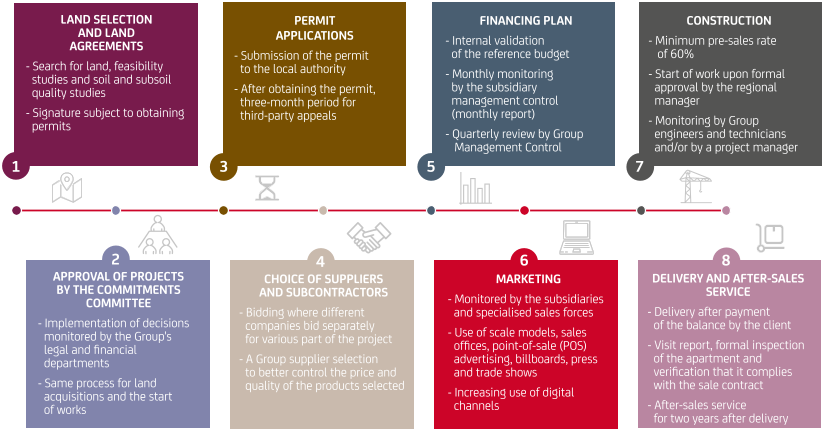 Horizontal diagram illustrating the complete process of a real estate project in eight successive steps, organized from left to right. The journey begins with the selection and securing of land, including land searches and feasibility studies, followed by project validation in terms of financial, legal, and technical challenges. Next come administrative approvals, involving the obtaining of permits and managing appeals, followed by the selection of suppliers and subcontractors. The financing package is then prepared and validated before the marketing phase, which relies on tailored sales mechanisms. Construction covers cost monitoring, deadlines, and execution quality. The process concludes with the delivery of the works and after-sales service, including client support after key handover.
Nexity pays particular attention to client satisfaction. To this end, Nexity has rolled out an internal satisfaction programme throughout the country to disseminate and foster a client culture throughout the Group. Thanks to its process of actively and continuously listening to customer feedback, the Customer Satisfaction Department is able to identify areas for improvement and adjust the relationship model to customer expectations (see Section 3.3.3 "Clients and end-users (ESRS S4)" of this Universal registration document).
Characteristics of a subdivision project
The process of a subdivision project is similar to that of a housing project (administrative authorisations, margin generation criteria).
Clients with subdivisions benefit from professional advisors, a website and a toll-free number, which helps the client to define his/her project on the land to be acquired, to complete a financing plan and to develop a timetable for the work. The Group also provides its clients with a financial guarantee covering work not yet carried out, which is mandatory to sign the final sales contract.
Characteristics of housing projects outside of France
Housing developments outside of France can differ in certain respects from those in France. In particular, land may be purchased before the required final building permits have been obtained and ownership may not be transferred until construction is complete, leading to a higher working capital requirement. The development and marketing processes for these projects are adapted to the legal and economic characteristics of each country, with the aim of maintaining a controlled risk profile in each of these local contexts. As a reminder, the Group only carries out marginal international activities (activities in the remaining countries, Belgium, Italy and Germany, are being managed on a run-off basis).
Project costs
The following table presents a breakdown of the average cost of projects by type of cost, for projects delivered during the 2022-2025 period:
(as % of total cost price)
2022
2023
2024
2025
Land costs
22.7%
21.6%
21.3%
19.9%
Roads & miscellaneous infrastructure (land development)
3.4%
3.6%
4.8%
4.0%
Construction works
51.0%
52.7%
50.9%
54.0%
Fees and insurance (1)
14.8%
14.8%
15.0%
14.7%
Financial expense
1.4%
1.2%
1.8%
2.0%
Marketing and advertising (1)
6.7%
6.1%
6.1%
5.3%
Total
100.0%
100.0%
100.0%
100.0%
- (1)Including intra-Group fees, which are generally around 10% of the total
Controlling construction costs
In a market where the cost of producing a home is significantly higher than the purchasing power of customers, it is Nexity's responsibility to constantly challenge its costs.
To this end, Nexity has put in place an operational performance plan, managed by the Construction Department, in conjunction with the regional teams, which has two objectives:
The roadmap is structured around an operational triptych: design better, buy better, execute better. Put simply: better production.
This Construction performance plan is based on four main levers for action, broken down into concrete initiatives to be rolled out in each region:
- •Design optimisation, which aims to improve the quality and efficiency of projects from their upstream phase;
- •Optimising the purchase of supplies, based on the improved structuring of purchases to strengthen economic performance and the reliability of commitments;
- •The streamlining of works purchases, based on panels of construction companies to better control costs and secure partnerships; and
- •Performance in the execution of works, which will strengthen the management of construction sites and risks to make deliveries more reliable and profitable.
Warranties given by the Group
For sales of new homes under the VEFA system, the Group is required by law to provide certain warranties to its clients:
- •A warranty against visible defects (garantie des vices apparents), covering visible construction defects reported by the buyer within one month of the buyer taking possession of the home;
- •A proper operation warranty (garantie de bon fonctionnement) covering malfunctions of items of equipment separate from the construction itself (valid for two years from date of delivery); and
- •A 10-year warranty (garantie décennale) covering problems relating to the structural soundness of the construction or the suitability of the structure for its intended purpose (valid for 10 years from date of delivery).
1.6.1.42025 Performance
Supply for sale
The supply for sale at the end of December 2025 stood at 5,447 units. It rose slightly (+3%) during the second half of the year.
With a supply/total market ratio(3) at its 2019 level, the decrease in supply for sale reflects the Group’s adjustment to new market conditions:
- •Time to market was 5 months (identical to 2019), securing supply rotation and resulting in virtually no unsold completed homes (~100 units);
- •Supply for sale under construction accounted for 48% of total supply, with more than 80% of projects scheduled to be delivered in more than 6 months and 64% in more than one year; and
- •Finally, the percentage of supply for sale located in supply-constrained areas is 15 points higher than in 2022 (91%), with the percentage in zones A/Abis up 17 points. It should also be noted that 100% of the supply for sale is eligible for the interest-free loan scheme since 1 April.
As part of its ongoing review of supply for sale in the planning stage, in light of the context and the targeted analysis of supply carried out during the second half of 2025, the Group made the decision to abandon 19 projects designed prior to year-end 2023, leading to its cancellation of 927 reservations (bulk sales) recorded prior to 2024.
Business activity
In a housing market still impacted by the non-renewal of the Pinel scheme at the end of 2024 and the deteriorating political environment in the second half of 2025, Nexity has consolidated its leading position by recording a total of 12,008 reservations over the period, i.e. a market share of 13% in a market that is consolidating by +10 basis points compared to 2024. This is a 10% drop in a market that is down 11% over the year.
With a steady improvement in the trend in 2025, notably supported by homebuyers and bulk sales in the second half of the year, Nexity posted above-market commercial performance in each of its markets for the second consecutive quarter.
- •Retail reservations over the year amounted to 4,558 units, i.e. 38% of the Group's housing reservations, a decrease of 10% in volume and 8% in value, reflecting healthy pricing levels achieved after the recalibration in 2024. This change reflected the following two trends:
- •Decline in individual investors, as expected, due in particular to the non-renewal of the Pinel scheme at the end of 2024 (which, for reference, accounted for 80% of individual investor and 18% of total reservations in 2024), and
- •Continued strong momentum among homebuyers at +19% over the year, to nearly 2,600 reservations (+23% for first-time buyers), driven notably by:
- -Appealing product range and effective marketing campaigns featuring innovative, attractive financing solutions aimed at helping first-time buyers and young people access loans in order to become homeowners, in particular by aligning monthly mortgage repayments as far as possible with what they used to pay in rent,
- -Good momentum in sales launches: 106 launches with retail sales spread over 101 municipalities, reflecting the appeal of our range. The average pre-sales rate before the start of works is 75%, and
- -Financing conditions with the stabilisation of borrowing rates over the year, the extension of the interest-free loan scheme to the whole country and the appetite of banks (number of loans granted up 34.9% over a rolling 12-month period in January 2026);
- •Bulk sales represented 7,450 reservations for 2025 (62% of the mix), down 9% in volume and 7% in value. More than half of these reservations were made in the fourth quarter, confirming the highly seasonal nature of bulk sales at the end of the year; and
- •In addition, the Planning business accounted for more than 1,400 subdivision reservations for the year, up 32% in volume, reflecting momentum amplified by the extension of the PTZ interest-free loan scheme to single-family homes starting 1 April 2025.
Number of units - FRANCE
2023
2024
2025
Q1
H1
9M
12M
Q1
H1
9M
12M
Q1
H1
9M
12M
New homes
2,811
6,085
9,213
14,602
2,005
5,060
8,109
13,387
1,434
4,278
7,106
12,008
Subdivisions
288
647
833
1,050
221
439
706
1,068
278
684
997
1,407
Total number of reservations
3,099
6,732
10,046
15,652
2,226
5,499
8,815
14,455
1,712
4,962
8,103
13,415
Value - FRANCE, in €m incl. taxes
2023
2024
2025
Q1
H1
9M
12M
Q1
H1
9M
12M
Q1
H1
9M
12M
New homes
575
1,260
1,865
2,964
446
1,060
1,690
2,718
312
930
1,515
2,492
Subdivisions
28
56
81
101
18
35
58
95
26
58
92
133
Total amount of reservations
604
1,316
1,946
3,065
464
1,095
1,748
2,812
339
988
1,607
2,625
Breakdown of new home reservations in France by client
Number of units
2024
2025
Change
Homebuyers
2,160
16%
2,568
21%
+19%
o/w: First-time buyers
1,850
14%
2,267
19%
+23%
o/w: Other homebuyers
310
2%
301
3%
-3%
Individual investors
3,075
23%
1,990
17%
-35%
Professional landlords
8,152
61%
7,450
62%
-9%
o/w: Institutional investors
2,404
18%
2,671
22%
+11%
o/w: Social housing operators
5,748
43%
4,779
40%
-17%
Total
13,387
100%
12,008
100%
-10%
Results
Revenue from Planning and Residential Real Estate Development totalled €2,277 million in 2025, down 5% compared to 2024, mainly reflecting the decline in activity.
Current operating profit was positive at €13 million compared to -€119 million in 2024 and reflects, as expected, the restored margins, mainly thanks to the rising contribution under the percentage-of-completion from project launches aligned with target commitment margins since the beginning of 2024.
Outlook
The backlog stands at €3.9 billion, stable compared to 30 September 2025 and equivalent to 1.5 years’ revenue. The level secured by sales for which notarial deeds of sale were signed is 48%.
This volume does not yet include the initial contributions from the Carrefour partnership, the first building permits for which were filed in the fourth quarter of 2024 and are currently being processed (for reference, revenue at termination over approximately the next ten years is estimated at more than €2 billion). Around ten other building permits are currently being worked on but have been delayed by the context of upcoming municipal elections in March 2026. An acceleration is expected after the local elections.
-
1.7Investments, innovation and intellectual property
1.7.1Investments
Aside from the financing of purchases specific to the operating cycles of its development and planning activities, which mainly consist of inventory components and work in progress held for sale (land, development and construction works, etc.), the Group carries out a variety of different types of investment:
- •Day-to-day operating investments for its activities (fitting out, IT, furniture, maintenance and renovation of managed serviced residences, development of coworking spaces, etc.);
- •External growth investments with the aim of developing the Group’s business by way of acquisitions of companies, equity interests, business goodwill or contributions; and
- •Investments that are more financial in nature, through acquisitions of non-controlling interests (in particular by the investment business).
Day-to-day operating investments in 2025 totalled €39 million net for the Group as a whole (€42 million in 2024 and €56 million in 2023), including €15.6 million for the fitting out of coworking spaces, €5.7 million for the renovation of student residences, and the remainder pertaining to IT investments (€13 million) and other subsidiary investments.
Investments and disposals in subsidiaries and shareholdings over the last three years are presented below.
In 2023, the Group acquired property management contract portfolios and firms for a purchase price of €8.4 million. In addition, Nexity entered into exclusive negotiations in December 2023 to sell its Services to Individuals activities to Bridgepoint for an enterprise value of €440 million. The transaction was completed on 2 April 2024. Lastly, together with Carrefour, the Group created a land banking joint venture (80% owned by Carrefour and 20% by Nexity) for €39 million.
-
1.8Legal and regulatory environment
1.8.1Regulations promoting real estate purchases
For more than 20 years, the Group’s new housing development and property development business has benefited from several tax measures such as:
- •The Pinel (rental investment) and Loueur en meublé non professionnel (LMNP) schemes allowing clients to deduct their rental expenses or benefit from a tax reduction calculated on the amount of the investment. The Pinel scheme ended for deeds signed after 31 December 2024;
- •The so-called "Jeanbrun" scheme, adopted as part of the 2026 Finance Bill, introduces a new tax scheme to support private rental investment, intended to replace the Pinel scheme. Based on a tax depreciation mechanism for the property, supplemented by the deduction of charges and the possibility of generating a land deficit, this scheme aims to boost the construction of housing and increase the rental supply across the entire country, without zoning. In particular, it encourages the marketing of low-cost housing, thus helping to address ongoing tensions in the housing market;
- •The PTZ interest-free loan scheme, aiming to support the construction of new homes and boost social home ownership by facilitating access to ownership for low-income households. As part of the 2025 Finance Act, the PTZ scheme was extended for new buildings throughout the country as well as to single-family houses until 31 December 2027;
- •Reduced-rate VAT in ANRU urban regeneration zones and QPV priority urban planning districts;
-
1.9Material contracts
Nexity considers the contracts it signs to be material when they have a significant weighting in the Group’s business activity with one sole counterparty, as well as those that could have reputational importance given their visibility in the event of poor execution or late delivery.
Carrefour and Nexity join forces for the redevelopment of 74 Carrefour sites in France
This long-term partnership is enabling the development of mixed-use projects with high environmental performance, incorporating housing, serviced residences, shops, offices and/or hotels.
- •40 city centre sites will be completely refurbished, with the reintegration of a food retail space.
- •The 36 other sites, on the outskirts of cities or in commercial areas, concern existing car parks, which will be partly reallocated to urban projects.
The initial 76 sites represent approximately 800,000 square metres; their development should enable the creation of 12,000 homes, 120,000 square metres of retail space, 10,000 square metres of office and business space and 17,000 square metres of hotels. The number of sites fell from 76 to 74 after local authorities exercised their right of first refusal on 2 sites.
For Carrefour, it is part of the Carrefour 2026 strategic plan and the project to upgrade its real estate portfolio in France:
- •Continue the integration of Carrefour shopping centres in redesigned neighbourhoods in close consultation with elected officials and local authorities;
- •Develop projects that are tailored to their environment by integrating a mix of uses on already artificialised land; and
- •Support the ecological urban transition by creating new green spaces and promoting soft local mobility.
For Nexity, this project, which is aligned with its desire to accelerate the focus on urban regeneration, is an opportunity to implement a transformative and exemplary approach, and to rise to the challenges of combating urban sprawl and supporting the energy transition.
-
2Risk factors and risk management
Nexity operates in a continuously changing environment and, like all companies in its sector, is inevitably exposed to risks whose occurrence could have material impacts. To ensure its continued development and the achievement of its objectives, the Group ensures that it identifies and manages its risk exposure in the regions where it operates and in its different areas of activity: planning, development and serviced properties.
-
2.1Risk management and internal control system
2.1.1Objectives and general principles
Nexity’s internal control is based on the COSO II framework (Committee of Sponsoring Organizations of the Treadway Commission) and on the reference framework of the French Financial Markets Authority (Autorité des Marchés Financiers - AMF). It is structured around five dimensions: control environment, risk assessment, control activities, information and communication, assessment and management. This ensures a consistent and uniform approach across the Group and facilitates compliance with the French Financial Security Act (known as LSF – Loi de sécurité financière).
Key principles of risk management
Risk management refers to a permanent set of arrangements that enable Executive Management and Nexity’s managers to identify, assess and contain any risks that could lead to a material adverse impact on the Company’s ability to achieve its objectives, its staff, assets, environment or reputation. Risk management forms an integral part of all Group processes (business lines and support functions) and informs decision-making.
- •Safeguard decision-making and the Group’s strategic, operational and support processes in order to facilitate the achievement of objectives;
- •Create and protect the Group’s value, assets and reputation by identifying and analysing the main threats and opportunities; and
- •Rally the Group’s employees around a shared vision of the main risks and make them aware of the issues and risks relating to their activities.
- •The mapping of major risks, which identifies the main concerns of the Group’s executives that could affect the achievement of the Group’s objectives. The results of this approach are presented in Section 2.2 "Specific risk factors and their management" of this chapter;
- •The mapping of operational risks, fed by the internal control system, which is based on an analysis of risks by operational processes, led by the Risk Department and the network of risk and compliance officers. More information on this approach is provided in Section 2.1.2.1 "Risk management organisation" of this chapter;
- •The mapping of corruption and influence peddling risks, managed by the Compliance Department, is based on the identification and analysis of scenarios specific to the real estate sector, with the aim of defining relevant and tailored action plans. This mapping is formalised in accordance with the recommendations of the French Anti-corruption Agency (AFA) and is based on the assessment of the risks specific to each of the Group's entities. In 2025, this mapping was incorporated into the Group's computerised risk management tool. Further information is provided in Section 3.4.1.4 "Prevention and detection of corruption and bribery (G1-3)" of this Universal registration document;
- •The mapping of risks related to anti-money laundering and combating the financing of terrorism, led by the Compliance Department, was based on the Tracfin guidelines for the real estate sector. It aims to identify and assess the risks specific to each entity, using an approach based on the risk type. In 2025, this mapping was incorporated into the Group's computerised risk management tool; and
- •The CSR risk mapping, managed by the CSR Department, is based on a dual materiality analysis that includes all the methodological elements of the Group’s risks. It complements Nexity’s risk analysis by identifying sustainability issues, both for operational risks and major risks. The risks resulting from the double materiality analysis are presented in Chapter 3 “Sustainability statement” of this Universal registration document;
Key principles of internal control
The Group’s internal control system is defined by Executive Management and implemented by all employees. It complements the risk management system, since it serves to identify and analyse risks while playing an active role in addressing them, in particular through the implementation of controls. Internal control helps control all activities, the efficiency of its operations and efficient use of its resources. It thus allows the Group to appropriately assess material risks, whether strategic, operational, financial, employee or compliance-related.
- •The compliance with applicable laws and regulations;
- •The application of instructions and guidelines set by Executive Management;
- •The proper functioning of the Group’s internal processes; and
- •The reliability of financial and accounting disclosures.
The risk management and internal control system therefore plays an essential role in the execution and management of the Group’s activities, since it makes it possible to:
- •Know and anticipate: ensure regular monitoring of the Group’s significant risks, recognise and monitor the environments in which the Group operates and anticipate changes in the nature or intensity of these risks;
- •Organise: ensure that the main risks identified are effectively taken into account by the Group at the most appropriate level;
- •Manage: ensure that the resources in place are effective to best control the risks identified, in line with the Group’s values and strategy; and
- •Raise awareness and inform: the implementation of a coordinated risk management system is based on raising employee awareness of risk management. It includes risk communication to various stakeholders.
Risk appetite and risk culture
The control environment, vital to the internal control system, proper risk management and the application of procedures, is also based on behaviours, actions, organisation and employees. The smooth running of Nexity’s organisation is based on, among other factors, compliance with the clear principles of action and behaviour that frame its activities and its development:
- •Strict application of Group-wide rules, particularly in terms of undertaking projects;
- •Knowledge of and compliance with the Code of Ethics, the Group's Anti-corruption Code of Conduct and the relevant procedures, (see Section 3.4.1.3 “Corporate culture and business conduct policies (G1-1)” of this Universal registration document);
- •Transparency and loyalty of employees towards their line managers at the operational level and at the central functional departmental level (divisions and the holding company); and
- •Responsibility of the executives of operating entities in communicating the above principles to their teams using the most appropriate means.
In order to prevent and effectively manage its risks, Nexity adopts a moderate risk appetite policy leading it to limit and control acquisitions of high-risk land assets, manage its real estate development operations within a prudential framework, ensure its commitments are highly diversified, and avoid speculative activities and those with high fixed costs.
The Group also aims to ensure that it conducts its business activities at all times in compliance with the legal requirements applicable to its various business lines and with the rules on business ethics. As such, it has set up appropriate training for its employees (see Section 3.4.1.3 “Corporate culture and business conduct policies (G1-1)” of this Universal registration document).
The Group generally considers that its executives and employees demonstrate a shared culture of risk management and works continuously to reinforce it. Risk analysis is integrated into the Company’s various processes: governance, operational and support processes. Measures to support the continuous improvement of risk management are regularly implemented, in particular by raising the awareness of employees and involving them in the deployment of control systems.
-
2.2Specific risk factors and their management
In a housing market undergoing profound change, Nexity continued to make changes to its organisational structure in 2025. The Group is thus confirming its ability to adapt and the relevance of its positioning to tackle the real estate crisis. The key points of the updated mapping of major risks at 31 December 2025 mainly relate to strategic risks and risks related to the business lines and relations with third parties.
The conflict in the Middle East is changing the geopolitical context and could have an impact on the macro-economic environment. Nexity operates in France (with its international business managed on a run-off basis) and has no direct exposure in the Middle East. The Group remains attentive to changes in the situation, the consequences of which, if long-lasting, could result in an increase in inflation, particularly in the cost of raw materials, interest rates or tensions in supply chains.
2.2.1Summary of major risks
Additional risks not currently known to Nexity may also adversely affect its business and financial performance. Any of these risks could cause significant differences with the forward-looking information released to the market and filed by the Group with the AMF.
Mapping of Nexity's major risks
Category
Risk
CSR
Specific risk factor
Residual criticality
Level of control
STRATEGY
Disruption of the business model
Moderate
Satisfactory
Business volatility
✓
Very high
Satisfactory
Unfavourable developments relating to taxes and regulations applicable to real estate
✓
High
Can be improved
Shortcomings in the management of major partnerships
✓
High
Satisfactory
Non-achievement of the Group's strategic climate and biodiversity objectives
✓
Moderate
Satisfactory
Shortcomings in reputational crisis management
Low
Very Satisfactory
Difficulty in the management and control of subsidiaries
✓
High
Satisfactory
Non-alignment of information systems with the Group's development challenges
✓
High
Can be improved
INFORMATION SYSTEM
Prolonged unavailability of the IS due to a cyberattack and exploitation of a security breach
✓
High
Can be improved
IS obsolescence
High
Satisfactory
Shortcomings in the management of authorisations and accesses
High
Can be improved
HUMAN RESOURCES
Mismatch between skills and changes in the Group’s business lines
✓
Moderate
Satisfactory
Significant increase in staff turnover
Moderate
Satisfactory
Extended unavailability of a key skill/person
Moderate
Satisfactory
BUSINESS LINES
Scarcity of land eligible for transactions
✓
High
Very Satisfactory
Lack of cost control on a project
✓
Very high
Satisfactory
Severe incidents at construction sites
✓
Moderate
Satisfactory
Increased time to market on supply for sale
✓
Moderate
Very Satisfactory
RELATIONSHIP WITH THIRD PARTIES
Lack of quality of products/services
✓
Very high
Satisfactory
Failure of key supplier/partner
✓
Very high
Can be improved
COMPLIANCE
Non-compliance
Moderate
Satisfactory
FINANCIAL
Liquidity risk
✓
Moderate
Satisfactory
External fraud
High
Satisfactory
-
3.1General information (ESRS 2)
3.1.1Basis for the preparation of the Sustainability Statement
3.1.1.1Explanatory note regarding the European CSRD(1)
The Sustainability Statement presented in this chapter of the Universal registration document was prepared in the context of the second year of application of the provisions of the EU Corporate Sustainability Reporting Directive (CSRD).
The Group is applying a continuous improvement approach to this reporting and communication exercise.
3.1.1.2General basis for the preparation of the Sustainability Statement (BP-1)
Scope of reporting
The Sustainability Statement is prepared on a consolidated basis. Its scope of reporting is identical to the scope of the financial statements, and all subsidiaries are included in the same scope. The non-financial scope is aligned with the financial scope, and its reference period is the same as that for the Group’s financial reporting, i.e. the calendar year from 1 January to 31 December. All metrics for the Sustainability Statement take into account the entire scope. Due to the disposals of Accessite on 1 October 2025 and Service Personnel on 30 July 2025, it is specified when indicators do not include one of these entities.
It should be noted that the option to omit specific information on intellectual property, expertise and innovation results has been applied.
Value chain coverage in the Sustainability Statement
The preparation of the Sustainability Statement is based on the double materiality assessment which was updated in 2025. It has enabled the identification and assessment of the impacts, risks and opportunities (IRO) present throughout Nexity’s value chain (see Section 3.1.3.1 “Strategy, business model and value chain (SBM-1)” of this chapter).
Consequently, the entire Sustainability Statement takes into account Nexity’s value chain and in particular its tier-one suppliers (BTP companies(2)). A table presents the Group’s material IROs broken down across the value chain in the introduction to each corresponding ESRS(3) in this chapter.
3.1.1.3Disclosures in relation to specific circumstances (BP-2)
Incorporation by reference
All of the data points listed below have been incorporated by reference. They have been addressed within this Universal registration document as follows:
Data point
Section of the Universal registration document
ESRS 2 GOV 5-36
Section 2.1 "Risk management and internal control system"
ESRS 2 GOV 1-21
Section 4.2.2 "Functioning of the Board of Directors"
Section 4.2.3 "Specialised Committees of the Board of Directors"
ESRS 2 GOV 1-23
Section 4.2.2 "Functioning of the Board of Directors"
Section 4.2.3 "Specialised Committees of the Board of Directors"
ESRS 2 GOV 1-5
Section 4.2.3 "Specialised Committees of the Board of Directors"
ESRS 2 GOV 3-29
Section 4.4 "Remuneration and benefits paid to executive company officers and directors"
ESRS 2 SBM 1-40 i and ii
Section 1.2 "General presentation of the Group" Section 1.6 "The Group's business lines"
ESRS 2 SBM 1-42
Introductory section to this Universal registration document Section 1.4 "Strategy and objectives"
Time horizons
The default time horizons defined by the Group are those defined in the climate-related standard, ESRS E1. These time horizons are measured from the end of the reporting period, i.e. 31 December 2025:
- •Short term is defined as less than 1 year;
- •Medium term is defined as 1 to 5 years; and
- •Long term is defined as more than 5 years.
The time horizons defined by the Group for its analysis of climate-related physical risks are presented in Chapter E1 (see Section 3.2.1.3 "Climate change adaptation" of this chapter).
Information regarding the preparation and presentation of the Sustainability Statement
Environmental metrics
Data on greenhouse gas emissions are published in accordance with the GHG Protocol for all scopes, as for the 2024 fiscal year.
Emissions related to the administrative carbon footprint are calculated using primary data (88%) and extrapolated data (12%). The uncertainty of data collected ranges from low to high. Scope 3 emissions related to the life cycle of projects are calculated using secondary data (FDES forms (Environmental and Health Declaration Forms), PEP (Product Environmental Profiles), and RE2020 data). This data is highly uncertain. This data will be strengthened in the future with more detailed calculations (RSEE methodology(4)) and management using a carbon tool. The methodology for calculating carbon assessment data is presented in Section 3.2.1.4 "Methodology note and regulatory tables" of this chapter.
With regard to the data for ESRS E5 on the “Circular economy” topic, as the purchases of resource inflows are made by the suppliers in Nexity’s value chain, the monitoring thereof is not yet consolidated by the Group.
Social indicators
Regarding the breakdown of salaried employees by age group, there is no change in methodology for determining the number of employees concerned. There are no other significant methodological changes relating to social indicators.
European taxonomy
Nexity applies the EU Taxonomy regulatory framework as defined by the most recent delegated regulation in force (Commission Delegated Regulation (EU) 2026/73, adopted on 4 July 2025 and which entered into force on 28 January 2026). For the 2025 fiscal year, the Company did not apply the principle of materiality by activity (threshold of 10%).
Disclosures from other legislation or from sustainability reporting standards and frameworks
In addition to the ESRS-related sustainability reporting requirements, Nexity publishes additional sustainability- related information in accordance with the following standards:
- •Law No. 2020-105 of 10 February 2020 on the fight against waste and the circular economy;
- •RE2020 environmental regulations for new buildings; and
- •Article L.229-25 of the French Environmental Code, which requires companies with more than 500 employees to perform a greenhouse gas emissions assessment (GHGA), was introduced by the Grenelle II law (Law No. 2010-788 of 12 July 2010). This article has been amended and clarified by subsequent decrees to adjust the application methods.
- •Law No. 2023-630 of 20 July 2023 aimed at facilitating the implementation of objectives for combating soil artificialisation and strengthening support for local elected representatives; and
- •Law No. 2021-1104 of 22 August 2021 on the fight against climate change and strengthening resilience to its effects.
- •Law No. 78-17 of 6 January 1978 on data processing, data files and civil liberties;
- •Law No. 2018-493 of 20 June 2018 on the protection of personal data;
- •The Charter of Fundamental Rights of the European Union;
- •European Union Convention 108 on the protection of individuals with regard to automatic processing of personal data;
- •Order No. 2014-159 of 20 February 2014 on intermediate housing;
- •Law No. 2018-1021 of 23 November 2018 on changes in housing, land management and digital technology;
- •Law No. 2015-990 of 6 August 2015 on growth, activity and equal economic opportunities; and
- •Law No. 2000-1208 of 13 December 2000 on solidarity and urban renewal (Article 55).
-
3.2Environmental information
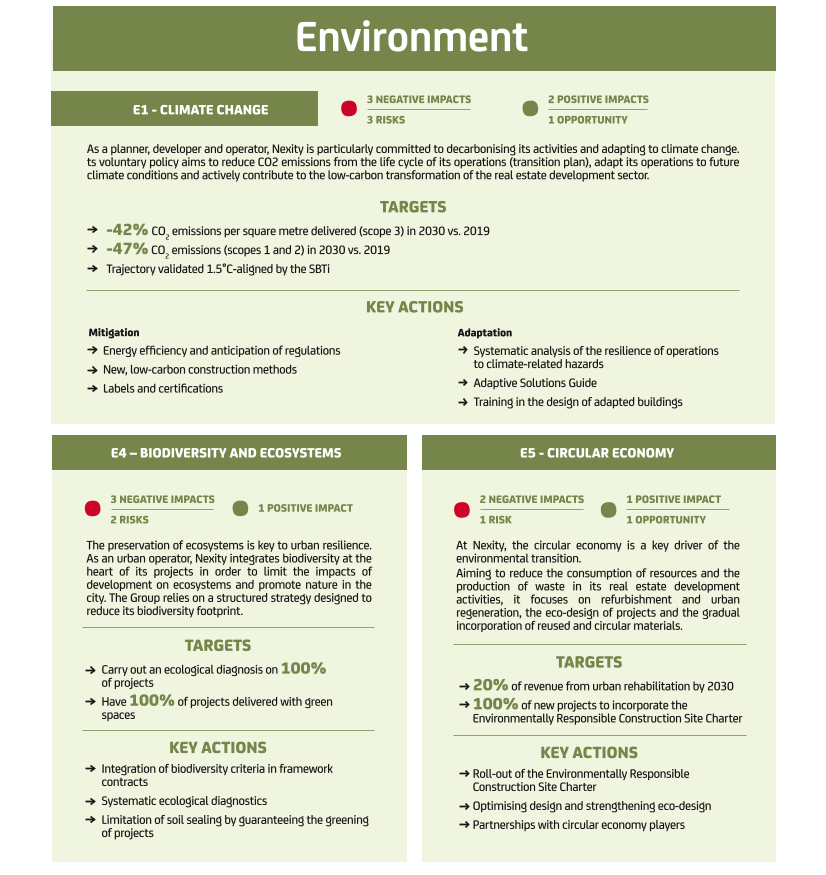 Summary visual presenting the structure of Nexity’s environmental information, which will be detailed further below. The graphic illustrates the Group’s climate and environmental priorities related to climate change (E1), biodiversity and ecosystems (E4), and the circular economy (E5). It incorporates CO₂ emission reduction targets aligned with a 1.5°C trajectory validated by the Science Based Targets initiative (SBTi), as well as the key identified impacts, risks, and opportunities, and the main mitigation and adaptation actions implemented.
3.2.1Climate change (ESRS E1)
3.2.1.1Climate-related impacts, risks and opportunities (IRO-1; SBM-3)
Climate change is a physical reality that is redefining the context of habitability both for society and for the continuity of business activities. As a real estate development company, called upon to orchestrate the design of living spaces ranging individual homes to entire neighbourhoods, the Nexity group is heavily impacted by and attentive to the physical, economic and societal changes brought about by this context. The Group has therefore defined a climate policy based on the two complementary pillars of climate change mitigation and adaptation to the effects of climate change. This policy is presented in this chapter and is the result of a context-induced assessment of impacts, risks and opportunities (IROs).
The table below presents the characteristics of the IROs identified by the double materiality assessment as material to the challenges of climate change mitigation and adaptation:
IROs
Description
Policies
Targets
Shares
Negative impact
[Exposure of users to risks in the event of extreme weather]
The inadequacy of housing, offices and major urban projects to adapt to the consequences of climate change exposes users to health and safety risks caused by extreme weather events.
Climate change adaptation policy
- •Awareness and training on climate change adaptation
- •Physical risk resilience diagnostics with the Batadapt tool
Positive
impact[Improving user comfort]
Adapting existing buildings makes it possible to improve the comfort of users, particularly during heat waves.
Climate change adaptation policy
- •Development of a guide to adaptive actions
Risk
[Economic losses related to physical risks]
Climate change may lead to the risk of suspension or shutdown of construction sites and disruptions in the supply of materials. Ignoring this context could expose the Group to reputational and economic risks.
Climate change adaptation policy
- •Integration of these elements into site preparations
Negative
impact[Carbon emissions related to materials (upstream value chain)]
Real estate development activities and their value chain are high carbon emitters, particularly in the life cycle of projects delivered, for which carbon emissions related to construction materials represent nearly 60%.
Climate change mitigation policy
- •Reduce CO2 emissions per square metre related to the life cycle of delivered buildings in 2030 by 42% compared to the 2019 reference year.
- •Develop new construction methods and new low-carbon products
- •Develop refurbishment activities
Negative
impact[Carbon emissions related to energy consumption during the life of the building (downstream value chain)]
The poor energy performance of constructed and marketed buildings has a negative impact on the environment during their use: overconsumption of energy and carbon emissions (nearly 40% over the life cycle).
Climate change mitigation policy
- •Reduce CO2 emissions per square metre related to the life cycle of delivered buildings in 2030 by 42% compared to the 2019 reference year.
- •Develop high-energy performance buildings
- •Implement low-carbon energy vectors
Positive
impact[Reduction of carbon emissions]
Promoting refurbishment, low-carbon materials, energy performance and changes in user behaviour reduces carbon emissions
Climate change mitigation policy
- •Reduce CO2 emissions per square metre related to the life cycle of delivered buildings in 2030 by 42% compared to the 2019 reference year.
- •Reduce absolute CO2 emissions related to scopes 1 and 2 by 47% in 2030 compared to the 2019 reference year.
Scopes 1 and 2
- •Reduce emissions associated with the vehicle fleet
- •Reduce emissions associated with office sites
Risk
[Failure to achieve our climate objectives]
Faced with the increasing challenges associated with climate change, Nexity has implemented a structured environmental strategy based on ambitious climate objectives. If these are not met, Nexity is exposed to risks that affect its reputation and credibility and weaken its position as a leader in the environmental transition sector
Climate change mitigation policy
- •Inclusion of CSR criteria in the remuneration of company officers
- •Training and awareness-raising for employees and executives
- •Carbon trajectory certified 1.5°C-aligned by the SBTi
Risk
[Economic losses related to transition risks]
Climate change may lead to transition risks related to the necessary adaptation of operations in the face of growing demand for low-carbon architecture. This trend may be accompanied by higher costs due to the use of low-carbon materials and more in-depth preliminary studies for projects. Ignoring this context could expose the Group to economic risks.
Climate change mitigation policy
- •Anticipation of changes (objective of RE2020 -10%)
Opportunity
[Increased attractiveness thanks to a leading position in low-carbon construction]
Increasing the development of low-carbon construction helps to anticipate regulations, improves the attractiveness of projects for investors and represents a financial opportunity for Nexity.
Climate change mitigation policy
- •Differentiation in bids
- •Working with an ecosystem of experienced partners on these topics
3.2.1.2Climate change mitigation
Climate change mitigation is defined by the IPCC(1) (AR6 report, 2023) as human intervention aimed at reducing greenhouse gas emissions or enhancing atmospheric carbon sinks. Its principle is based on limiting radiative forcing to stabilise the climate and avoid critical warming, through actions such as the decarbonisation of energies, energy efficiency and carbon sequestration.
It is essential because cumulative emissions determine the trajectory of warming over centuries; without an immediate drastic reduction, the impacts (rising water levels, extreme events) would exceed any capacity to adapt, threatening planetary stability and societies.
On a global scale, the mitigation goals aim to limit warming to 1.5°C compared to the pre-industrial era, in accordance with the Paris Agreement, by reducing global greenhouse gas emissions by 45% between 2010 and 2030 and achieving carbon neutrality around 2050. At company level, these objectives consist of aligning strategies with these ambitions, by measuring their carbon footprint using methodological frameworks such as the GHG Protocol, and through commitments to absolute emission reductions (as with the Science Based Targets initiative).
Nexity impacts on climate change
The impact of Nexity’s activities on climate change is predominantly due to greenhouse gas emissions in the Group’s value chain. As a service company, the Group's scope 1 and 2 emissions are linked only to its administrative sites, and scope 3 emissions are for the most part associated with the life cycle of real estate projects brought to market (real estate development activity).
Real estate development consists of the design and construction of housing, offices and/or business premises. The use of construction methods and materials during the construction phase by construction companies emits greenhouse gases, due to the carbon related to the materials on the one hand (extraction, processing, transport) and related energy consumption over the life of the building on the other. It should be noted that the majority of the Group’s real estate projects are carried out in mainland France (97% of 2025 revenue). Real estate development activities do not fall into the category of activities incompatible with carbon neutrality if they are covered by decarbonisation trajectories validated by the SBTi as aiming for neutrality by 2050. As a result, these activities require significant efforts to measure and reduce their impact on the climate. Nexity's trajectory and efforts are described in this chapter.
Although Nexity does not carry out any real estate activity, due to its real estate development activities and as a project owner, the Company has an important responsibility to participate in the transition to global neutrality, based on the significant carbon impact of the construction sector.
The impact of Nexity group’s activities on the climate is measured annually through an assessment of greenhouse gas emissions on the Group's value chain and its operations, as well as on its administrative sites (scopes 1, 2 and 3 of the GHG Protocol). Methodological details and emissions reporting from recent years can be found in the methodological note.
2025 Group carbon footprint
The Nexity group's carbon footprint is the sum of the "administrative" carbon footprint (specific to the operation of the Group's administrative sites) and the "life cycle of buildings delivered" carbon footprint (specific to the development activity). The calculation methods for these two assessments are detailed in the methodological note. This dual approach enables the Company to identify the main sources of its greenhouse gas emissions. For administrative activities, this concerns business travel and the energy consumption of offices. The carbon footprint of the delivered buildings relates to the impact of materials and energy efficiency.
- •For 0.4% of Scopes 1 and 2;
- •Scope 3 - administrative (1.4%); and
- •Scope 3 - life cycle of delivered buildings (98.2%).
As such, a very large proportion of emissions is attributable to the life cycle of the buildings delivered during the year by the Group, which can be broken down into 45.5% of the Group's total carbon footprint for upstream (carbon related to the materials used) and 48.8% of the Group's total carbon footprint for downstream (carbon related to energy consumption during use and the end of life of buildings).
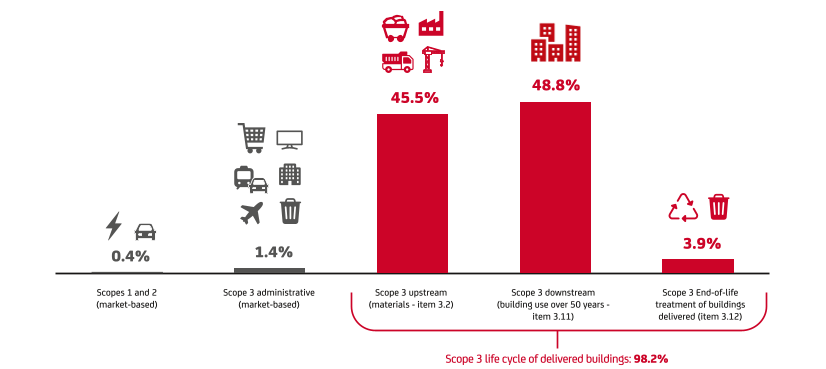 The diagram shows the breakdown of greenhouse gas emissions by different scopes. Scopes 1 and 2 account for a very small share, just 0.4%. The Scope 3 emissions related to administrative activities reach 1.4%. The majority of emissions come from Scope 3 activities: The upstream phase, mainly linked to materials, represents 45.5%. The downstream phase, corresponding to the use of buildings over 50 years, accounts for 48.8%. The end-of-life phase of delivered buildings constitutes 3.9% of emissions. In total, the three Scope 3 categories make up 98.2% of emissions.
As shown in the table below, the Group’s total carbon footprint for 2025 amounted to 1,201,096 metric tonnes of CO2 (market-based), which represents a decrease of 5.8% compared to the 2024 carbon footprint. This decrease is due to a reduction in the administrative carbon footprint (reduction in scope 1 due to the implementation of the vehicle policy, decrease in scope 2 attributable to a decrease in electricity consumption with the disposal of several sites), as well as the decarbonisation of development activities (scope 3). It should also be noted that the design of projects delivered in 2025 dates back to at least three years previous.
This represents an increase of 22.3% in scopes 1 and 2 and a decrease of 34.6% in scope 3, the life cycle of buildings delivered in absolute value since 2019, for an SBTi objective of -47% and -36% respectively.
Nexity group's carbon footprint (GHG Protocol) in tCO2eq
2024
2025
2024-2025
changeScopes 1 and 2 - location-based*
5,977
5,254
-12.1%
Scope 3 administrative**
18,493
16,734
-9.5%
Scope 3 life cycle of delivered buildings
1,250,991
1,179,108
-5.7%
Total
1,275,461
1,201,096
-5.8%
- *For scopes 1 and 2, following the disposal of the Property management activity (SP) which represented 30% of the workforce, on 02/04/2024, the reference year 2019 was recalculated and verified by an independent third party in June 2024. Following the sale of the Nexity Property Management business on 31/10/2024, the reference year 2019 and the year 2024 were recalculated and verified by an independent third party in June 2025. The impact of the sale of Accessite on 01/10/2025 and of Service Personnel (Weekin) on 30/07/2025 on the administrative carbon footprint was less than 5%
- **The value of the administrative scope 3 for 2024 was adjusted in 2025. This adjustment has been validated by the sustainability auditors
The following table shows the progress made in decarbonising Nexity's production (its real estate projects), in intensity. All the regulatory tables relating to the carbon footprint are presented in Section 3.2.1.4 "Methodology note" of this chapter.
Life cycle carbon intensity (CO2/sq.m) of delivered buildings - RE2020
In kgCO2eq/sq.m
2019
2022
2023
2024
2025
2025
vs 2024
2025
vs 2019
Residential Real Estate Development
1,369
1,305
1,310
1,284
1,264
-1.5%
-7.6%
Of which materials (construction CI)
820
831
821
817
800
-2.0%
-2.4%
Of which energy (energy CI)
549
474
489
467
464
-0.6%
-15.5%
Commercial development
1,169
1,109
1,101
1,083
974
-10.1%
-16.7%
Of which materials (construction CI)
N/D
935
964
938
841
-10.4%
Of which energy (energy CI)
N/D
174
137
146
133
-8.7%
Total development activities*
1,349
1,285
1,289
1,264
1,235
-2.3%
-8.4%
- *The consolidation between residential and commercial development is performed using a weighting of 90% for residential development and 10% for commercial development
Emissions per square metre of residential development under RE2020 fell by 1.5% over one year and are 7.6% lower than in 2019. Those of commercial development fell by 10.1% in one year and are 16.7% lower than in 2019. Total emissions per square metre of the development activity fell by 8.4% in 2025 compared to 2019. These emissions in intensity are influenced by a record year in terms of square metres of residential spaces delivered, this being due to an extension of the period between the filing of the building permit and delivery: some projects for which building permits were filed longer ago - with lower carbon ambitions - were delivered this year.
- •For scopes 1 and 2 only: 1.86 tCO2 per million of revenue generated (1.79 tCO2 using the market-based approach); and
- •For scopes 1, 2 and 3: 425.77 tCO2 per million of revenue generated (425.70 tCO2 using the market-based approach).
Nexity’s Carbon intensity in 2025
The IFRS revenue of €2,821 million, used to calculate the intensity of GHG emissions, is disclosed in Notes 3.8 and 6.2 to the Consolidated financial statements presented in Section 5.1 of this Universal registration document.
Climate change mitigation policy (E1-1; E1-2)
In order to reduce its impact on climate change, Nexity has developed a policy to measure and reduce the greenhouse gas emissions of its value chain, at the level of the Group and all its subsidiaries. The aim of this policy is to achieve the Group's climate-related objectives.
- •Measurement of greenhouse gas emissions related to its internal (Scopes 1 and 2) and external (Scope 3) scope of responsibility;
- •Decarbonisation trajectory aligned with the objectives of the Paris Agreement; and
- •Identification and activation of the main decarbonisation levers(2).
The topics of energy efficiency and renewable energies are included, on the one hand, in the mitigation policy for Scopes 1 and 2 (administrative activities), and on the other hand in the Group’s Scope 3 mitigation policy related to delivered buildings (energy efficiency and energy vectors of these buildings).
Global and operational management
The Group’s mitigation policy is managed by the Group’s CSR Department, which has also overseen its development. The operational monitoring of decarbonisation objectives has been entrusted to:
- •The Group's Real Estate and Purchasing Department and Human Resources Department for scopes 1 and 2, and scope 3 administrative; and
- •The Construction Department for Scope 3 life cycle of projects. It monitors carbon emissions on a quarterly basis, focusing on projects delivered or in the building permit application phase (for operational management of the carbon trajectory of deliveries).
The monitoring of the decarbonisation trajectory was the subject of the first Impact2030 Committee meeting – a committee bringing together Executive Management, the CSR Department and the Regional Departments – in July 2025.
Objectives of the variable component
The remuneration of company officers includes a variable component, which was 10% for the 2025 fiscal year, indexed to the objective of decarbonising the life cycle of buildings delivered (scope 3) (see Section 4.4.1 "Remuneration of Nexity’s executive company officers and directors awarded in respect of or paid during the 2025 fiscal year (ex-post)" of this Universal registration document).
Internal carbon price (E1-8)
To implement the Group’s strong ambition to decarbonise the development activities, in 2022 the CSR Department and the Finance Department defined the procedures for implementing an internal carbon price, which were validated by Executive Management. Beyond education, the objective is to create a true culture of sustainable performance and to contribute to the systematic linking financial and environmental performance in the future. The principle adopted is that of a bonus/penalty system based on the carbon performance of a project in relation to the average carbon objective for the year based on the Group’s carbon trajectory, and the creation of a corresponding carbon margin for each project reviewed by the Group’s Commitments Committee or Acquisition Committee. After analysing the programmes reviewed by the Group Works Council and benchmarking practices in other companies, the internal carbon price was set in 2022 at €100 per metric tonne of CO2.
The carbon margin that appears in the documents to be presented to the committee may thus either represent an improvement in the margin in the event of carbon outperformance in the project, or a deterioration in the margin in the event of carbon underperformance in the project. Thus, a carbon margin that represents an improvement on the “traditional” margin reflects the fact that a programme has made a positive contribution to the Group’s carbon trajectory. As part of this system, the carbon margin is currently only used for information purposes.
Transition plan for climate change mitigation (E1-1)
As a real estate operator, Nexity has a key role to play in driving the ecological transition, particularly in urban areas. Although it is neither a materials manufacturer nor a construction company, the Group has a responsibility during construction as a project owner and therefore as a principal, and must have an ambitious transition plan.
Global warming requires profound transformations in the functioning of regions and lifestyles, to move towards more energy efficient and sustainable urban models. Nexity has adapted its environmental strategy to take these factors into account and initiate far-reaching changes to its business lines, in particular the design of buildings resulting from its development activities.
The Nexity group’s transition plan is based on decarbonisation objectives. These objectives and their monitoring, the decarbonisation levers and the associated actions to achieve these objectives are presented below.
Climate change mitigation targets and performance (E1-4)
The transition plan for climate change mitigation is based on a trajectory for reducing greenhouse gas emissions generated directly or indirectly by Nexity in its value chain. Nexity’s carbon trajectory can be broken down into two objectives for 2030. They concern, on the one hand, scope 1 and 2 emissions - which are solely associated, in view of the Group’s activities, with administrative sites and vehicles (0.5% of scopes 1, 2 and 3) - and on the other hand, scope 3 emissions related to the Group’s development activities, i.e. the life cycle of delivered buildings (98.1% of scopes 1, 2 and 3). The rest of scope 3 is related to administrative sites and vehicles (1.4% of scopes 1, 2 and 3) for which the Group has not set itself any objectives.
The Group set itself the following two strategic objectives in 2022 (an ambition was set in 2015, enhanced in 2020 and then 2022):
- •Reduce absolute CO2 emissions related to scopes 1 and 2 by 47% in 2030 compared to the 2019 reference year(3); and.
- •Reduce CO2 emissions per square metre related to the life cycle of delivered buildings by 42% compared to the 2019 reference year (Scope 3 related to development activities). With regard to this objective, the ambition corresponds to the reduction in absolute value of 36.4% of CO2 emissions related to the life cycle of the delivered buildings.(4) (5)
These objectives were validated by the SBTi in July 2023 as being aligned with the objective to limit global warming to 1.5°C(6). These targets were analysed in light of the latest activity forecasts, and the ambition remains unchanged, in absolute value and in intensity; internal management for scope 3 development is always carried out in intensity, which is the most relevant for our activities.
These objectives were set following work carried out in 2021, coordinated by the CSR Department in conjunction with the Construction Department, and with the support of an external firm. The proposed objectives were validated by the Executive Committee in early 2022. The level of ambition of these objectives was put to the vote at the Shareholders' Meeting in May 2022 (Climate & Biodiversity Resolution) and was approved by 88%.
The SBTi certification of its 2030 decarbonisation constitutes a first milestone for Nexity in its objective of contributing to global carbon neutrality by 2050.
In order to achieve the objective by 2030, the carbon intensity trajectory of projects is monitored by the Construction Department when the building permit is filed to steer the trajectory, and at the time of delivery to measure the results.
Monitoring of the life cycle CO2 emission performance of delivered buildings
The RE2020, one of the most ambitious regulations in terms of limiting the carbon impact of buildings in Europe, has been applied since 1 January 2022. It sets both a carbon emissions threshold related to materials and a carbon threshold related to energy consumption over a 50-year period of use of the building. It sets emission intensity ceilings for building permit filings, with decreasing thresholds over time in three-year stages: 2022, 2025, 2028 and 2031.
Reducing the life cycle carbon footprint of buildings requires profound changes in building design. A corporate transformation process based on the design of low-carbon buildings has been in place since 2021 when the Construction Department and a Head of Low-Carbon Deployment position were created. To monitor the progress made in the decarbonisation of the life cycle of buildings, the Group has been monitoring, since the application of the RE2020 in 2022, a performance indicator from the building permit filing stage, which is on average three years prior to the delivery of the building. It should be noted that the average emissions per square metre of projects delivered in 2019 is equivalent to the 2022 threshold of the RE2020.
Targets and performance for reducing the life cycle carbon footprint of buildings - building permit filing stage:
2022
2023
2024
2025
Targets
RE2020 threshold in force
2022 threshold (7)
2022
threshold2022
threshold2025 threshold (8)
Performance
Outperformance against the RE2020 threshold in force
-10%
-25%
-30%
-11%
CO2 gain compared to the RE2020 threshold in force (tCO2eq)
N/A
300,000
380,000
70,000
Performance compared to projects delivered in 2019*
-10%
-25%
-30%
-35%
- *The average emissions per square metre over the life cycle of the projects delivered in 2019 are equivalent to the 2022 threshold of the RE2020.
In 2025, the outperformance of building permit filings compared to the 2025 threshold of the RE2020 -11%, i.e -35% compared to the 2022 threshold.
The RE2020 thresholds calculated in view of the Group’s average production that apply to building permit filings are as follows(9):
- •2025 threshold = 977 kg CO2eq/sq.m SHAB (floor space)(10);
- •2028 threshold = 872 kgCO2eq/sq.m SHAB (floor space); and
- •2031 threshold = 787 kg CO2eq/sq.m SHAB (floor space).
The following graph shows the performance in kg of CO2 per square metre on the projects delivered and on the building permit applications filed since 2019. This performance is put into perspective with the declining regulatory thresholds of the RE2020 and with the time horizon of 2030 for the achievement of the -42% objective for deliveries, compared to 2019. There is usually a three-year period between the filing of the building permit application and the delivery of a project, so it can be estimated that the projects delivered in three years will respect the trajectory of deliveries.
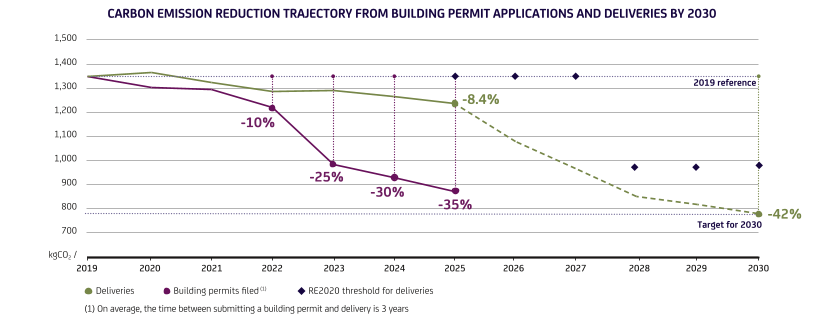 The diagram illustrates the carbon emission reduction trajectory between 2019 and 2030 for building permits and deliveries. The curve for building permits shows a gradual decline: -10% in 2022, -25% in 2023, -30% in 2024, -35% in 2025, compared to the 2019 baseline. In parallel, the target trajectory for deliveries follows a downward curve, shown in green and then in dashed green from 2025 onward (as it becomes hypothetical from that point), with a final goal of -42% by 2030. In 2025, the reduction is 8.4%. The graph also indicates that the RE2020 regulatory thresholds are positioned above these trajectories, demonstrating alignment with long-term carbon reduction requirements.
Decarbonisation levers to achieve objectives
- •Energy and carbon performance of the Group’s vehicle fleet (90% of Scopes 1 and 2): fleet optimisation and electrification; and
- •Energy and carbon performance of administrative buildings - which house Group employees - (10% of scopes 1 and 2): teams relocated to newer buildings, sobriety measures, etc.
Scope 1 and 2 emissions and decarbonisation levers for 2030(11)
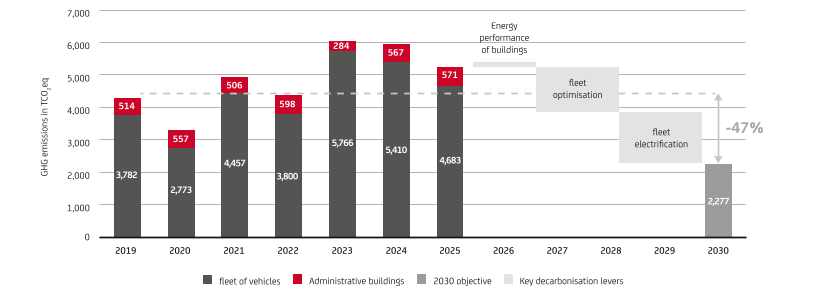 Graph showing the evolution of greenhouse gas emissions related to the vehicle fleet and administrative buildings between 2019 and 2025, with a target set for 2030. Emissions from the vehicle fleet represent the largest share throughout the period, showing annual variations and an overall downward trend starting from 2023. Emissions from administrative buildings remain more limited but fluctuate from year to year. The 2030 target is represented by a threshold significantly lower than the levels observed during the historical period. The graph illustrates the main decarbonization levers implemented by the Group, including: Electrification and optimization of the vehicle fleet, Improvement of the energy performance of buildings, contributing to an overall reduction of 47%.
The decarbonisation objectives for the life cycle of buildings lead the Group to identify levers to reduce this carbon footprint, both upstream (materials) and downstream (emissions related to the building’s consumption during its lifetime). The activation of these levers is a real change management project for the development business lines.
Four main decarbonisation levers make up the Group’s transition plan, the first two focusing on downstream and the other two upstream of construction:
- •Lever 1 - Energy efficiency of new buildings: develop high-energy performance buildings (7% gain);
- •Lever 2 - Energy mix of new buildings: implement low-carbon energy vectors (14% gain);
- •Lever 3 - Refurbishment and frugality: increase the share of refurbishment in our production and implement actions to save resources and reuse materials (9% gain); and
- •Lever 4 - New construction methods and low-carbon materials: develop new construction methods and use low-carbon products (12% gain).
These decarbonisation levers can contribute in the following proportions to achieving the decarbonisation target of Nexity's projects, i.e. 21% for downstream and 21% for upstream:
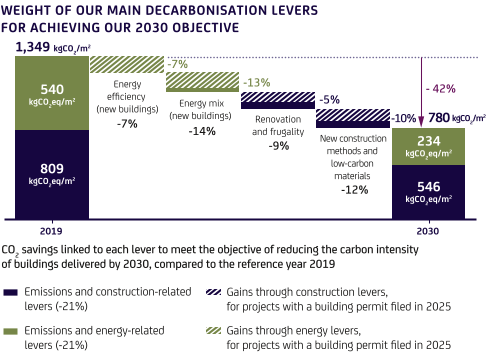 The diagram illustrates the contribution of the main decarbonization levers in achieving the 2030 target for reducing the carbon intensity of delivered buildings. It is a waterfall chart starting from a carbon intensity of 1,349 kgCO₂ per square meter in 2019, aiming to reach 780 kgCO₂ per square meter by 2030, representing an overall reduction of 42%. The reduction is distributed among several levers: Energy efficiency of new buildings, Energy mix of new buildings, Renovation and energy sobriety, Use of new construction methods and low-carbon materials. Each lever contributes cumulatively to the reduction of CO₂ emissions.
The analysis of projects for which building permit applications were filed in 2025 shows that the energy efficiency lever on new buildings led to a gain of 7% compared to the carbon intensity of 2019; the lever related to the energy mix in new projects led to a gain of 13%; refurbishment a gain of 5% and construction methods and low-carbon materials a gain of 10%. Efforts in terms of the energy mix and energy efficiency of new buildings will be maintained, and those relating to refurbishment and new construction methods will be stepped up.
These levers should make it possible to reduce emissions by 73,000 tCO2eq by 2030 compared to the emissions over the life cycle of projects delivered in 2019 through energy efficiency; 146,000 tCO2eq by decarbonising the energy mix; 93,000 tCO2eq thanks to sober construction methods and refurbishment; and 68,000 tCO2eq thanks to the use of low-carbon materials and construction methods(12)
These levers are supported by a cross-functional lever, the support of subsidiaries and the training of employees in changes to the development business lines.
The aforementioned decarbonisation levers are consistent with the climate and transition scenarios selected in the context of Nexity’s resilience study:
- •Lever 1 - The energy efficiency of new buildings is consistent with the objectives of French national regulation RE2020, in force since 2022 and which sets out ambitious decarbonisation thresholds to be met by 2030;
- •Lever 2 - The energy mix of new buildings is based on technological developments and is consistent with a transition of the national energy mix to renewable energies. In ADEME’s four Transition(s) 2050 scenarios, the energy mix in France in 2050 would be composed of at least 70% renewable energies;
- •Lever 3 - Refurbishment and sobriety are consistent with a societal and political change that promotes sobriety, in particular land sobriety, and a shift towards refurbishment and urban renovation. It is consistent with national policies such as the objective of zero net artificialisation by 2050 of the Climate and Resilience Act of 22 August 2021; and
- •Lever 4 - New construction methods and low-carbon materials are consistent with an innovation phase focused on low-carbon construction solutions (low-carbon concrete, wood-concrete mix, wooden structures, bio-sourced insulation, etc.).
The decarbonisation levers mentioned are consistent with the transition opportunities identified (see Section 3.2.1.1 “Climate-related impacts, risks and opportunities (IRO-1; SBM-3)” of this chapter).
Actions to mitigate climate change (E1-3)
Nexity’s strategy in terms of measuring and reducing its impacts on climate change is based in particular on the actions below which correspond to the aforementioned decarbonisation levers.
Actions related to the objective for Scopes 1 and 2:
Reduce emissions associated with the vehicle fleet
The carbon assessment shows that emissions related to the vehicle fleet represented 89% of scope 1 and 2 emissions in 2025.
In 2019, Nexity took out a mobility loan to limit the number of company vehicles allocated. From 2021, an action plan for the electrification of the vehicle fleet was put in place. In order to improve the monitoring of the consumption of its vehicle fleet, Nexity equipped itself in 2024 with a vehicle fleet management tool.
Following findings of an increase in vehicle emissions in 2023, an analysis was carried out in 2024 to define a stricter vehicle policy in order to comply with the reduction objectives for Scopes 1 and 2. A new plan, approved by Executive Management at the end of 2024, was rolled out in 2025 and is coordinated by the Real Estate and Purchasing Department and the Human Resources Department. It includes an increase in the number of hybrid and/or 100% electric vehicles in the fleet and proposals from Crédit Mobilité. This plan will make it possible to achieve the objective of a 47% reduction in scopes 1 and 2 by 2030 compared to 2019.
Reduce emissions associated with office sites
In order to reduce the emissions related to the use of its office sites, a sobriety plan was adopted in 2022 and made permanent: for the main buildings, this includes heating thermostats to be set at 19°C, the automatic switching off of lights and IT equipment at night, and other sobriety actions by Nexity’s Digital Solutions and Innovations Department (DSIN). Several regional office sites are equipped with Technical Building Management solutions to manage the implementation of these measures. Relocations to more energy-efficient regional sites have led to energy efficiency gains. In addition, the Group has signed framework contracts for its supply of green electricity. These framework contracts are accompanied by certificates of guarantee of origin.
Additional actions relating to Scope 3 of the administrative carbon assessment
Reduce emissions related to commuting and business travel
Every year, a commuting questionnaire is sent to all employees to establish their modes of travel and decarbonisation levers. In 2025, 56% of commutes were made using public transport and thus low-carbon, thanks to Nexity's presence in major cities on sites accessible by public transport. Since 2017, the Group has offered a bicycle mileage allowance to reimburse expenses related to commuting by bike (purchases, repairs, etc.).
With regard to business travel, the travel policy was also revised in 2021 to restrict air travel. In 2025, 56% of kilometres covered were by train.
Reduce emissions related to digital uses
Since 2022, actions have been carried out by the DSIN to reduce the carbon footprint of the non-current assets associated with the IT infrastructure, based on the recommendations of the Institut du Numérique Responsable. In order to define and manage the various projects, the DSIN appointed a CSR Manager in May 2020.
The Group's objective is to act on what has the biggest impact and raise awareness among all employees so as to integrate a digital frugality approach into projects and equipment purchases. Extending the life of laptops and mobile phones (scope 3 administrative) is now a reality with the introduction of repairs and refurbishment. In addition, workstations are switched off from 10 pm and the standby time of screens in meeting rooms and printers has been extended (measures impacting scopes 1 and 2 administrative). Awareness-raising campaigns are being rolled out to all employees, providing them with advice and best practices relating to equipment and data storage. The environmentally responsible printing policy in place since 2022 was maintained in 2025, resulting in a reduction in paper consumption. In 2025, the implementation of secure code-triggered printing also had a strong downward impact on print volumes.
Actions related to the objective of reducing the life cycle carbon impact of delivered buildings
Support subsidiaries and train employees on changes to the development business lines (cross-functional lever)
The main challenge for Nexity is a reorientation of project practices, in order to integrate within all projects solutions for reducing CO2 emissions, adapting to the new climate context and preserving biodiversity. It is therefore through training and support for employees in all subsidiaries that the aforementioned decarbonisation levers can be activated, in order to meet the RE2020 outperformance objectives.
With this in mind, the Low-Carbon Deployment Department (within the Construction Department) supports and advises the subsidiaries on how to achieve their objectives by making changes to construction materials and energy solutions for completed buildings.
Nexity’s internal training platform offers several training courses on operational topics such as the deployment of heat pumps, the principles and use of low-carbon concrete, decarbonisation of structural works and finishing work, and the RE2020 regulation. Accessible to all employees, all these training courses aim to provide concrete means of integrating decarbonisation solutions from the planning and design stage of projects.
- •The Purchasing and Services Department, whose mandate has been extended to secure the supply of low-carbon materials, equipment and solutions (wood, low-carbon concrete, joinery, wall and floor coverings, etc.) through industrial partnerships and referencing contracts;
- •The Construction Methods Department, which develops and deploys industrialised and off-site construction methods; and
- •The Low-Carbon Department, which deploys decarbonisation levers and innovations, and measures the achievement of objectives.
Develop high-energy performance buildings (lever 1)
Nexity designs high-energy performance buildings by optimising orientation, insulation, glazing and energy systems. All the Group’s new residential projects are therefore designed to consume only a small amount of energy for heating, cooling, hot water, ventilation and lighting.
The “Essentiel” residential building (24 units), currently under construction in Lyon Confluence, is an innovation in terms of energy efficiency. Its bioclimatic design will maintain an interior temperature of between 22°C and 26°C throughout the year, without heating or air conditioning. A thick covering that limits heat loss and protects against overheating, limewash finishes, ventilation through louvers, and smart ventilation regulation using sensors are some of the bioclimatic principles applied to this project. The apartments in this building were sold under a Real Solidarity Lease, demonstrating a desire to combine the challenges of energy efficiency, climate comfort and affordable housing.
Nexity relies on labels and certifications (HQE, BREEAM, BEPOS, BBCA) to guarantee the energy performance of its projects, with a view to transparency. As part of its commercial and residential activities, Nexity made a very early commitment to the energy and environmental performance of buildings by anticipating regulations and obtaining labels and certifications. This commitment improves the comfort of building users, especially during summer heat waves, thanks to the performance of the buildings.
Implement decarbonised energy vectors (lever 2)
To cover energy needs during the use phase of the delivered buildings (downstream of the value chain), Nexity implements decarbonised energy vectors.
In 2022, Nexity launched the deployment of heat pumps and thermodynamic solutions for heating, cooling and domestic hot water production. By largely using renewable heat from the air or the ground, these solutions allow for significant energy savings and reduce the CO2 emissions associated with the operation of a real estate project by around 80% compared to a gas-fuelled installation.
Thanks to this approach, 68% of the building permits filed by Nexity in 2025 related to projects equipped with a heat pump system for domestic hot water. Nexity has established industrial partnerships with three recognised suppliers of this type of equipment and has trained all employees in their use. This approach helped to reduce the emissions related to use (average Energy CI) of the Group's operations by 51% between 2022 and 2025.
Furthermore, Nexity is researching the use of renewable energies such as photovoltaic panels, geothermal energy, wind power and connections to district heating networks (DHN) with significant shares of renewable energy (more than 60%), for the production of heat, domestic hot water and electricity.
On the Engie Campus, delivered in 2024 in La Garenne-Colombes, 100% green energy is generated mainly from geothermal sources (80% of heating needs and 65% of cooling needs), cooling units and boilers powered respectively by electricity and gas guaranteed to be from renewable sources, and photovoltaic panels.
In December 2025, Nexity and Accenta, a global operator in energy-carbon performance for real estate, created a joint venture to develop geothermal energy in collective housing and accelerate the decarbonisation of the residential sector. Surface geothermal energy, a renewable, local and efficient energy solution, is possible in 97% of the metropolitan area. It makes it possible to heat homes at a low marginal cost, while significantly reducing CO2 emissions. The objective is to contribute to the development of this renewable heat production in the Group's main residential projects.
Develop new construction methods and new low-carbon products (lever 3)
Since 2010, Nexity has developed expertise in wood materials in the commercial market, which was extended to residential projects in 2014. Nexity is developing an affordable low-carbon commercial building, Nex'step, using wood and hemp concrete. The Nex'step concept complies with the 2028 threshold of RE2020 and the first Nex'step building was delivered in 2024 in Saint-Priest.
Regarding Residential real estate, Nexity delivered 620 "Ywood" homes in 2025. This product, developed by Nexity, is based on an industrialised mixed wood/concrete construction system. It reduces emissions by 50% compared to “standard” construction methods. The Ywood construction method includes thermal insulation to exceed RE2020 standards. To mark its commitment to timber construction, both in residential and office buildings, in 2023 Nexity joined the Fibois association and its regional pacts in Lyon, Orléans, Lille, Paris and Strasbourg and renewed its commitment for 2025.
The Group is also developing construction methods involving low-carbon concrete. The Interface project (161 housing units), delivered in 2024 in the 8th arrondissement of Lyon, is the first building in France to be made entirely of low-carbon concrete. The use of low-carbon concrete compared to standard concrete on this project represents a reduction of 640 tCO2.
As part of its deliveries of “Ywood” housing, the Group has for several years been developing off-site two-dimensional construction applied to wood (complete walls with insulation, exterior joinery, façade cladding). In addition, the Group is working off-site to develop two-dimensional mixed wood/concrete buildings, offering a prefabricated concrete structure and wooden façades, like the Merville and Anvin projects. 428 Ywood units with off-site construction were delivered in 2024, i.e. a total of 2,947 units since 2014.
The partnership signed in 2023 with the Carrefour group, to develop 12,000 housing units on 74 sites, includes a strong environmental component and off-site construction, and should make it possible to widely deploy these innovative construction methods proven by Nexity.
The development of new construction methods and new low-carbon products allows Nexity to strengthen its position as a leader in low-carbon construction, thus setting itself apart from its competitors thanks to its less emittive, innovative solutions.
In March 2025, Nexity and Maître Cube, a company specialising in off-site timber construction, signed a strategic partnership with the shared ambition of completing 30,000 square metres of off-site timber construction, corresponding to around 500 units by 2028. This partnership has many economic and environmental benefits:
- •It anticipates the 2028 threshold of RE2020 by guaranteeing a reduction in the carbon impact of the housing units produced by the Group;
- •Using a modular 2D construction method in the design and construction phases, it then acts on the operational efficiency of projects, in terms of the quality of design, construction and use of buildings, as well as reducing time on-site and disruption to local residents; and
- •Finally, it helps to control the cost of housing and strengthens Nexity's ability to consistently produce quality and affordable housing for its customers.
In 2025, the Group’s low-carbon construction work was once again recognised by the BBCA association at its 2025 Awards. For the 7th consecutive year, Nexity group ranked first in the following categories:
- •Leading developer in number of projects delivered with the “BBCA” label since 2016 and in 2025;
- •Leading developer in terms of “BBCA” square metres delivered since 2016 and in 2025 (all uses combined); and
- •Leading residential real estate developer in terms of “BBCA” square metres delivered since 2016 and in 2025;
Nexity has ranked second in the rankings for BBCA-certified office square metres since 2016 and in 2025.
Furthermore, in 2021, Nexity sponsored the proposal made to the French Ministry of Ecological Transition and Territorial Cohesion in 2021 for a low-carbon label methodology to value the carbon sequestration achieved through the use of bio-sourced materials in construction.
Develop refurbishment activities (lever 4)
In 2023, Nexity launched Nexity Héritage, its brand dedicated to urban regeneration. By transforming artificialised land, refurbishing and elevating existing buildings, and enhancing biodiversity and heritage, Nexity Héritage embodies the Group’s commitment to “building the city on the city”. This aim of this approach is to limit urban sprawl, reduce the carbon footprint and preserve ecosystems. 4% of building permits filed in 2025 concerned refurbishment projects.
A key partnership with Carrefour, signed in July 2023, provides for the redevelopment of 74 sites across France, marking a first large-scale national urban regeneration project.
Reflections on decarbonisation in future years
In 2024, Nexity was a partner of the Real Estate NZI (Net Zero Initiative) coordinated by Carbone 4, which resulted in the publication in June 2024 of a methodology specific to real estate development. Joint discussions led to recommendations for the recording of emissions associated with this activity, with discussions on avoided emissions and stored carbon (bio-sourced construction materials).
Investments for the implementation of the action plan
For Scopes 1 and 2, the main costs would be related to the vehicle fleet. The strategy rolled out from 2025 provides for annual savings of approximately 16% compared to previous years.
As a developer, Nexity’s transition levers mainly lie in its ability to adapt the design of its projects and to develop new practices for all its business lines in each project. As it does not operate a real estate business, the activation of the transition levers does not concern CapEx but new ways of working with the project design and construction ecosystem. Similarly, with regard to alignment with the EU Taxonomy (see Section 3.2.4 "Sustainable finance and EU Taxonomy of Sustainable Activities"), Nexity's action plan is to train its business lines in incorporating these requirements into the development of operations. Nexity does not have any significant CapEx expenses related to economic activities dependent on coal, oil and gas. Nexity has maintained the transitional provision to omit the publication of information relating to the future financial impacts related to the E1-9 data points.
- •Studies by and support from external firms and design offices;
- •Studies in the design phases of development projects;
- •Support provided by the CSR Department and the Construction Department (training, studies, monitoring tools); and
- •Internal training and awareness-raising costs dedicated to guiding the corporate culture towards the transition of its production.
The transition plan may have an impact on construction costs (works purchases), but the fact that Nexity has anticipated low-carbon design (the average carbon weight of projects delivered in 2019 was already at the 2022 threshold of the RE2020) means the Group is able to produce low-carbon buildings at controlled costs. Dedicated organisation with the Construction Department and its Purchasing Division also enables the signing of partnerships and the ability to carry out referencing or even Group purchases, thus allowing the construction cost of projects to benefit from the Group’s size.
The transition plan is integrated into and aligned with Nexity's overall business strategy, which consists of defending a low-carbon real estate offer accessible to everyone, everywhere in the country. The business strategy is based on the development of a supply of desirable and affordable low-carbon housing, which can create a growing demand for low-carbon housing.
3.2.1.3Climate change adaptation
Climate change adaptation is a strategic imperative, given that rising temperatures and increasingly frequent extreme weather events are now set to continue for several decades, even in scenarios of ambitious emission reductions. Mitigation makes it possible to contain the extent of warming in the long term, but it cannot, on its own, protect societies, economies and ecosystems against the already inevitable impacts (IPCC Sixth Assessment Report, 2023).
Mitigation and adaptation must therefore be considered as two inseparable components of the same climate policy: the first aiming to limit the severity of future disruptions, while the second aims to manage and reduce the current and future consequences of such disruptions.
Thus, Nexity group's Impact2030 environmental policy includes a climate change adaptation policy that is complementary to the climate change mitigation policy described above.
Resilience study
In 2024, the CSR Department organised a study of Nexity group’s resilience to climate change with an expert consulting firm in order to determine the various impacts of climate change on its business model. The study seeks to assess the challenges to be addressed for the development activity to anticipate and adapt to the context of climate change and transition.
This resilience study, partly based on the OCARA (Operational Climate Adaptation and Resilience Assessment) methodology developed by Carbone 4, assesses the exposure and vulnerability of the Company’s value chain and business model to the impacts of climate change. It identifies, for different time horizons (2050, 2070, 2100) and according to the IPCC's(13) RCP 8.5 warming scenario, the physical risks weighing on construction site conduct and on delivered buildings as part of the real estate development activities.
The study also qualified the risks and opportunities resulting from a transition context marked by the imperatives of climate change mitigation and adaptation, on a 2050 time horizon.
The table below presents the methods and scenarios used in the resilience study, which is detailed below:
Nexity resilience study
Type of risk
Scenarios and time horizons
Methods
Scope of the analysis
Climate-related physical risks
- •Heat
- •Drought and shrinkage-swelling of clays
- •Precipitation and flooding
- •Fire outbreaks
- •Extreme cold
IPCC RCP 8.5 scenario
Short term: 2050
Medium term: 2070
Long term: 2100
OCARA (qualitative approach to macroprocesses)
Macroprocesses relating to construction sites and buildings delivered for a sample of 6 representative projects spread across the country
IPCC RCP 8.5 scenario
Time horizon: 2050
Batadapt (quantitative approach for calculating the exposure of a large sample of projects)
Large sample of 1,030 projects spread across the country
Climate-related transition risks and opportunities
- •Political and legal risks,
- •Technological risks,
- •Market risks,
- •Reputational risks
4 prospective socio-economic scenarios put forward by ADEME(14) in its Transition(s) 2050 study.
Time horizon: 2020 to 2050
The probability of each risk is estimated in each of the four transition scenarios proposed by ADEME in its Transition(s) 2050 study. An average probability was calculated and the potential impacts on the business model estimated. This analysis was based on "gross risks".
Nexity's value chain
Climate-related physical risks for Nexity
Climate scenarios
The resilience study conducted by the Group is based on the RCP 8.5 scenario developed by the IPCC, the highest emissions scenario. It proposes projections for the 2050, 2070 and 2100 time horizons. The RCP 8.5 projections inform the resilience study in a high warming scenario, projecting a greater frequency and intensity of climate-related physical risks(15).
The time horizons chosen ensure that the lifespan of a given project is covered, in accordance with French regulations on the calculation of building life cycles (50 years for RE2020). The choice of the medium- and long-term horizons of 2070 and 2100 ensure a robust study, which includes the consideration of climate changes until the end of the century to feed the resilience strategy of the Group’s activities.
Exposure of Nexity’s real estate projects to climate-related physical risks
Physical climate risks, which are set to intensify in all emission scenarios, impact Nexity's value chain, posing a risk of economic loss for the Group. In order to study the impact of physical risks, two main processes within the value chain of a project were considered:
- •The construction site as an important phase in Nexity’s value chain. The vulnerability of construction-related activities to climate-related hazards was analysed, including the planning and execution phases and logistics; and
- •The building delivered, as a result of the development activity. This involves examining the resilience of buildings resulting from Nexity’s activity in the face of climate-related hazards during their use phase by customers.
Macro-processes were identified for each of the two perspectives using the OCARA method. This dual approach made it possible to identify the adaptation levers necessary to strengthen the resilience of Nexity’s business model and the resulting buildings, to the climate both now and in the future.
The resilience study therefore focuses on the processes that are vital to Nexity’s value chain, namely the integrity of construction sites and completed buildings. Nexity’s administrative sites are not yet included in the scope of the analysis.
The resilience of supplies for construction sites and for completed buildings was analysed. Nexity’s strong ability to adapt in this area (several suppliers for the same service, framework contracts, solid relationships with suppliers) limit the risk on these processes. The level of risk borne by the suppliers themselves (their exposure and vulnerability) was not studied as part of this resilience study.
Qualitative approach
The analysis of the level of risk for construction sites and delivered buildings, using the OCARA method, is based on knowledge of the development activity and was supplemented by interviews conducted with the Group’s project managers. A sample of projects was identified by ensuring that they presented the following typological criteria: tertiary and residential projects, under construction and recently delivered, using different construction methods (concrete, mixed wood-concrete), geographical positioning and exposure to different hazards.
For each project studied, the study measured the impact of climate hazards (from IPCC scenarios) on the macro-processes identified by the OCARA method. Sensitivity points and adaptation capacities were identified for the projects studied, in relation to the hazards of high temperatures, heavy rainfall, flooding, strong winds, drought and shrinkage-swelling of clays.
For example, heat waves, which are likely to intensify in the climate scenarios studied, are a sensitivity factor on construction sites: they can cause a deterioration in outdoor working conditions, or even a deterioration in the performance of construction site machinery (overheating, breakdown), which could lead to site interruptions. Possible responses to this known risk of heat waves include: adaptation of working hours, provision of sun protection kits for workers, a good water supply for the worksite, adaptation of living quarters to high temperatures. Exposure to high temperatures is also a sensitivity factor for the delivered buildings. Heat waves can create a risk of thermal discomfort inside buildings, which can cause significant discomfort for users and pose risks to their health. Adaptation capacities specific to the building’s design could include for example: building orientation, insulation, high albedo surfaces, open-plan housing and solar protection systems. These design principles are discussed in the section "Actions related to the adaptation policy".
The risk levels for each hazard were determined by cross-referencing two elements: the probability of occurrence of the hazards in the IPCC scenarios; and the sensitivity of the project to climatic hazards (which takes into account the capacity to adapt). The level of resilience of construction sites to hazards was also studied. The ability to adapt to site hazards, inherent in the real estate development business, is the main source of resilience in operations. Various measures may be deployed depending on the risks identified: different working hours, anticipation of groundworks, etc. Measures that can be taken to deal with physical risks vary and depend on the characteristics of each project and its location. The adaptation of delivered buildings from the design phase also benefits from the performance requirements for new builds (RE2020 regulation includes a strong requirement for summer comfort during heat waves).
The lessons learned from this study fed into the discussions for the development of the Group's adaptation strategy, which was formalised in 2025.
Quantitative approach
A quantitative analysis was also carried out using Bat-ADAPT, a geographical and prospective tool for diagnosing the resilience of real estate activities in the face of climate change. The Bat-ADAPT tool is the result of the work of the Observatoire de l'Immobilier Durable (OID); Nexity has been contributing to the financing and roll-out of this tool since 2023.
An analysis of exposure to climate-related hazards was carried out on a sample of 1,030 Nexity project sites in mainland France recently delivered or under construction at the end of 2024, using their geographical coordinates.
The Bat-ADAPT tool used made it possible to consider the following five climate-related hazards, which represent major challenges for real estate in France:
- •Heat: heat waves pose health risks to building users, requiring adaptation for summer thermal comfort;
- •Drought and SSC(16): droughts can lead to structural damage by causing the clay to shrink and swell and slow down the construction process in the event of water restrictions. Combined with high temperatures, they can be a source of water stress on construction sites or for users;
- •Precipitation and flooding: land located in areas liable to flooding is at risk of temporary submersion, causing material damage to users and depreciation of the value of the property;
- •Fire outbreaks: proximity to forested or planted areas at risk of wildfires increases the threat to homes and infrastructure; and
- •Extreme cold: roads, pipes and electrical systems can be damaged, compromising the operation and safety of a building.
Other relevant climate-related hazards for real estate in France and Nexity’s value chain, such as marine submersion, storms, strong winds and landslides, should be able to be taken into account in the coming years in Bat-ADAPT.
The Bat-ADAPT tool makes it possible to consider different global warming scenarios, including the RCP 8.5 scenario, over various time horizons (2030, 2050, 2070 and 2100).
The proportion of sites in the 1,030 selected projects with a very high exposure to climate-related hazards by 2050 in the RCP 8.5 scenario is presented in the table below. These are site exposure data, which therefore do not take into account the actions to adapt to these risks that may be implemented on the building.
Results of the analysis of the exposure of the Group’s project sites to the various hazards:
Heat
Drought and shrinkage-swelling of clays
Precipitation and flooding
Wildfires
Extreme cold
Percentage of the sample of projects exposed to climate-related hazards (Bat-ADAPT “very high exposure” category)
44%
63%
28%
12%
0%
Current design practices for apartment projects aim to take into account most of these risks. Systematising the consideration of these risks is one of the priorities of the Group's adaptation policy (see the section on the objectives and actions of the adaptation policy). Carrying out a Bat-ADAPT analysis from the start-up phase of the project enables their identification.
Intersection of qualitative and quantitative approaches
The cross-referencing of the sensitivity factors from the qualitative analysis (OCARA methodology) with the exposure data from the quantitative analysis (Bat-ADAPT tool) made it possible to identify an overall level of risk(17) per climate-related hazard by 2050. The main results show medium to high risks(18) for the most significant hazards for Nexity: high temperatures, extreme precipitation and flooding, and droughts and risks of SSC.
Most significant climate-related
hazards for NexityMost vulnerable processes in Nexity’s value chain (upstream and downstream)
High temperatures
Outdoor working conditions and the operation of construction machinery (upstream) Thermal comfort of occupants of delivered buildings (downstream)
Droughts and shrinkage-swelling of clays
Working conditions and water supply to construction sites (upstream)
Structural integrity and delivered buildings (downstream)Extreme precipitation and flooding
Integrity of the construction site area and access roads, storage of materials on the site (upstream) Integrity of the basements and ground floors of buildings delivered (downstream)
Climate-related transition risks and opportunities for Nexity
The transition of society and the economy towards carbon neutrality is creating a new context, to which Nexity must adapt. So-called “transition” risks may be political, legal or technological in nature, or relate to the market or the Company’s reputation. Opportunities are also emerging in a society in transition: energy efficiency and new energy sources, market opportunities and the development of a new offering, opportunities for expertise related to adaptation.
Transition scenario
The transition risks and opportunities were assessed in the light of the prospective socio-economic scenarios presented by ADEME(19) in its Transition(s) 2050 study. Specifically adapted to the French climate, ADEME’s scenarios benefit from a transparent methodology, wide recognition by economic and institutional players, and are designed in line with the national energy and climate transition objectives (SNBC(20) and PEE(21)). As Nexity operates almost exclusively in France, these transition scenarios at national level are adapted. In addition, they take into account the challenges of Nexity’s business sector. The four scenarios propose four paths to France’s carbon neutrality in 2050. Adopting to varying degrees the paths of sobriety, cooperation, and technological adaptation, they anticipate changes in regulations and public policies that will directly impact companies operating in France. The horizon that these scenarios have in common is that of a gradual economic and societal transition to carbon neutrality, between the years 2020 and 2050. These scenarios are based on climate projections that predict a +2.1°C temperature increase by 2100.
Transition risks
Transition risks specific to Nexity's value chain have been identified and classified as they constitute a risk of economic loss. The probability of each risk was estimated in each of the four transition scenarios proposed by ADEME in its Transition(s) 2050 study (see Section 3.2.1.1 “Climate-related impacts, risks and opportunities (IRO-1; SBM-3)” of this chapter). An average probability was calculated and the potential impacts on the business model estimated. This analysis was carried out on a “gross risk” basis without taking into account the current pivot of Nexity’s business model towards urban regeneration.
Based on this analysis, the following transition risks have a high to very high impact and a high probability by 2050:
- •Rising construction costs due to the growing demand for low-carbon materials (not addressed in ESRS E1, but covered in section ESRS E5 of this document);
- •Reduction in demand for new construction towards demand for renovation;
- •Increased constraints on new construction due to the limitation of urban sprawl; (not addressed in ESRS E1, but covered in section ESRS E4 of this document); and
- •Increased constraints related to the technical design of buildings (energy performance, materials).
Transition opportunities
Opportunities of different kinds arise from the transitional context. Several categories of opportunities have been identified: energy efficiency opportunities, opportunities for the development of new products and services, market opportunities, opportunities related to the ability to adapt projects to climate conditions. The resilience study identified, by comparing these types of opportunities with the trends of the four Transition(s) 2050 scenarios, the opportunities specific to Nexity’s value chain. The probability of each opportunity was estimated in each of the four scenarios. An average probability was then established, as well as a level of impact. The following transition opportunities have been identified as having a high to very high impact on Nexity’s model, and having a very high probability of occurrence:
- •Development of low-carbon, highly resilient buildings at controlled costs;
- •Ability to become a player in regional resilience; and
- •Development of modular and multifunctional projects, shared housing projects (not addressed in ESRS E1, but covered in section ESRS E5 of this document).
Climate change adaptation policy (E1-2)
The resilience study has thus made it possible to identify a series of physical and transition risks induced by the context of climate change. In order to adapt to these risks, Nexity group has developed a policy to prepare a strategy for adapting its business model to climate change. The Group's adaptation policy aims to change its practices to further integrate the anticipation of climate change into its businesses and reduce its vulnerability to climate risks.
The study on the resilience of operations and the business model, initiated in 2024 and finalised in early 2025, forms the basis for the development of Nexity group’s adaptation strategy. In 2025, several actions were taken to define objectives and initiate change management.
The adaptation policy is integrated into the Group's Impact2030 environmental policy in its climate pillar. Its methods and objectives were presented at the first Impact2030 Committee meeting – a committee bringing together Executive Management, the CSR Department and the Regional Departments – held in July 2025.
Climate change adaptation targets (E1-4)
Objectives relating to the adaptation policy
Objective of systematising resilience analysis
As part of the Impact2030 strategy, an objective of systematising the analysis of exposure and vulnerability to risks has been defined: 100% of resilience analyses carried out for all new projects.
The identification and analysis of climate-related physical risks in Nexity’s operations has been done since 2022 using the Bat-ADAPT tool. Based on the geographical coordinates of a project, the software makes it possible to visualise exposure to climate-related hazards representing challenges for Nexity’s value chain, over several time horizons(22) and in high-emission scenarios(23). In order to take into account the risks identified during the exposure analysis in the design of buildings, Bat-ADAPT can simulate the vulnerability of a project to each hazard, based on its main construction and programmatic characteristics.
Nexity finances the development of Bat-ADAPT as a member and sponsor of the OID's Building Adaptation Programme. The CSR Department thus participated in the overhaul of the vulnerability matrices during workshops with the OID in 2025, to adapt it to the challenges faced by developers.
Objective relating to the level of climate risk of operations
The objective is that Nexity's new projects do not present a "very high" risk to the hazards of high temperatures, flooding and forest fires on Bat-ADAPT. This risk is measured in Bat-ADAPT ("cross-analysis", the result of the cross-referencing of exposure and vulnerability). This objective can be achieved with a design that incorporates basic principles for adaptation to these hazards: avoid façades with a high proportion of glass, opt for high albedo coatings, install solar protection, install flood protection systems, plant greenery around the building, etc. Bat-ADAPT makes recommendations for adaptive actions and allows for simulations to improve the vulnerability of a building according to the actions implemented. These simulations and recommendations for adaptive actions, supported by the Guide to Adaptive Actions developed by the OID, help with decision-making while highlighting the importance of a design that incorporates adaptation.
Actions and resources for climate change adaptation (E1-3)
Actions in favour of the adaptation policy
Signing of the Commitment Charter for Climate Change Adaptation
Based on the work of the OID and its signatories, the Commitment Charter for Climate Change Adaptation was signed on 13 November 2025 by Nexity, alongside Bouygues Immobilier, Icade, La Poste Immobilier, SFL and the OID. The aim of this Charter is to accelerate the implementation of concrete, objective and monitored actions, and recommend tools for steering an adaptation strategy. The signatories will meet from 2026 to share feedback and collectively advance the adaptation of the French real estate portfolio.
Conferences and training
The CSR Department carried out work to put climate change adaptation at the heart of the Group's shared culture in 2025, including the organisation of conferences and training for all employees.
An online training course, "VISA Adaptation", was developed by the CSR Department and La Cité (internal training body). This 20-minute training course bridges the gap between climate science and the Group's adaptation objectives. It aims to answer, for all employees, the following questions: “Why adapt? What to adapt to? What tools to use to adapt?”. The training defines the concept of climate change adaptation and its relationship with mitigation, addresses the IPCC scenarios and their link with the intensification of hazards, the conclusions of Nexity's resilience analysis, and introduces the Bat-ADAPT tool. It aims to serve as a shared reference on the subject.
With a view to engaging employees and creating meaning around a complex subject, the CSR Department and La Cité also organised a series of three conferences on the theme of adaptation in 2025. The aim was to address this multiscalar subject by narrowing the analysis: observation on the need for adaptation on a global scale, the challenges of adapting in French regions, and the challenges and solutions for buildings. The conferences were broadcast live to all employees. The table below presents the speakers and the topics covered by this series of conferences.
No. and date
Conference theme
Speakers
Conference 1: Global Scale
April 2025
Climate change: what to expect and how to adapt?
François Gemenne, political scientist, researcher, former co-author for the IPCC
Conference 2: Regional Scale
September 2025
How are the regions adapting to climate change?
Round table: Hélène Peskine - Deputy CEO of CEREMA; Sonia Lavadinho - urban anthropologist; Jean-Luc Porcedo - Managing Director of Nexity Transformation des Territoires
Conference 3: Building Scale
December 2025
Building for tomorrow: urban planning and architecture in the face of climate change
Round table: Maud Caubet - architect; Frédéric Bonnet - architect
In 2023 and 2024, around fifty of the Group’s CSR officers were trained in Bat-ADAPT and since then have helped to roll out the tool within the subsidiaries. In 2025, with the new objectives presented above, a new training course was developed for all employees. Training all developers and project managers in the tool is an objective for 2026.
Nexity Guide to climate change adaptation solutions
In order to integrate the challenges of adaptation into the design of Nexity projects, in 2025, the CSR Department began creating a Guide to climate change adaptation solutions, supported by the design offices Pouget and Urban Water. This guide will be finalised and distributed in the first quarter of 2026. It focuses on making adaptation solutions to the main risks identified in the resilience analysis fully operational. To this end, the guide will present around twenty technical solutions such as ceiling fans, solar protection and greywater treatment with regard to their performance, carbon footprint and cost in the project economy. It will be complementary to the OID Guide to Adaptive Actions, which aims to address in more detail the technical and economic feasibility of the solutions favoured by the Group.
Integrating adaptation innovations into projects
Aware of the impact of repeated droughts due to climate change, which are having an increasing impact on urban development, Nexity and Odalie (a joint venture between the Saur group, an exclusive player in the water sector, and the French start-up InovaYa) have signed a framework agreement to promote the inclusion of Odalie's innovative solutions in Nexity's new build projects. This partnership will enable the deployment of Aquapod, a greywater management solution(24) in buildings developed by Nexity.
The Aquapod solution makes it possible to treat part of the building's greywater with the aim of reusing it (concept of the reuse of treated wastewater (REUT) made possible by the publication of a decree on 12 July 2024). The solution creates a new cycle for this water, which allows buildings to recover and reuse up to 45% of the water consumed. The treated water replaces the drinking water from the network to supply new uses: toilet water, watering of green spaces or exterior cleaning of common areas. A firm believer in the need to save drinking water, Nexity has signed a framework agreement with Odalie to promote the integration of Aquapod in future projects in which the Group is involved, as well as water solutions tailored to the specificities of buildings. As such, Odalie and Nexity are working to meet the needs of local authorities, relieve the strain on this resource, and thus rebalance the water management model in the regions, with a view to adaptation.
Develop the "Essentiel" building
Adaptation to high temperatures is at the heart of the design of the "Essentiel" residential building (24 housing units), currently under construction in Lyon Confluence. Its bioclimatic design will maintain an interior temperature of between 22°C and 26°C throughout the year, without heating or air conditioning. A thick covering that limits heat loss and protects against overheating, limewash finishes, ventilation through louvers, and smart ventilation regulation using sensors are some of the bioclimatic principles applied to this project.
The apartments in this building were sold under a Real Solidarity Lease, demonstrating a desire to combine the challenges of energy efficiency, climate comfort and affordable housing. In 2025, Nexity and In'li, a subsidiary of the Action Logement group, joined forces to build the first "Essentiel" building in the Paris region. This innovative project, consisting of 35 housing units, will offer employees and young professionals in La Garenne-Colombes high quality accommodation, at controlled rents and exemplary from an environmental point of view. This new project involves a collaboration between Nexity's teams in Lyon and those in the Paris region, demonstrating synergy in the development of typologies adapted to hot weather.
Thus, the Group's adaptation policy has a positive impact on user comfort. The adaptation of buildings delivered must ensure a positive impact on the comfort, safety and health of users, despite the context of climate change, and over the life of the building.
3.2.1.4Methodological note and regulatory tables
Methodology for preparing the 2025 carbon assessment (E1-5; E1-6)
Background
Nexity’s carbon assessment presents specificities related to the nature of its activities. It consists of:
- •Emissions related to its administrative sites: these are internal scope 1 and 2 emissions on the one hand (fuel consumption of the vehicle fleet, heating of offices, etc.), and external scope 3 emissions on the other (non-current assets, purchases of services, etc.); and
- •Emissions related to the life cycle of the delivered buildings by its development activity: these are external Scope 3 emissions due to its role as principal in the context of real estate projects.
To carry out the Company’s carbon assessment, a dual methodological approach is applied, with the calculation of a so-called “administrative” carbon assessment using the ADEME Bilan Carbone® method, and the calculation of emissions linked to delivered buildings according to the regulatory method of the RE2020 specific to the life cycle (construction and use) of buildings. It should be noted that the life cycle emissions of a building developed by Nexity are recorded in the year of delivery. It should also be noted that ADEME’s Bilan Carbone® methodology is compatible with the GHG Protocol and that a transposition into the GHG Protocol is carried out based on RE2020 calculations for the life cycle of delivered buildings. To ensure the consistency and consolidation of the two emission footprints, the RE2020 data is converted using data conversion ratios into the GHG Protocol.
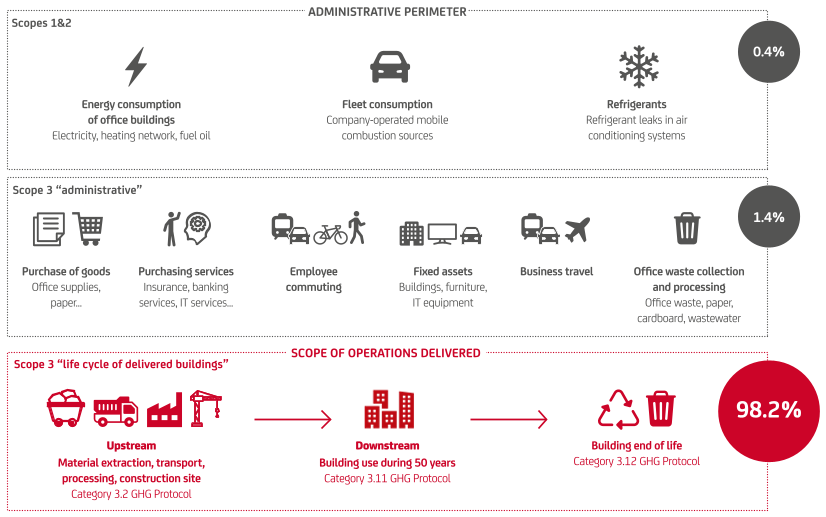 Presentation of the breakdown of greenhouse gas emissions across Scopes 1, 2, and 3, distinguishing between administrative activities and delivered operations. It shows that emissions related to Scopes 1 and 2, primarily associated with energy consumption in office buildings, the vehicle fleet, and refrigerants, represent a very limited share of the overall carbon footprint. Administrative Scope 3, which includes purchases of services, employee travel, capital expenditures, and office waste management, also remains marginal compared to total emissions. In contrast, the diagram clearly highlights that the majority of the carbon footprint comes from Scope 3 related to the life cycle of delivered buildings. The Group's carbon impact is therefore primarily linked to real estate operations and the life cycle of buildings, far more than to administrative activities.
Calculation methods
Calculation method and scope of the administrative carbon assessment
As Nexity does not carry out real estate activities, the first part of the carbon assessment concerns only emissions related to the Company’s administrative activities (use of offices, business travel, purchases of services, etc.). The Group carries out this calculation using the ADEME Bilan Carbone® methodology, which is compatible with the GHG Protocol, making it possible to obtain data in GHGA (25) and GHG Protocol formats. This “administrative” carbon assessment covers scope 1 and 2 emissions, and a portion of scope 3 emissions.
In 2025, the CSR Department installed the "Sweep" carbon calculation tool, a recognised SAS solution. The software has been configured to reproduce the accounting method used in 2024 for the "administrative" scope (Bilan Carbone® method set up with the Ekodev design office). The emission factors are mainly those taken from the ADEME V23.7 database.
All emissions due to the administrative activities of Nexity and its consolidated subsidiaries are taken into account in the administrative carbon assessment. The consolidated Group’s administrative scope changes from one year to the next, depending on subsidiary purchases and sales. Isoperimetric carbon assessments have been performed in order to ensure consistency in inter-annual comparisons and to allow for comparison with the reference year. In 2025, the companies Accessite and Service Personnel were removed from the Nexity group scope, respectively on 1 October and 30 July 2025. Their respective activities are taken into account until these dates in the calculation of the 2025 administrative carbon footprint.
Scope 1 corresponds to direct emissions from the combustion of fuels for the vehicle fleet, gas and fuel oil consumption and refrigerants. It should be noted that the Company does not own the offices it occupies. Scope 2 encompasses indirect emissions related to energy consumption, such as electricity and heating and cooling systems for offices. Finally, scope 3 includes all other indirect emissions related to the Company’s administrative sites, including business travel, employee commutes, non-current assets (vehicle fleet and surface area of offices occupied), the purchase of goods and services such as furniture and supplies (excluding the purchases of works which are recorded in scope 3 life cycle of delivered buildings).
Details on scope 2: market-based/location-based
79% of the electrical energy consumption of Nexity's office buildings is governed by a framework agreement accompanied by guarantees of origin covering 100% of green electricity consumption. Thus, the corresponding emissions are considered in the Scope 2 market-based calculation.
Assessment of “life cycle of delivered buildings” emissions
The second part of the carbon assessment concerns the buildings that Nexity has built. As such, the Company measures the greenhouse gas emissions associated with the complete life cycle of the delivered buildings, over a conventional period of 50 years. This assessment of indirect Scope 3 emissions is based on the RE2020 regulation implemented in 2022, which includes a methodology for assessing the carbon impacts of new buildings.
- •The construction phase, which includes materials (extraction, processing and transport of materials to the site, as well as on-site energy consumption for machinery and construction equipment);
- •The use phase, which includes energy consumption by future occupants for their heating, lighting and domestic hot water needs, as well as the upkeep and maintenance of buildings; and
- •Lastly, the end-of-life of the building includes demolition, waste transportation and recycling.
Calculation method and scope of the life cycle carbon assessment of real estate projects
Greenhouse gas emissions related to the life cycle of residential and office delivered buildings during the year by Nexity are calculated taking into account the entire life cycle of the buildings, over a conventional period of 50 years.
The life cycle emissions of the delivered buildings are calculated using the in-house Carbone 20 tool, which uses a simplified LCA(26) method based on the RE2020 methodology (description of construction methods and energy solutions planned or implemented) to determine the carbon impact over the life of the buildings. The regulatory calculations imposed by RE2020 are then used.
- •The “construction” carbon intensity (construction CI), expressed in kgCO2 per square metre: this corresponds to the carbon footprint of construction materials and equipment assessed from extraction to end-of-life (Life Cycle Analysis or LCA), using data from the INIES database (Information on Environmental and Health Impacts), FDES (Environmental and Health Declaration Forms) or PEP (Product Environmental Profiles); and
- •The “energy” carbon intensity (energy CI) expressed in kgCO2 per square metre: this corresponds to the carbon footprint of the energy consumed during the use phase of the delivered buildings, over a lifetime of 50 years, using conventional environmental data from RE2020.
The data calculated according to the RE2020 methodology (dynamic LCA) are then transposed according to the GHG Protocol methodology (static LCA), using cross-referencing ratios developed for Nexity by Carbone 4 and Elioth in 2023.
The table below shows the cross-referencing between the RE2020 indicators and the GHG Protocol items:
Carbon indicators of the RE2020 calculation method
Corresponding category
£in the GHG Protocol methodologyDescription of the emissions item
in Nexity’s value chain (upstream/downstream)Construction CI excluding end of-life of buildings
3.2 Capitalised assets (upstream)
Embodied emissions in delivered buildings by Nexity
Construction CI
of end-of-life of buildings3.12 End of life of products sold (downstream)
Emissions generated by the deconstruction or demolition of delivered buildings by Nexity after their use phase
Energy CI
3.11 Use of products sold (downstream)
Energy consumption during the use phase of delivered buildings over a conventional period of 50 years
Emissions by project are consolidated at Group level by the Construction Department each quarter for all projects delivered.
For the 2025 fiscal year, the calculation of the absolute value of the carbon footprint of residential projects was carried out on the basis of secondary data. Work to strengthen data reporting has been carried out in order to improve the reliability of the calculation. Projects for which we do not have data were assigned the most conservative RE2020 and GHG Protocol emission factors. For office buildings, the calculation was based purely on secondary data (no extrapolated data). In the future, data will be increasingly precise with more accurate regulatory calculations (RSEE).
The carbon footprint of delivered buildings includes emissions from real estate development projects under Nexity’s exclusive control and those from joint developments where Nexity has operational control. This does not include emissions from joint development projects over which Nexity does not have operational control.
The reporting date of the Company’s financial statements is 31 December 2025, and the carbon assessment covers the same period. No significant events or changes in circumstances relating to carbon emissions are to be reported for 2025.
Methodological details relating to the definition and consistency of objectives
Nexity has no locked-in emissions because it does not own any plants or machinery and does not plan to acquire new sites or non-current assets for its activities.
In order to set objectives for 2030 in absolute value, Nexity made assumptions in 2022 with regard to activity growth, in FTE for Scope 1 and 2 and in square metres delivered for the Scope 3 life cycle of delivered buildings.
The Group has implemented rigorous measures to ensure the consistency and accuracy of its environmental data, by regularly recalculating the scopes covered and ensuring that the reference values are representative of the activities.
In order to ensure consistency in the monitoring of decarbonisation objectives, it was necessary to ensure that the reference values of our SBTi objectives (values for the year 2019) correspond to the same scope and cover the same activities as the annual carbon assessment.
For scopes 1 and 2, following the disposal of the Property management activity (SP) which represented 30% of the workforce, on 2 April 2024, the reference year 2019 was recalculated and verified by an independent third party in June 2024. Following the sale of the Nexity Property Management business on 31 October 2024, the reference year 2019 and the year 2024 were recalculated and verified by an independent third party in June 2025. The sale of Accessite on 1 October 2025 and that of Service Personnel (Weekin) on 30 July 2025 had no impact on the administrative carbon footprint beyond 5%.
Scope 3
Scope 3 emissions relating to the administrative carbon assessment are reported under the following items: Purchases of goods and services (3.1), Capitalised assets (3.2), Fuel and energy activities (not included in Scopes 1 and 2) (3.3), Waste generated by activities (3.5), Business travel (3.6) and Employee commuting (3.7). ADEME emission factors are applied according to the Bilan Carbone® methodology.
Scope 3 emissions relating to the life cycle of projects are recorded under Capitalised assets (3.2), Use of products sold (3.11) and End of life of products sold (3.12). Their calculation method is detailed in the previous chapters.
The following Scope 3 GHG Protocol items do not relate to Nexity’s activity: Upstream leased assets (3.8), Downstream transport and distribution (3.9), Transformation of products sold (3.10), Downstream leased assets (3.13), and Franchises (3.14). Emissions relating to the transportation of materials are recorded under item 3.2 Capitalised assets (including embodied emissions in delivered buildings by Nexity) and not under item 3.4.
Within the Group, almost all companies accounted for using the equity method are companies that carry out real estate projects. They have no associated staff or infrastructure, so their Scope 1 and 2 emissions are zero. Indirect emissions (Scope 3) resulting from these companies carrying out real estate projects are included in the calculation of Scope 3 emissions associated with the life cycle of the delivered buildings.
Two companies(27) accounted for using the equity method are not included in this category of companies that carry out real estate projects and do employ staff. These companies' administrative emissions are estimated and included in the Group's carbon assessment under item 3.15 Investments(28).
Concerning the Group’s operating activities (Studéa and Edénea residences), their Scope 3 carbon footprint has not yet been calculated. With regard to urban planning activities, pilot studies are underway with Efficacity’s Urban Print tool to estimate the corresponding Scope 3 carbon footprint.
Emissions related to the administrative carbon footprint are calculated using primary data collected from employees (88%) and extrapolated data (12%). Scope 3 emissions related to the life cycle of projects are calculated using secondary data (FDES forms, PEP and RE2020 data).
Biogenic emissions
Nexity is not concerned by the combustion or biodegradation of biomass under its Scopes 1 and 2, because no biogas or biofuel is consumed to heat the Group’s buildings or as fuel for its vehicles.
For Scope 3, the methodology for calculating the life cycle carbon footprint of delivered buildings by Nexity does not yet make it possible to identify biogenic emissions. These emissions correspond to the change in land use (artificialisation and upstream of bio-sourced products).
Emissions and energy mix in detail
Nexity’s total emissions according to the GHG Protocol
Retrospective
Objectives and target years (1)
2019
2024
2025
2024-2025 change
2026
2050
Annual objective
as a %/
Reference yearGross Scope 1 greenhouse gas emissions
Total Scope 1 emissions (tCO2eq)
3,979
5,410
4,683
-13.4%
N/A
N/A
N/A
Percentage of Scope 1 greenhouse gas emissions from regulated emissions trading systems (%)
0%
0%
0%
N/A
N/A
N/A
Gross Scope 2 greenhouse gas emissions
Total Scope 2 location-based emissions (tCO2eq)
317
567
571
+0.8%
N/A
N/A
N/A
Total Scope 2 market-based emissions (tCO2eq)
N/A
353
376
+9.4%
N/A
N/A
N/A
Significant Scope 3 greenhouse gas emissions (2)
Total gross indirect (Scope 3) greenhouse gas emissions (tCO2eq)
1,829,271
1,269,484
1,195,843
-5.8%
N/A
N/A
N/A
1. Products and services purchased (3)
688,167
12,051
5,959
-50.6%
N/A
N/A
N/A
Optional subcategory: IT storage (cloud and data centres)
N/A
N/A
N/A
N/A
N/A
N/A
N/A
2. Capitalised assets - of which embodied emissions in delivered buildings by Nexity
7,768
606,564
552,980
-8.8%
N/A
N/A
N/A
3. Fuel and energy emissions (not included in Scope 1 or Scope 2)
30,983
1,758
1,170
-33.4%
N/A
N/A
N/A
4. Upstream goods transport and distribution
25,384
0
0
N/A
N/A
N/A
5. Waste generated
739
43
109
+151.7%
N/A
N/A
N/A
6. Business travel
5,584
817
817
0%
N/A
N/A
N/A
7. Commuting
8,605
1,962
2,105
+7.3%
N/A
N/A
N/A
8. Upstream leased assets
112
0
0
N/A
N/A
N/A
9. Downstream goods transport and distribution
0
0
0
N/A
N/A
N/A
10. Processing of products sold
0
0
0
N/A
N/A
N/A
11. Use of products sold - emissions generated by energy consumption during the use phase of delivered buildings over a conventional period of 50 years.
1,039,017
594,830
586,336
-1.4%
N/A
N/A
N/A
12. End of life of products sold - emissions generated by the deconstruction or demolition of delivered buildings by Nexity after their use phase
21,758
51,457
46,327
-10%
N/A
N/A
N/A
13. Downstream leased assets
0
0
0
N/A
N/A
N/A
14. Franchises
0
0
0
N/A
N/A
N/A
15. Investments
1,154
0
39 (4)
+100%
N/A
N/A
N/A
Total greenhouse gas emissions
Total location-based greenhouse gas emissions (tCO2eq)
1,833,567
1,275,461
1,201,096
-5.8%
N/A
N/A
N/A
Total market-based greenhouse gas emissions (tCO2eq)
N/A
1,275,247
1,200,901
-5.8%
N/A
N/A
N/A
- (1)The objectives relate on the one hand to the total of scopes 1 and 2, and on the other hand to 98.6% of scope 3 (scope 3 objective linked to the life cycle of projects delivered). As the items of this regulatory table do not include details of the objectives, please refer to the objectives set out in Section 3.1.2.4 “Climate change mitigation” of this chapter
- (2)From 2023, the emissions relating to the life cycle of projects delivered are broken down into scope 3 GHG Protocol items which differ from the 2019 breakdown, so as to comply with new SBTi guidance on buildings. For 2019, they are broken down under items 3.1, 3.3, 3.4, 3.5, 3.11 and 3.12. From 2023, they are broken down under items 3.2, 3.11 and 3.12
- (3)In 2019, the life cycle emissions of delivered buildings corresponding to the construction CI of RE2020 were mostly reported under item 3.1 of the GHG Protocol. From 2023 and to align with the recommendations of the new SBTi guidance on buildings, they are broken down between items 3.2 and 3.12. This explains the significant difference in item 3.1 between 2019 and 2023, 2024 and 2025. Compared to the 2024 Univeral registration document, item 3.1 2024 was adjusted and validated by the independent third party to take into account an adjusted scope on non-production purchases
- (4)Emissions related to equity-accounted companies are included in the Group's carbon assessment under item 3.15 Investments
Scope 3 life cycle emissions of delivered buildings, in absolute value and intensity
Emissions due to the life cycle of delivered buildings as part of Nexity’s development activity constitute the vast majority of the Company’s emissions across its value chain. The following tables and graphs present these emissions in absolute value (tCO2) and in carbon intensity (kgCO2/sq.m), according to the GHG Protocol and the RE2020 calculation method.
Life cycle CO2 emissions of delivered buildings (absolute value) - GHG Protocol
In tCO2eq
2022
2023
2024
2025
2025
vs 2024
Residential Real Estate Development
1,093,894
1,165,055
1,114,156
1,172,015
+5.2%
3.2 Capitalised assets
506,313
528,567
515,667
541,935
+5.1%
3.11 Use of products sold
544,642
591,677
554,774
584,146
+5.3%
3.12 End of life of products sold
42,939
44,811
43,715
45,934
+5.1%
Commercial development
28,961
86,971
136,835
7,093
-94.8%
3.2 Capitalised assets
18,593
58,700
89,037
4,510
-94.9%
3.11 Use of products sold
8,751
23,167
40,056
2,190
-94.5%
3.12 End of life of products sold
1,617
5,104
7,742
392
-94.9%
Total development activities
1,122,855
1,252,026
1,250,991
1,179,108
-5.7%
Life cycle CO2 emissions of delivered buildings (absolute value) - RE2020
In tCO2eq
2019
2022
2023
2024
2025
2025
vs 20242025
vs 2019
Residential Real Estate Development
917, 842
1,089,167
1,156,197
1,054,350
1,154,092
+9.5%
+25.7%
Of which materials
N/D
693,335
724,868
705,252
730,516
+3.6%
Of which energy
N/D
395,832
431,329
349,098
423,576
+21.3%
Commercial development
140,198
33,260
103,756
169,167
8,839
-94.8%
-93.7%
Of which materials
N/D
28,035
90,848
146,429
7,629
-94.8%
Of which energy
N/D
5,225
12,908
22,738
1,210
-94.7%
Total development activities
1,058,040
1,122,427
1,259,953
1,223,517
1,162,931
-5.0%
+9.9%
Life cycle carbon intensity (CO2/sq.m) of delivered buildings - GHG Protocol
In kgCO2eq/sq.m
2022
2023
2024
2025
2025
vs 2024
Residential Real Estate Development
1,311
1,320
1,291
1,284
-0.6%
3.2 Capitalised assets
601
599
598
594
-0.7%
3.11 Use of products sold
653
670
643
640
-0.5%
3.12 End of life of products sold
51
51
51
50
-0.7%
Commercial development
966
923
876
782
-10.8%
3.2 Capitalised assets
620
623
570
497
-12.8%
3.11 Use of products sold
292
246
257
241
-5.9%
3.12 End of life of products sold
54
54
50
43
-12.8%
Total development*
1,276
1,280
1,250
1,234
-1.3%
- *The consolidation between residential and commercial development is performed using a weighting of 90% for residential development and 10% for commercial development
Life cycle carbon intensity (CO2/sq.m) of delivered buildings - RE2020
In kgCO2eq/sq.m
2019
2022
2023
2024
2025
2025
vs 2024
2025
vs 2019
Residential Real Estate Development
1,369
1,305
1,310
1,284
1,264
-1.5%
-7.6%
Of which materials (construction CI)
820
831
821
817
800
-2.0%
-2.4%
Of which energy (energy CI)
549
474
489
467
464
-0.6%
-15.5%
Commercial development
1,169
1,109
1,101
1,083
974
-10.1%
-16.7%
Of which materials (construction CI)
N/D
935
964
938
841
-10.4%
Of which energy (energy CI)
N/D
174
137
146
133
-8.7%
Total development activities*
1,349
1,285
1,289
1,264
1,235
-2.3%
-8.4%
- *The consolidation between residential and commercial development is performed using a weighting of 90% for residential development and 10% for commercial development
Energy mix of Nexity’s energy consumption in 2025
The energy mix concerns Scopes 1 and 2 consumption: for Nexity, this is the consumption associated with its administrative sites and vehicles. As a planner and developer, Nexity does not carry out activities related to the production of non-renewable or renewable energy. Planning and development projects may include renewable energy solutions, but Nexity never owns these facilities beyond delivery. Moreover, the Nexity Solaire entity values land with third-party investors for the production of photovoltaic energy.
The table below shows the energy mix of the energy consumption of Nexity’s administrative sites and vehicles (Group’s total scopes 1 and 2) in 2025:
Energy consumption and energy mix
2024 in MWh(1)
2025 in MWh
Fuel consumption from coal and coal products
-
-
Fuel consumption from crude oil and petroleum products
22,208
18,733
Fuel consumption from natural gas
1
-
Fuel consumption from other fossil sources
-
-
Consumption of purchased or acquired electricity, heat, steam, or cooling from fossil sources
599
919
Total fossil energy consumption
22,808
19,651
Share of fossil sources in total energy consumption
67.1%
70%
Consumption from nuclear sources
3,190
1,030
Share of consumption from nuclear sources in total energy consumption
9.4%
3.7%
Fuel consumption from renewable sources, including biomass (also comprising industrial and municipal waste of biologic origin, biogas, renewable hydrogen, etc.)
-
-
Consumption of purchased or acquired electricity, heat, steam, and cooling from renewable sources
8,011
7,411
Consumption of self-generated non-fuel renewable energy
-
-
Total renewable energy consumption
8,011
7,411
Share of renewable sources in total energy consumption
23.6%
26.4%
Total energy consumption
34,009
28,092
- (1)2024 figures have been recalculated to take into account the disposal of the Property management for individuals business and Nexity Property Management in 2024
The Group's total energy consumption related to scopes 1 and 2 was 28,092 MWh, a decrease of 22% compared to 2024. This decrease is due to lower fuel consumption by the vehicle fleet and lower electricity consumption at the sites.
Energy intensity of Nexity’s activities considered to be in a high climate impact sector
The Group’s main real estate development activity falls under section F of NACE (Statistical Classification of Economic Activities in the European Community) - Construction sector, which is considered to be a high climate impact sector under ESRS E1.
Nexity’s real estate management activities fall under section L of NACE (real estate activities on behalf of third parties), and are also considered to be a high climate impact sector under ESRS E1. Nexity’s IFRS revenue, including these two activities, was therefore used to determine the energy intensity of Nexity’s activities.
Total energy consumption
(in MWh)
Net revenue (29) from activities in high climate
impact sectors (in millions of euros)Energy intensity
(MWh per € million
of revenue generated)28,092
2,821
9.95
-
3.3Social information
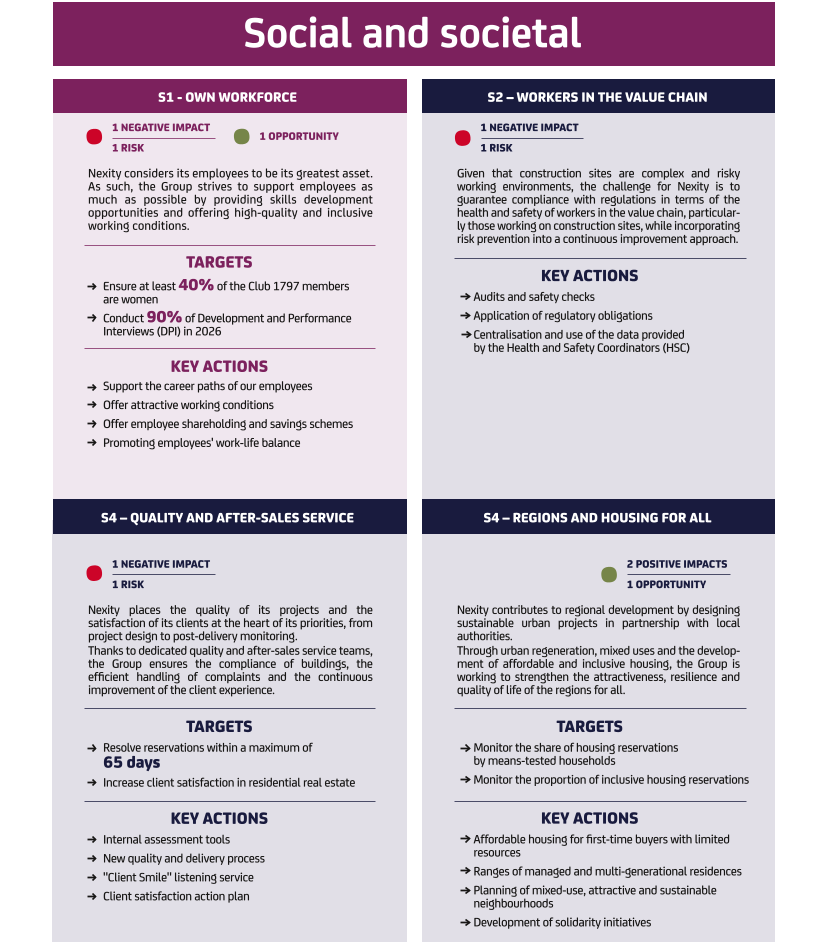 Image summarizing Nexity’s social and societal issues, which will be further developed in the following sections. It presents four key themes: Company personnel (S1), Workers in the value chain (S2), Quality and after-sales service (S3), Territories and housing for all (S4). The visual outlines the Group’s commitments to skills development, diversity, and inclusive working conditions, with a goal of maintaining 40% women in the Club 1797 (the Group’s highest responsibility positions). It highlights the priority given to the quality of projects and customer satisfaction, with targets for reducing the processing time of reservations and improving the customer experience. Additionally, the visual emphasizes actions related to the health and safety of workers in the value chain, as well as Nexity’s contribution to territorial development.
3.3.1Own workforce (ESRS S1)
The role of the Group's Human Resources Department is to manage the skills and commitment of the 3,354 employees of the entire Nexity group, thus contributing to the achievement of the Group’s strategic objectives, as determined by Executive Management. It also ensures compliance with legal and contractual obligations, as well as the maintenance of high-quality social dialogue. In addition, Nexity is committed on a daily basis to offering its employees an attractive quality of life and working conditions in order, on the one hand, to retain its employees and, on the other hand, to attract new skills. The Group’s Human Resources Department is also committed to implementing diversity and inclusion policies. In this respect, it contributes, through its strategic role, to the overall performance and culture of the Company.
Description of the Company's workforce
Nexity defines its workforce as all employees bound by an employment contract, regardless of the type of contract (permanent or fixed-term), their length of service or working hours (full-time / part-time), as well as temporary workers considered to be workers under the operational control of the Company. This definition differs from the operational definition set out in the French Labour Code, under which temporary workers are not legally considered to be Nexity employees.
As such, any person having a contractual relationship with a third party (temporary workers, service providers or value chain workers) is excluded from this notion of own workforce. Employees on notice who remain contractually bound to Nexity are included in the Company's workforce.
3.3.1.1Material impacts, risks and opportunities and their interaction with the strategy and business model (SBM-3)
The table below presents the characteristics of the IROs identified by the double materiality assessment as material in terms of working conditions and employee inclusivity:
IROs
Description
Policies
Targets
Shares
Opportunity
[Employee loyalty and commitment]
An attractive social policy makes it possible to retain key talents and strengthen Nexity's employer brand, while creating added value and differentiating the Group from its competitors.
Attractiveness and loyalty policy: employee remuneration terms, quality of life and working conditions
- •Recognition of individual performance through salary reviews using a retention system.
- •Gender pay gap of less than 5% by 2026.
- •Free share award plans and incentive and/or profit-sharing schemes.
- •At least 5 initiatives relating to health and safety and quality of life at work per year.
- •Salary reviews
- •Fair pay
- •Establishment of profit-sharing schemes
- •Platform, tools and events dedicated to health and safety
Risk
[Mismatch between skills and changes in the Group’s business lines]
Nexity's teams are at the heart of its business model. Without solid policies in terms of attractiveness, loyalty, training and career management, the Group risks lacking the key skills to ensure its development and maintain its leadership position.
Attractiveness and loyalty policy: employee training and skills development
- •Training of managers over two years (2025 and 2026) on the managerial model.
- •Business line training in line with strategic decisions.
- •First aid training for employees.
- •Reception of secondary school interns, mainly from QPV (1).
- •Achieve a Development and Performance Interview (DPI) completion rate of 90% in 2026.
- •Optimise the DPI interface.
- •Roll-out of training courses
Negative impact
[Growing inequalities]
A lack of inclusion and equality in the workplace contributes to growing inequalities, discrimination and the exclusion of certain employees.
Non-discrimination policy and ensuring an inclusive environment
- •At least 40% of the Club 1797 members to be women by 2026.
- •50% women among the high-potentials identified each year.
- •Maintain our previous employment rate for workers with disabilities in 2024, of 3.1%.
- •Increased representation of women in governing bodies and the business lines
- •Fair pay
- •Communication and raising awareness of gender equality and disability issues
- •Recruitment of workers with disabilities
- •Integration of employees with disabilities
- •Support dedicated to job retention
- •Procedure for reporting PSRs with the appointment of harassment and discrimination officers
3.3.1.2Policy related to own workforce (S1-1)
These policies reflect Nexity's commitment to meeting the challenges identified during the double materiality assessment, by placing the quality of working conditions, skills development and ongoing training, as well as the promotion of inclusion and diversity, at the heart of its actions. Through this approach, the Group affirms its desire to contribute to a responsible business model, promoting personal fulfilment, social cohesion and sustainable performance.
Nexity’s policy on working conditions aims to attract and retain employees. It is based on two main priorities:
- •Offering attractive remuneration conditions to all its employees; and
- •Guaranteeing a respectful and balanced quality of life and working conditions.
Offering attractive remuneration conditions to all its employees
Adequate wages (S1-10)
Given that almost all Nexity employees work in France, adequate wage is defined in accordance with the legal standards and collective bargaining agreements in force and corresponds to the minimum wage set either by the legislation or by the collective bargaining agreements applicable to the Company's business sector.
As a result, all employees receive remuneration that is at least equivalent to the agreed minimum wages in force or, failing this, the Minimum Interprofessional Growth Wage (SMIC or Salaire Minimum Interprofessionnel de Croissance in French). Furthermore, Nexity ensures equal pay and applies any adjustment imposed by legislation or collective bargaining agreements in order to ensure remuneration is in line with social and economic standards.
Total remuneration ratio
The total annual remuneration ratio is 33 (34 in 2024). The latter was calculated by taking the remuneration of the Chairwoman and Chief Executive Officer (company officer) as the numerator and the median remuneration of employees on permanent contracts present as of 31 December 2025 and over the year as the denominator. In addition, the denominator includes the remuneration of the other company officer (Deputy Chief Executive Officer).
The remuneration used to calculate this indicator is the remuneration used to calculate the equity ratio (see Section 4.4.1.5 "Comparison of the remuneration of executive company officers with the Company's performance and the average and median remuneration of employees"). This is the fixed salary calculated for full-time hours excluding absences, to which is added the variable remuneration received over the year, benefits in kind, long-term remuneration granted in 2025, free shares granted in 2025 and employee savings (profit-sharing and incentive payments received in 2025 in respect of 2024).
Remuneration policy (S1-1)
In order to align the interests of employees and executives with those of the Group, Nexity has developed a remuneration policy based on remuneration for individual and collective performance and on the sharing of the value created, while controlling its costs and respecting the principles of fairness. Remuneration is a key factor in attracting and retaining employees. The remuneration policy, managed by the Human Resources Department, applies to all entities in the UES.
Targets relating to remuneration conditions (S1-5)
- •To recognise individual performance via salary reviews: ensuring that pay increases are in line with the employee’s performance and follow the rules of fairness;
- •Guarantee equal pay by ensuring a gender pay gap for work of the same value (equivalent position and profile) of less than 5% by 2026; and
- •To set up mechanisms to share results with all employees through free share award plans, and incentive and/or profit-sharing schemes.
Action plan for the implementation of fair and rewarding remuneration (S1-4)
1. Base salary reviews on individual performance
Employees’ fixed individual remuneration constitutes the counterpart of the good performance of their role. Variable remuneration, immediate or deferred, serves to reward individual contributions to the Group’s performance by achieving specific objectives over a given period. At the individual level, performance is recognised and rewarded through the allocation of salary measures and, depending on the position held, the allocation of individual variable remuneration according to their individual contribution.
Every year, the Human Resources Department pays particular attention to ensuring that employees with a higher performance or being identified as high-potential (Next) benefit from a retention mechanism (promotion, pay rise or long-term remuneration).
Remuneration is reviewed at least once a year through a structured, global process that is applied by all Group entities, which ensures that remuneration principles are uniformly applied. In order to guarantee the fairness of wage measures granted and identical pay levels for equivalent positions and profiles, the wage review process is underpinned by the principle of non-discrimination. This is notably ensured by a two-stage review process of each employee’s situation (carried out by managers on the one hand and by the Human Resources Department on the other), thus allowing for factual and objective assessments.
The Group also seeks to safeguard the principle of solidarity, with specific attention paid each year to employees on the lowest incomes.
As part of the NAO (Mandatory Annual Negotiations) for the year 2025, Executive Management granted a maximum budget of 2% of the payroll including individual increases. As such, 38% of employees benefited from a pay rise, for a total amount of more than €3 million.
2. Ensuring equal pay
Nexity is committed to ensuring equal pay for women and men and to fighting against gender pay gaps and unjustified treatment.
To calculate this metric, the study was carried out on all permanent employees present at 31 December 2025 and throughout 2025. The remuneration taken into account for the calculation of this metric is the remuneration used to calculate the equity ratio (see Section 4.4.1.5 of Chapter 4 "Corporate governance"). This is the fixed full-time salary excluding absences, to which is added the variable remuneration received over the year, benefits in kind, long-term remuneration granted in 2025, free shares granted in 2025 and employee savings schemes (profit-sharing and incentives paid in 2025 in respect of 2024(2)).
In addition, a review of the remuneration components between men and women is regularly carried out according to a methodology that has been validated by the internal audit team so as to calculate an adjusted pay gap. The last audit carried out on 2025 remuneration highlighted that for equivalent skills and profiles, pay equity was respected between men and women.
Furthermore, in accordance with the implementing decree of the French law on the freedom to choose one's professional future (loi "Avenir professionnel"), Group entities whose workforce is affected have measured the indicators defined by the gender equality index in respect of the 2025 fiscal year. Thus, at 31 December 2025, 94% of the total workforce is located in entities covered by this index (legal threshold). In addition, the average score of the main entities that make up the Group is 88.5/100.
3. Set up systems to share results with all employees
In order to strengthen the minimum welfare benefits, in 2015 Nexity set up a comprehensive employee savings scheme consisting of a Group Savings Plan (PEG) and a Group Collective Retirement Savings Plan (PERCOLG) through collective bargaining agreements entered into with the trade union and employee representatives. This scheme evolved in 2020 to take into account the provisions of the Pacte law and to further encourage employee shareholding by introducing matching contributions corresponding to a percentage of the amount saved, capped on the employee shareholding fund. It was then further amended in 2025 to promote employee savings by offering matching contributions on all our savings plans and all payment types.
The Group Savings Plan (PEG) is funded by various sources: profit-sharing, incentives, voluntary contributions from employees, rights deriving from accrued paid leave and free shares awarded as part of Group plans. The PEG offers a comprehensive and clear range of investment funds: five Amundi mutual funds (FCPE), including a so-called “Low Carbon” fund incorporating environmental criteria added in 2022, and one dedicated mutual fund, Nexity Actions, invested solely in Nexity shares.
To enable Group employees to build up a long-term savings supplement in preparation for their retirement, Nexity set up a Group Collective Retirement Savings Plan (PERCOLG). PERCOLG offers a comprehensive and user-friendly range of investment funds: six Amundi mutual funds (FCPE), five of which are freely managed.
At 31 December 2025, the FCPE Nexity Actions mutual fund held 1,301,242 Company shares, representing 2.32% of Nexity’s share capital.
At the collective level, performance is measured on the basis of the economic results achieved by the Company and/or the Group. The efforts made by each company are reflected in the possible payment of incentive and profit-sharing bonuses, provided that the entity’s workforce, economic performance and results allow it.
Profit-sharing agreements are concluded within each structure, if their workforce, economic maturity and results allow it. In 2025, the Group paid its employees €1.5 million in profit-sharing bonuses (€3.9 million in 2024) and €306,000 in incentives (€2.3 million in 2024) - at entity level - linked to the results of the 2024 fiscal year (gross amount before CSG/CRDS). 50% of these employees deposited all or part of their profit-sharing/incentive payments into the Group's employee savings schemes.
In 2025, a new incentive agreement was negotiated within UES PC with the trade union and employee representatives, for a term of one year, incorporating financial and non-financial criteria.
To involve employees as shareholders in the creation and sharing of value, employee shareholding operations are regularly proposed to Nexity employees (collective plans for the free share award plans and a capital increase reserved for employees). At 31 December 2025, 61.9% of Group employees held Nexity shares, either directly or via the PEG mutual funds. The percentage of Nexity’s share capital held by Group employees and managers represented 4.13% of the share capital on 31 December 2025.
In 2025, a collective plan was put in place following the approval granted by the Board of Directors on 18 December 2024.
In addition, the collective plan of 18 May 2022 vested on 30 June 2025. Employees were offered the option to save their shares in the PEG's employee shareholding fund and receive the matching contribution. 765 employees, i.e. 34% of employees whose shares vested, chose to save their shares in the PEG.
Guaranteeing a respectful and balanced quality of life and working conditions
Policy related to quality of life and working conditions (S1-1)
In order to promote well-being at work, Nexity has introduced a policy to improve the quality of life and working conditions of all its employees. This policy covers three major areas:
- •Flexible work organisation;
- •Work-life balance; and
- •Health and welfare and preventing psychosocial risks.
This policy was developed by the Human Resources Department, in collaboration with its trade union and employee representatives, and formalised through collective bargaining agreements.
The implementation of this policy is performed by the HR teams and monitored by the trade union and employee representatives as part of the social dialogue to assess the performance of the latter and any potential improvements that may be required.
In order to achieve its ambition in this area and in line with the updated 2026 roadmap, a clear and measurable objective has been defined:
- •to roll out at least five initiatives related to health and safety and quality of life at work per year.
This objective will be monitored and reassessed annually to analyse the results obtained and redefine the ambition.
Action plan related to working time and work-life balance (S1-4)
Nexity’s Human Resources Department is aware that quality of life at work relies heavily on the well-being of employees, improving their working conditions and paying particular attention to work-life balance. To this end, the Group deploys various measures intended to benefit the greatest number of employees, regardless of their parent company.
1. Enable flexible work arrangements
Since 2017, the Group has set up arrangements for working from home, allowing all eligible employees who so wish to work from home or in a Nexity third-party location, one day per week. In October 2021, this system was extended to two days per week for compatible positions. Lastly, since 2022, an additional day of working from home has been offered to employees with disabilities or parents caring for a disabled child.
At 31 December 2025, 2,535 Group employees were eligible for this scheme. Moreover, as part of the annual campaign related to the professional development interview (PDI), employees who had completed their PDI and were permitted to work from home had the opportunity to express their opinions on their conditions of access to the working from home scheme and the related procedures.
Moreover, a managerial interview is held annually with manager employees on a fixed-day rate in order to take stock of the organisation of their activity within Nexity and to plan potential organisational improvements for the coming year. This interview is an opportunity for employees to discuss workload management with their manager as well as respect for rest periods and the right to disconnect.
In addition, in 2025, an awareness-raising campaign on the right to disconnect was rolled out, notably intended to remind employees of the importance of respecting rest periods and encouraging working practices that are conducive to well-being.
The terms and conditions for organising and managing working time are specific to each company or UES and are defined by collective bargaining agreements, in particular based on the nature of their activity and the provisions of the agreements applicable to them. They depend upon an employee’s status and level of responsibility.
2. Promoting work-life balance
In addition to the legal framework of 16 weeks of maternity leave and 4 weeks of paternity leave, the Group supports its parent employees through a variety of initiatives. Each year, Nexity offers all its employees the benefit of nursery places and parenting-related services through the signing of a partnership with recognised professionals in the early childhood sector:
- •At 31 December 2025, 55 employees benefited from a nursery place either close to their home or workplace;
- •In the event of failure of usual childcare arrangements, Nexity offers an occasional and emergency childcare service in partnership with this network of nurseries;
- •Since 2023, a parenting support platform has also been made available to employees, giving them access to a variety of content related to parenthood (articles, conferences and exclusive offers); and
- •Lastly, to encourage employees to take full advantage of their rights to paternity leave, Nexity ensures that their full salary is maintained for the duration of this leave. The Group also pays particular attention to those returning to work after maternity leave.
All Nexity group employees are eligible for family leave. Family leave includes maternity, paternity and childcare leave, parental leave and adoption leave, regulated by social legislation or through the Group’s collective agreements. In 2025, 6.8% of Group employees took family leave(3).
Family-related leave, introduced within the various UES and entities, notably as part of the agreements on quality of life at work and working conditions, aims to strengthen the balance between personal and professional life for all employees.
Indeed, the legal terms of this leave (duration, conditions, eligibility), may be strengthened by the outcome of social dialogue between the various UESs and the Group. For example, in addition to the legal obligation concerning paternity and childcare leave, the UES Nexity Promotion-Construction honours employees' wages with no seniority-related conditions. In addition, supra-legal leave may be taken. By way of illustration, "back-to-school" leave of between one half-day and one full day has been introduced by the UES Nexity Promotion-Construction, for employees who have completed their probationary period.
As part of its prevention policy, Nexity introduced a caregiver support service in 2019 for its employees who are looking after immediate family members (ascendants, descendants, spouses, etc.) or close relatives. This service involves assisting employees in all of their procedures, from analysing their needs, through monitoring all administrative formalities, to implementing solutions adapted to the loss of autonomy of their relative.
3. Preventing psychosocial risks and promoting health
As part of its policy related to quality of life and working conditions, Nexity pays particular attention to the prevention of psychosocial risks (PSR). To support this approach of vigilance and responsibility, the Group has implemented a dedicated reporting policy, enabling all employees to report a situation of concern. Standardisation of the procedure at Group level was implemented in 2025 to guarantee homogeneous protection standards for all employees, in line with Nexity's new organisational structure and transformation challenges. The new procedure also redefines the role of the dedicated contact persons and their scope of intervention:
- •In the context of a situation of moral or sexual harassment or discrimination: any employee, regardless of their status, may report a situation to their Human Resources Manager or to their Harassment and Discrimination Officer (employer or SEC).
- •In the context of a situation relating to any other psychosocial risk (working conditions, burn-out, conflict within a team, etc.): any employee, regardless of their status, may report such a situation to their Human Resources Manager or an employee representative.
In accordance with legal and regulatory provisions, the whistle-blowing procedure is strictly supervised at each stage and at all levels of the system: reporting, establishment of facts, investigation and action plan, which may include disciplinary measures. To this end, the system includes a principle of confidentiality and anonymity for all parties concerned, as well as guaranteed protection against any form of retaliation.
In the event of proven facts at the end of the whistle-blowing procedure, the Group may implement a range of remedial measures, such as psychological support, a HR support plan designed to restore the victim's rights and establish a peaceful working environment, or disciplinary action against the perpetrator.
As part of this procedure, three investigations were carried out in 2025. One of them resulted in disciplinary action, as in 2024. In addition, one report, the facts of which had already been established, and therefore did not require the opening of a formal investigation, also resulted in disciplinary action. In 2024, two investigations were carried out, one of which resulted in disciplinary action.
Details of the whistle-blowing procedure are set out in an official document available to all employees. In addition, a "Bien chez Nexity" section, dedicated to the prevention of psychosocial risks, has been set up on the Group's internal social network. This feature aims to facilitate access to awareness-raising and training materials, as well as the whistle-blowing procedure and the contact details of the dedicated contact persons.
- •Access to training dedicated to understanding and regulating stress and the mental load, for employees as well as managerial staff. For more information, please refer to Section 3.3.1.3 "Support the training and skills development of all Group employees (S1-1)" of this chapter;
- •Access to a range of services to help take care of their mental health with analysis of symptoms, guidance and coaching, depending on the needs of the employee; and
- •Access to a psychological support service, which puts employees in touch with a psychologist as quickly as possible. This service is available 7 days a week, 24 hours a day.
In line with the legislation in force in France, all employees exercising their employment contract in France are covered by public programmes and/or benefits offered in the event of loss of income due to illness, temporary incapacity, disability or permanent incapacity, unemployment, parental leave, maternity/paternity leave or retirement.
In addition, all Nexity employees in France benefit from high-quality supplementary social coverage, with advantageous guarantees and controlled social contributions via a supplementary health insurance organisation (insured by AG2R and provided by Vivinter) for temporary incapacity, disability or permanent incapacity and healthcare costs. In order to maintain quality coverage, whether in terms of health or personal protection insurance, negotiations are conducted annually with the trade union and employee representatives. Over the last two years and in particular following the gradual withdrawal of Social Security, the focus has been on maintaining guarantees.
In addition, in line with its desire to support parenthood, Nexity maintains its employees’ salaries during periods of maternity or paternity leave and childcare.
- •Social protection: in 2011, Nexity established a shared foundation in terms of social protection for its employees to demonstrate its commitment to fairness and its desire to create a social protection system favourable to all employees. The system is based on high-quality health and personal risk insurance guarantees and gives priority to preventive healthcare;
- •Medical teleconsultation: this service is available to all Group employees and their beneficiaries who benefit from Vivinter supplementary health insurance. In 2025, 92 employees benefited from this service;
- •Assistance with Day-to-Day Life: this service was set up to help employees who are immobilised or hospitalised, due to an accident or long-term illness, to carry out day-to-day tasks that they are no longer able to do. In 2025, 38 employees were listened to and cared for; and
- •Sport and well-being: see the paragraph below on the Group's approach to sport and well-being.
For employees working abroad, the table below summarises the social protection cover provided to employees via the social protection system specific to each country and compliance with the regulations in force. The latter can be supplemented via an additional programme, as is the case for employees in Switzerland, whose minimum benefits are enhanced by cover for illness and workplace accidents.
Social protection cover
Italy
(16 employees)
Germany
(12 employees)
Switzerland
(3 employees)
Loss of income due to illness
✓
✓
✓
Loss of income due to workplace accident and acquired disability
✓
✓
✓*
Loss of income due to unemployment
✓
✓
✓
Loss of income related
to parental leave✓
✘**
✘***
Loss of income due to retirement
✓
✓
✓
- *Employees benefit from an additional protection system, to strengthen the guarantees of the public system
- **In accordance with current legislation, employees may benefit from parental leave, without any compensation
- ***Local federal law does not currently provide for parental leave
Furthermore to psychosocial risks, Nexity regularly carries out several actions relating to prevention and the safety of employees, in particular through the prevention of workplace accidents. Nexity group has not implemented a health and safety management system based on recognised standards and directives, but it is fully committed to prevention and employee health and safety. In this respect, in accordance with social legislation, eligible companies have a single occupational risk assessment document (DUERP or "document unique d’évaluation des risques professionnels" in French), which is updated each year. This document is presented to the employee representatives and monitored regularly. Targeted actions, including training (see Section 3.3.1.3 "Support the training and skills development of all Group employees (S1-1)" of this chapter) are carried out to improve working conditions and prevent risky situations.
Furthermore, an internal “serious incident” platform has been rolled out within the Group. The latter makes it possible to identify so-called serious workplace accidents. This information is shared with the Risk Department, the Human Resources Department and the Safety and Prevention Department to identify any action plans to be implemented.
Moreover, the PAPRIPACT (Annual Programme for the Prevention of Occupational Risks and Improvement of Working Conditions), drawn up by all eligible entities, helps to identify the various risks and implement any preventive measures.
Health and safety metrics
2024
2025
Number of deaths in own workforce due to workplace accidents and occupational illnesses
-
0
Number of deaths resulting from workplace accidents and occupational illnesses of other workers working at the Company’s sites*
-
0
Number of recordable workplace accidents for own workforce
29
18
Percentage of recordable workplace accidents for own workforce
3% frequency rate**
2.8%
Number of recordable cases of occupational illnesses among employees
-
1
Number of days lost due to workplace accidents and deaths due to workplace accidents, occupational illnesses and deaths due to occupational illnesses among employees
1,696
1,095
- *Work sites are defined as all Nexity group’s administrative establishments
- **Number of lost-time workplace accidents in the year x 1,000/number of hours theoretically worked in the year
In addition, as part of its health and safety policy, Nexity has implemented several actions throughout 2025 at various Group sites:
- •Face-to-face workshops and webinars on the theme of the 5 senses and well-being at work during the quality of life and working conditions week;
- •Several sporting challenges, including the "Bouge pour la cause" solidarity challenge for Breast Cancer Awareness Month, with the twofold objective of mobilising employees for an important cause and fighting against sedentary lifestyles;
- •Stands run by the nurse to promote prevention among employees for Breast Cancer Awareness Month and Movember;
- •A skin cancer prevention and screening clinic run by a health professional; and
- •A flu vaccination campaign.
3.3.1.3Support the training and skills development of all Group employees (S1-1)
Training and skills development policy (S1-1)
Nexity’s training policy, defined by the Human Resources Department, puts human capital at the heart of the strategy and aims to develop and enhance the skills of employees. The ongoing development of employee skills is a significant factor in the Company’s sustainable performance. The training policy is aimed at all Group employees and is based on four key areas:
- •Offering a range of training, open to all, on various topics related to the Company’s activities and strategy;
- •Training managers through the managerial training centre to create a sustainable and responsible environment that fully incorporates the Company’s strategic challenges;
- •Allowing operational functions access to tailor-made and specific training content through the opening of academies; and
- •Setting up dedicated systems to develop skills and career paths.
The training and skills development policy is defined by the Human Resources Department through training guidelines that are presented to the SECs as part of meetings with the trade union and employee representatives, as well as to employees via targeted communications. These training guidelines help to adapt priority training actions to the Group’s strategic choices.
Since its launch in January 2020, La Cité has been the entity driving this ambition to establish Nexity as “the company of possibilities”; a place where employees can grow and develop. La Cité relies on an open collective of experts and focuses on the pooling of expertise and cross-functional work with all departments on skills development topics. La Cité is responsible for the training offered to Nexity’s employees.
La Cité is open to all Nexity employees and offers training that meets the Company's strategic challenges, changes in the business lines and the need to develop the employability of its employees.
Training targets (S1-5)
- •Managerial training: 60% of managers trained over two years (2025 and 2026) on “Understanding the Nexity managerial model”. Since its launch, 345 managers have already been trained, i.e. 62%;
- •Business line training: 80% of employees holding a sales position trained in 2025 as part of the Sales Academy. With 56 of the 59 sales advisors trained as part of the Sales Academy, 95% of employees concerned have been trained, in particular on the Nexity sales method;
- •Roll-out of the online training module "Discover Multi-Product at Nexity" to all employees;
- •Training for all: 70 employees trained in first aid in 2025. The objective was exceeded thanks to the mobilisation of the teams: 161 employees took part in this training in 2025; and
- •Support for young people: 100 young secondary school interns, mainly from QPV (priority urban planning districts), were welcomed in 2024/2025. This objective has also been achieved, with 154 young people being welcomed in 2024/2025.
Action plan to develop employee skills and know-how (S1-4)
To achieve its objectives, Nexity invested €1.7 million in training for 2025, developing 17,837 hours of training for the entire Group, i.e. an average of 5.32 hours per employee (30,004 hours of training in 2024, representing an average of 7.65 hours). The distribution of training hours between women and men is in line with the breakdown of the workforce, with respectively 48% women and 52% men completing the training hours (60% and 40% in 2024).
More specifically, the training courses and content developed aim to establish a shared knowledge base, develop skills for employees, managers and executives, and share new technical know-how specific to the various positions held by employees.
1. Ensuring training for all
In the context of adapting to new market conditions, La Cité has prioritised its training actions. 2025 was marked by the following themes:
- •Artificial intelligence: training with the DSIN, Conference Manager, animation of the Academ'IA digital platform, acculturation webinars at the Technical Academy, acculturation during the orientation day;
- •The Business Academies: overhaul of training courses and relaunch of the 6C course for Sales;
- •Catalogue offering: update of the cross-functional training catalogue;
- •Updated E-learning: deployment of the AI certification and the Climate Change Adaptation Visa, design of the Customer Culture Visa and the Quality Visa; and
- •The continued roll-out of training on the Nexity managerial model.
Acculturation and skills development in Generative Artificial Intelligence (Gen AI)
Launched in January 2024, the Academ'IA programme enabled all Group employees to familiarise themselves with the challenges and uses of generative artificial intelligence. From its first weeks, the platform attracted a lot of interest, with more than 700 unique visitors recorded.
This first phase played a key role in demystifying AI, by popularising internal tools and supporting employees in their understanding of risks and opportunities. The "AI passport", obtained by more than 500 employees, was a fundamental milestone in this responsible approach to acculturation.
- •Support for the drafting of prompts whose content was proposed by La Cité, in masterclass format, led by in-house trainers;
- •Simplification and accessibility through the centralisation of all content, initiatives and productions on a single hub page, being created on Live. This entry point aims to streamline access to information and encourage the appropriation of Generative AI; and
- •Development of an "Artificial Intelligence" AI certification by La Cité and DSIN, a veritable cornerstone of access to AI tools. This certification determines access to internal generative AI solutions, thus guaranteeing informed and secure use. In less than two months, more than 1,100 certification badges were issued, testifying to the strong commitment of employees and the collective skills development.
Raising awareness of environmental and social issues
This year, the Group's CSR approach focused on several major actions. The CSR Department, together with La Cité, organised a series of conferences to raise awareness and mobilise employees around environmental and societal issues. In September, it also defined and rolled out a new visa dedicated to climate change adaptation, thus strengthening the Group's commitment to climate-related challenges.
More generally, the Group continues to offer the CSR Academy to its employees, a practical resource to support the CSR strategy and enable everyone to get involved, both individually and collectively.
Introduction to first aid
Nexity is upholding its commitment to train as many employees as possible in life-saving skills with an "Introduction to First Aid".
Business ethics
The two mandatory E-learning certifications, "Combating Money Laundering and the Financing of Terrorism" and "Prevention of Corruption and Influence Peddling", were obtained by 1,069 and 930 employees respectively in 2025, as described in this chapter in Section 3.4.1.3 "Corporate culture and business conduct policies (G1-1)".
2. Developing managerial skills to support the transformation
The Managerial Training Centre (CEM) supports this transformation by relying on the three pillars of Nexity's managerial model:
- •Human Capital Development Manager: developing the skills of teams to address the challenges of sustainable performance while guaranteeing their expertise and employability on an individual basis;
- •Change Manager: driving change and transformation by implementing a culture of innovation; and
- •Inclusivity Manager: creating a climate of cooperation and developing cross-functionality, thus enabling everyone to fulfil their potential.
In line with the objective of training 60% of managers in this managerial model by 2026, 345 managers have already completed this training, i.e. 62% of the target population.
3. Structuring training courses around business issues
In 2025, the Group's Business Academies contributed to a renewed dynamic to meet strategic and operational challenges. Their mission is to develop key skills, strengthen employee commitment and mobilise employees to boost collective performance.
- •The integration of the Academies within La Cité, a centre of expertise in educational engineering and business skills development; and
- •The appointment of business line sponsors to oversee the consistency of career paths with strategic and operational priorities.
Over the past 10 years, the five academies: Customer Relations, Sales, Development, Technical and Programme, have been promoting a culture of excellence. In 2025, they accelerated their impact through the following concrete actions:
- •Opening of career pathways dedicated to new target customers (e.g. integration of the after-sales service in the Customer Relations Academy);
- •Creation of career pathways to improve quality and customer satisfaction;
- •Roll-out of a common set of commercial practices via the 6C method for all sales advisors;
- •Relaunch of short and inspiring formats (Creative Mornings) to stimulate operational innovation; and
- •Mobilisation of business line communities (e.g. land developers' seminar) to strengthen cohesion and strategic alignment.
These initiatives reflect our desire to rethink the systems in place to support the transformations, further develop business line skills and create the right conditions for a sustainable commitment to the Group's performance.
4. Skills development and career paths: dedicated systems
In order to participate in the Group’s transformation, Nexity has developed a HR policy that encourages employee engagement and development to collectively build the company of tomorrow.
To this end, the Human Resources Department implements engagement initiatives that are consistent with the Group’s values and whose objectives are to enable employees to aim high within the Company and to support the development of their skills throughout their careers at Nexity.
One objective to achieve a Development and Performance Interview (DPI) completion rate of 90% was set for 2026:
Development and Performance Interview
The DPI is a key annual ritual in the managerial relationship and the life of the employee in order to strengthen their sense of belonging and commitment by reconciling the quest for meaning and performance. Conducted by the manager with his or her employee, it makes it possible to take stock of the year by assessing the objectives of the past year, skills and performance. It allows employees to plan ahead with their employees by setting annual objectives to be achieved and defining support needs related to their professional development. It is also an opportunity for employees to share their motivation drivers with their manager and to express feedback on his/her management method.
To establish these annual one-to-ones as a tool for performance development and commitment, Nexity aims to maintain the rate of completion of DPIs and optimise the relevant interface.
In 2025, the actions implemented made it possible to achieve an interview completion rate of 94%, i.e. 2,293 employees (compared to 97% in 2024). Of the interviews carried out, 53% were for women and 47% for men.
HR Professional Interview
This system helps to strengthen support for employees' career paths and to promote their commitment and development. Conducted by the HR teams, it provides an opportunity to discuss employees' careers and professional plans and to identify development plans to ensure their achievement.
Employment and Career Path Management (GEPP) and cross-functional and managerial skills frameworks
As part of the agreement on Employment and Career Path Management (GEPP), signed unanimously with the trade union and employee representatives at the end of 2021 and currently under renegotiation, Nexity has strengthened the systems and practices in place to support career paths, by taking into account changes in the business lines. A business line observatory bringing together the trade union and employee representatives, HR and employees in the field was set up to bring this approach to life and make it a place for discussion, reflection and the prospective analysis of jobs. In a context of significant internal and external changes and in line with the GEPP approach, Nexity has carried out a study to identify the impacts of these changes on the business lines and working methods, which revealed that new skills must be developed to collectively adapt to these changes. On the basis of this information, Nexity has built a framework comprising seven cross-functional skills and three managerial skills.
Nexity has also redrafted the job descriptions for its main business lines to take these changes into account. Employees can access a dedicated space entitled “The business line platform” where they can find information (like job descriptions, videos, podcasts) and careers support.
Talent review meetings
In order to implement its policy on talent development and retention, each year, talent review meetings are held after the Development and Performance Interviews.
The purpose of these committees is to identify both the potential and risks among the managerial population in order to support employees’ career development in a targeted manner.
The talent review meetings held in 2025 identified 356 high-potential employees, of which 150 female managers (42%) and 206 male managers (58%).
The Professional development programme to retain potential talent: Next
The Next programme is sponsored by Executive Management and was launched in 2015. It is an individual Group professional development system for employees identified during the talent review meetings as having a high potential for advancement and high performance within the Group. The Next programme is a comprehensive support system designed to accelerate their careers. In addition to the visibility they benefit from, the Next programme gives them the means to move on to higher-responsibility positions, with the tools they need to progress and develop within the Group.
Around its two central themes, which are management and new collaborative methods, the Next programme serves several purposes:
- •Developing the network: by building a community of managers and transformative agents to increase cross-functionality and agility and create business opportunities;
- •Developing agility: by understanding innovative managerial practices and collaborative methods (for the benefit of internal teams and clients); and
- •Developing cross-functionality: by deepening the understanding of Nexity to enable a better understanding of the Group and career progression opportunities whilst encouraging new synergies.
In 2025-2026, the programme supported 12 employees (of which 33% were women). Since its creation, over 200 high-potential employees have taken part in the programme in 9 groups representing all of Nexity's divisions and business lines. At the end of the programme, the majority of employees move on to key positions within the organisation.
Training and skills development measures and performance (S1-13)
Breakdown of the number of training hours by gender in 2025
Breakdown of the number of training hours by socio-professional category in 2025
Breakdown of the number of training hours by gender and employee in 2025
3.3.1.4Fostering diversity and inclusion for a high-performing company (S1-1)
Compliance with the principle of non-discrimination
First of all, it should be noted that Nexity ensures compliance with the principle of non-discrimination, both during the recruitment process and throughout the duration of the employment contract. Any decision based on non-professional grounds or prohibited subjective criteria therefore is prohibited for ethical reasons, and to properly manage the image risk arising therefrom.
Discrimination based on physical appearance, age, medical conditions, known or presumed race, nationality, sex, gender identity, sexual orientation, pregnancy, disability, origin, religion, bank domiciliation, political opinions, philosophical opinions, marital and parenthood status, genetic characteristics, customs or traditions, surname, trade union activities, place of residence, ethnicity, loss of autonomy, the ability to express oneself in a foreign language, or vulnerability resulting from one's economic situation, is prohibited.
In 2025, as in 2024, the Group did not identify any incidents of discrimination, i.e. situations in which a person is treated unfairly or unfavourably because of personal characteristics protected by law. As such, Nexity has not recorded any complaints, fines or penalties in this respect.
The number of incidents, complaints and financial penalties was determined following monitoring and consolidation by the various HR operational teams, via the channels described in Section 3.3.1.5 "Processes to remediate negative impacts and channels for own workers to raise concerns (S1-3)" of this chapter.
In addition, the subject of inclusion and equal opportunities is seen as a key priority: the Group firmly believes that the performance of a company notably relies on the diversity of the people that work there. As such, the Group deploys a proactive policy in favour of inclusion.
Gender equality and inclusive employment
Firmly of the belief that human capital and the diversity of profiles are both its strength and its primary asset, for several years Nexity has been deploying a proactive inclusion policy based on two particular aspects of diversity:
To make diversity a concrete reality on a daily basis and ensure an inclusive working environment, the Group has put in place an action plan for each aspect in order to include quantifiable objectives and concrete measures to monitor and assess the progress made in each area.
More generally, the Group's commitment to the employment of seniors will be the subject of specific negotiations in 2026.
Gender equality policy (S1-1)
In order to guarantee equal treatment between women and men, Nexity has been rolling out a Group-wide professional equality policy since 2018, which covers the following aspects:
- •Increase the percentage of women in its governing bodies and business lines traditionally more staffed by men;
- •Maintain equal pay between employees with equivalent positions, skills and backgrounds;
- •Ensure a good work-life balance; and
- •Communicate and raise awareness of gender equality issues.
This policy was developed by the Human Resources Department under the leadership of the Chairwoman and Chief Executive Officer, in collaboration with Executive Management, so as to address the topic at the highest level of the Company. The commitments are monitored annually by a CSR Committee, which meets twice a year and is composed of four directors and members of the Legal, Human Resources and CSR Departments. An internal network dedicated to equality, made up of over 80 committed employees from all business lines, also participates in the proper monitoring of the professional equality policy and contributes to its daily implementation. This network met again in 2025 after pausing in 2024 due to the specific context.
With a view to continuous improvement, this action plan is redefined every 3 years and submitted to the Board of Directors for approval.
In order to ensure transparency, accountability and accelerate the increase in the number of women in its governing bodies, Nexity has set itself concrete quantitative targets within its professional equality policy. The 2024-2026 Equality Action Plan provides for the following objectives:
These objectives, defined by the Human Resources Department, are monitored annually by the CSR Committee and reassessed every three years to analyse the results obtained and redefine ambitions.
These objectives are also included in collective bargaining agreements and dedicated action plans depending on the eligible entities. They are monitored annually through a presentation to employee representatives, such as the Social and Economic Committee (SEC) and the Professional Equality Committee.
Action plan related to gender equality (S1-4)
In order to accelerate the achievement of professional equality between women and men, the Diversity Department, composed of two dedicated members of staff, works in close collaboration with various internal stakeholders, including the harassment and discrimination officers, the internal network dedicated to equality, the HR teams and employee representatives. It also collaborates with external service providers, including training organisations and experts on specific topics related to gender equality.
The Group’s 2024-2026 Equality Action Plan is based on the aforementioned quantitative targets and concrete measures such as:
1. Increase the percentage of women in governing bodies and business lines traditionally more staffed by men
- •To guarantee career development opportunities commensurate with the skills of the Group’s female employees, Nexity has developed a female mentoring programme: each year, volunteer executives support female employees identified as having potential for growth, offering them the benefit of their experience and contributing to their professional and personal development. This scheme is also based on a partnership with two service providers renowned for their expertise in female leadership and Qualiopi-certified, through which coaching and specific training is provided to mentees. In order to incorporate this system into a process of continuous improvement, specifically responding to the needs identified by stakeholders, the content of the programme is reviewed and updated at the end of each academic year, taking into account feedback from the mentees and mentors. In 2025-2026, this scheme will benefit 10 female employees from various business lines and regions;
- •In order to ensure that women are represented when recruiting executives, all new contracts entered into with recruitment firms include a clause whereby the shortlist of male candidates must be in proportion to the number of female applications received, and consistent with the proportion of qualified women in that particular business sector; and
- •An awareness-raising campaign comprising a series of videos about “Women in the field” was launched in 2019, in collaboration with the Communications Department, to promote business lines traditionally more popular with men. The objective is to highlight "role model" female employees in positions of responsibility or traditionally occupied by men with a view to eliminating gender bias in the business lines. To boost the accessibility and attractiveness of these business lines, awareness-raising actions for students are regularly shared via presentations and forums to deconstruct gender stereotypes. All of these initiatives are carried out in conjunction with the Human Resources Development and Engagement Department. Within the Group in 2025, women represented 22% of the workforce of the Digital Solutions and Innovation Department (DSIN) (28% in 2024), and occupied 35% of the so-called technical roles (33% in 2024).
2. Maintain equal pay between employees with equivalent positions, skills and backgrounds
- •Professional Equality Index (see Section 3.3.1.2 “Policies related to own workforce” of this chapter); and
- •In 2025, an allocation criterion linked to equality was included in the executives' individual free share award plans: achievement of the target of 40% women within Club 1797 and no gender pay gap exceeding 5%, for an equivalent profile, position and situation.
3. Ensuring a good work-life balance
- •The actions implemented as part of the work-life balance are presented in Section 3.3.1.2 "Policies related to own workforce (S1-1)" under "Offering attractive remuneration conditions to all employees" of this chapter.
4. Communicate and raise awareness of gender equality issues
- •A charter of concrete commitments was drawn up on the basis of the results obtained, called "Ensemble pour l’inclusion" (Together for Inclusion). It was signed by Executive Management and approved by all Nexity managers. It was submitted for approval by all the employees and will be included in the employment contract of new recruits;
- •Since 2018, an internal exchange and work network, “Réso”, has been dedicated to gender equality issues within the Group. Composed of more than 80 members from all business lines and meeting when appropriate, this community contributes to the emergence of concrete and innovative actions and allows for the sharing of experiences and best practices. This network, as a space for openness and discovery, establishes a partnership with a different service provider for each meeting, offering talks from inspiring women and men. In 2025, the members of the network met with Bérangère Couillard, President of the High Council for Equality and former Minister Delegate for Gender Equality, to shed light on a major societal issue: "Sexism in France: insight and levers for action";
- •On 25 January 2023, Nexity joined the #StOpE initiative, a collective working to fight everyday sexism in the workplace. In 2025, tools to prevent and raise awareness of sexism and sexual harassment were shared with all Group employees. The new reporting procedure redefines the role of the Harassment and Discrimination Officers and their scope of intervention. These officers are appointed in each UES (Employer and SEC). Training was provided for the Group's Harassment and Discrimination Officers. The year 2026 will then mark the launch of a training course for all Group managers and employees;
- •To analyse the measures introduced and measure the impact of its diversity policy, Nexity has decided to participate in the Inclusion Observatory (ODI). Conducted every two years in partnership with the AFMD and Alternego, this survey aims to evaluate the initiatives implemented and collect employees' perceptions of inclusive practices. This survey tool was rolled out for the first time in June 2025 with more than 740 respondents within the Group. The results will be reported to Management in 2026 and will help define the objectives and actions to be included in the new 2027-2029 Equality Action Plan, as well as in the Disability Agreement as part of its renewal;
- •Lastly, to monitor best practices, Nexity is a member of the AFMD (French Association for Diversity Managers), the French Observatory of the Charter for Parity in Real Estate, and Club Landoy (which works in favour of the employment of seniors) and participates in the various events organised (conferences, workshops, sponsorship programme, etc.); and
- •In addition, an employee communications campaign devoted to inclusion and including a specific gender equality component continued in 2025. This campaign took the form of regular communications on the Group’s intranet site and a dedicated newsletter for diversity ambassadors.
In terms of inclusion, Nexity applies a proactive approach to continuous improvement on a daily basis, defining new priorities and actions each year in conjunction with the Human Resources Department and its equality Réso. The objective is to maintain existing initiatives within its three-year action plan while continuing to come up with new proposals and upholding its efforts in terms of equality.
All the actions and initiatives rolled out as part of the Group’s professional gender equality policy are rigorously monitored through the contribution of the internal network to the implementation of the measures and actions carried out. The results and impacts of these actions are then presented to the members of the network, and are the subject of recommendations and avenues for reflection for future action, thus ensuring ongoing improvement and adaptation to the Group’s evolving needs.
Gender equality policy measures and performance
Objectives
Maturity
Breakdown
by number
in 2024Breakdown as a percentage in 2024
Breakdown by number
in 2025Breakdown as a percentage in 2025
Women
Men
Women
Men
Women
Men
Women
Men
Achieve 40% of women
within Club 1797*2026
33
49
40.24%
56.76%
42
57
42.42%
57.58%
Achieve parity among identified high-potentials
2026
179
239
42.82%
57.18%
150
206
42.13%
57.87%
- *Club 1797 is the reference for governing bodies at Nexity. It includes the positions of greatest responsibility within the Group, among Executive Management and the functional and operational departments
More broadly, the Group monitors key metrics on an annual basis to measure its progress and results in terms of gender equality:
Metrics
2024 results
2025 results
Total percentage of women managers
47.2%
47.7%
Percentage of women in middle management
47.42%
43%
Percentage of women among non-managers
73%*
71.8%
Percentage of women promoted within the Group
53%
47%
Retention rate of women after maternity leave
64%
84%
- *For information, non-managers represent 31% of the workforce
Policy and targets related to the employment of people with disabilities (S1-1)
It should be noted that Nexity group defines "people with disabilities” as any person recognised as a disabled worker (RQTH) by the CDAPH (Commission for the Rights and Autonomy of People with Disabilities) as well as beneficiaries as defined in Article L.5212-13 of the French Labour Code.
The population of “people with disabilities” at Nexity is mainly represented by employees with RQTH status. There are also a few employees registered as unable to work and, to a lesser extent, employees with a permanent partial incapacity for work greater than or equal to 10% (IPP).
Each beneficiary is registered in the payroll system in order to ensure the reporting of information in the monthly Nominative Social Declaration (DSN), the employer being required to produce its declarations each year as part of the Mandatory Declaration of the Employment of Disabled Workers (DOETH).
The data collected concerns all entities operating in France. All registrations, of which the employer is aware, are collected as follows:
- •Registration submitted to the employer;
- •File compiled with the Disability Mission and registration awarded upon acceptance of the file by the MDPH; and
- •Registration awarded following the recruitment of the employee.
With a view to encouraging the recruitment of people with disabilities and ensuring their sustainable professional integration, the Group has introduced a disability policy for all employees that covers the following issues:
- •Encouraging the recruitment of disabled workers;
- •Promoting the integration of employees with disabilities within the Company;
- •Offering dedicated support to keep employees in employment; and
- •Training and raising awareness of all managers and employees on disability-related issues.
This policy was developed by the Human Resources Department in collaboration with the trade union and employee representatives in light of the reports drawn up for the 2019-2020-2021 fiscal years. It is the subject of the first Group agreement signed in 2022, for a period of 3 years, and validated by the Labour Department. The renewal of this agreement will be negotiated in 2026. Its implementation is overseen by the Group’s Disability Mission.
The commitments made are monitored annually as part of a quantitative and qualitative assessment, shared with the Regional and Interdepartmental Directorate for the Economy, Employment, Labour and Solidarity (DRIEETS) and to the trade union and employee representatives at a monitoring committee meeting. An Inclusion Committee, made up of HR staff and local contacts, also meets every year to ensure the proper implementation of this policy.
Target related to the employment of people with disabilities (S1-5)
In order to ensure a dynamic employment policy for people with disabilities, Nexity has set itself a concrete objective to be measured over time:
In addition, new recruitment and employment rate objectives will be defined as part of the renewal of the agreement in 2026, subject to approval by the DRIEETS.
Action plan related to the employment of people with disabilities (S1-4)
In order to encourage the widespread application of the policy in favour of the employment of people with disabilities, the Disability Mission, composed of two dedicated people, works closely with various internal stakeholders, such as the Inclusion Committee made up of HR Officers and volunteer employees, HR staff and the employee representatives. It also collaborates with external service providers, including training organisations, and government institutions in charge of regional and interdepartmental services.
The Group’s Disability Action Plan is based on the aforementioned quantitative objectives and concrete measures such as:
1. Encouraging the recruitment of disabled workers
- •In order to ensure internal mobilisation in the recruitment of people with disabilities and support the Human Resources Department, a dedicated officer has been appointed within the internal recruitment firm Cap Recrutement;
- •Since 2022, Nexity has been entering into various partnerships, most notably with Aktisea, a specialist recruitment firm, and participates in dedicated forums and job dating events. In addition, in order to optimise the visibility of its job vacancies, the Group ensures that these are shared with specialised networks such as Agefiph, as well as other specialist job sites. Lastly, all of the Group’s job vacancies specifically mention that they are suitable for people with disabilities; and
- •To facilitate the recruitment procedure, support is in place to offer candidates the best possible conditions during their job interview. To this end, all HR teams have been trained in the recruitment of disabled workers. The recruitment process can also be adapted according to the needs of the candidates and in conjunction with the Disability Mission.
2. Promoting the integration of employees with disabilities within the Company
- •As part of the hiring process, newcomers, whether disabled or not, receive a set of information on the Group’s inclusion policy including: the “Ensemble pour l’Inclusion” charter, the Group’s disability leaflet which contains a list of dedicated people within the Company and the assistance available, as well as access to "VISA Inclusion" training; and
- •Depending on the situation, a specific induction process for new employees is proposed in order to create an environment favourable to their integration. In particular, employees can ask a member of the Inclusion Committee for advice and support during their first few days.
3. Offering dedicated support to keep employees in employment
- •In order to best support employees on all disability-related topics, the Disability Mission is responsible for the following:
- •the inclusion and support of employees with disabilities,
- •keeping them in employment by calling upon specialised players and offering them remuneration solutions,
- •providing guidance to people with disabilities and assisting them with various processes, and
- •listening to them and ensuring that any information shared remains confidential.
- •In addition, an Inclusion Committee, whose members are Group employees located throughout the country, was created in 2021 to enable all employees, regardless of their location and their division, to benefit from local contacts in order to have easier access to disability policy measures. The members of this Committee are responsible for:
- •supporting the integration of employees with disabilities,
- •sharing useful information,
- •helping to roll-out awareness-raising actions in the regions,
- •directing them towards the Disability Mission, and
- •listening to them and ensuring that any information shared remains confidential.
In order to best adapt to the Group's new organisational structure (regional division), new ambassadors have joined the Committee, enabling employees to benefit from a local officer regardless of their geographical location.
- •Nexity offers a variety of support schemes for employees with disabilities:
- •3 days of authorised paid leave to attend medical appointments or carry out administrative procedures related to recognition as a disabled worker,
- •CESUs of €750 for employees with disabilities or their beneficiaries,
- •granting of an additional day to work from home, and
- •the payment of an allowance of €1,200 for any new recognition of the status of disabled worker. In 2025, 18 employees benefited from the financial assistance set up by Nexity on 1 January 2020.
- •Following the signing of the agreement, these schemes were supplemented by specific measures dedicated to employees with a child with a disability:
- •granting of three days of authorised paid leave to accompany the disabled child to medical appointments, and
- •option to benefit from an additional day of working from home.
Although the agreement in favour of people with disabilities ended on 31 December 2024, Nexity has chosen to maintain all of these measures in 2025. The renewal of this agreement is scheduled for 2026.
4. Training and raising awareness of all managers and employees on disability-related issues
As soon as it signed its first disability agreement in 2022, the Group set up training courses on how to welcome and accommodate people with disabilities. One such session saw the members of the Inclusion Committee, recruitment managers and payroll teams receive training to improve their knowledge of disability and support their business-related needs.
Since 2023, the Group has been rolling out training sessions for managers entitled “Management and disability: breaking down stereotypes”. This training, which uses virtual reality for an immersive experience, aims to raise awareness among managers in order to challenge their unconscious stereotypes and biases, collect practical advice on managerial practices to adopt and share details of the dedicated resources and contacts within the Group. Since 2024, 82 managers have been trained and new sessions may be organised in 2026 in order to continue this management training.
Lastly, a training course entitled “VISA Inclusion”, designed for all employees, was rolled out in September 2022 as a continuation of the CSR training, the aim being to enable them to learn about best practices to combat stereotypes and adopt inclusive behaviour at work. Since its launch, 590 employees have been trained on the current scope, including 55 in 2025.
In 2025, to coincide with France's National Hearing Day, a new hearing loss prevention campaign was conducted at certain Group sites to facilitate the daily health care procedures of employees through hearing screening and to reiterate the support measures available within the Group. In total, 116 employees took advantage of the hearing screening. Access to a patient service is also available to all employees in order to provide them with personalised support from hearing experts through a dedicated hotline.
As part of the European Week for the Employment of People with Disabilities, a digital game called "le bureau des séries" (the series office) was available online for 2 weeks, helping to raise awareness in an entertaining way, through popular television series, for all Group employees.
In addition, during the first week of December, on International Day of Persons with Disabilities, an interactive digital calendar on the theme of disabling illnesses also allowed employees to learn about a different condition each day and the best practices to adopt.
To close the week, a remote coffee morning was also organised with a patient expert. The aim was to initiate a dialogue with employees, offer a supportive environment for discussion, and share information about practical tools. For employees who asked for them, private and individual sessions have also been organised.
Lastly, the Inclusion Committee is involved in the day-to-day deployment of the disability policy, distributing all communications locally, organising on-site events, answering employees’ questions and directing them to the Disability Mission, where applicable.
Lastly, in accordance with the signed agreement, Nexity has undertaken to promote subcontracting with organisations operating in the sheltered and adapted work sector. To this end, partnerships have been forged with:
- •Aktisea: recruitment of people with disabilities;
- •The Elise network: collection and recycling of office waste;
- •Disability-friendly company Les Ateliers de l'Houstal: office supplies and advertising goodies;
- •Disability-friendly company Cap Sud Valorisation: paper waste collection;
- •Disability-friendly company ATF Gaia: reconditioning of IT hardware; and
- •Disability-friendly company SASU SIFU Groupe Ile de France: delivery of fruit baskets.
Measures and performance of the policy to promote the employment of people with disabilities
Objectives
Maturity
2022
2023
2024
Result at the end of the agreement
Achieve a 3.1% employment rate for disabled workers by 2024
2024
2.9%
3.3%
3.5%*
3.5%
Recruit 103 people with disabilities in 2024
2024
37
37
4
78
- *The employment rate is only known in year N + 1 once OETH contributions have been paid
In order to meet legal obligations and the commitments made in the agreement, a three-year report was drawn up, presented to the trade union and employee representatives, and sent to the DRIEETS via the dedicated platform of the Ministry of Labour and Solidarity "AGAPE'TH".
This report includes details of the quantitative and qualitative elements of the three years covered by the agreement, as well as the results of the objectives set in terms of employment rates and recruitment.
As for the number of recruitments, the target was not achieved. The number of recruitments was 78. This figure is mainly due to the unfavourable economic environment given the implementation of the Employment Protection Plan (PSE) in 2024, the disposal of several companies and the recruitment freeze. For information purposes, during the years 2022 and 2023, the Group was able to achieve the objectives set for the recruitment of people with disabilities.
Finally, regarding the budget, the distribution of expenses was respected: 25% dedicated to steering and awareness-raising and 75% dedicated to other actions.
Nexity's three-year report was validated on the AGAPE'TH platform and no balance is to be paid to URSSAF.
Employees with disabilities - position at 31/12/2025
Employees with disabilities - position at 31/12/2024
In 2025, 23 employees benefited from specific support from the Disability Mission in the context of the creation of their file for recognition as a disabled worker (RQTH in France) or a workstation adaptation paid for in full by the Group.
3.3.1.5Processes for engaging with own workers and workers’ representatives about impacts (S1-2)
The Human Resources Department works on a daily basis to ensure the implementation of high-quality social dialogue, listening, conversing and sharing information between the representatives of the different business lines.
Employee representation bodies
Each entity in the Group has a Social and Economic Committee (SEC) and trade union representatives, depending on the size of its workforce. These bodies have clearly defined powers and their members are consulted and informed on a regular basis about the implementation of projects concerning the situation of employees within the Company.
Overall, at 31 December 2025, Nexity has 56 employee representatives (including both the appointed representatives and their alternates) spread across 6 bodies (SECs) within the companies, where this is justified pursuant to legal requirements, and 11 trade union representatives.
Employees of the companies are informed and express themselves collectively in particular via the SECs which meet monthly. Nexity group has 6 SECs (UES(4), Nexity Promotion Construction, UES Invest, Angelotti Aménagement, Angelotti Promotion, Holding LPA and Costame).
Nexity’s contributions to the Group’s various SECs for social and cultural activities in 2025 totalled €1.2 million. The total operating budget for the various SECs came to €0.4 million.
- •A Health, Safety and Working Conditions Committee (HSWCC) has been created within two SECs (UES Nexity Promotion Construction and UES Invest) to discuss these matters on a quarterly basis;
- In some entities (UES Nexity Promotion Construction), local representatives have also been appointed. They meet quarterly and their discussions with local management make it possible to take account of employee issues;
- •Within the UES Nexity Promotion Construction, meetings of committees such as the economic committee may be arranged, or others related to training, diversity and professional equality; and
- •Within UES Invest, officers dedicated to certain topics (housing, professional equality and training) may also be appointed, the aim being to have specific feedback on these subjects before the SEC meetings.
At Group level, a Group Works Council was set up by collective agreement on 21 November 2008 and its members were most recently reappointed in July 2025. This body serves as a forum for dialogue intended to ensure the effective exchange of information between Group Management and employee representatives. The Group Works Council thus receives information about the Group’s business activities, financial position, employment trends and outlook.
Taking into account the importance of induction at all Nexity structures, the decision was made in April 2016 to broaden access to the Group Works Council by introducing observer seats for companies with their own Works Council but no members of the Group Works Council. Executive Management and the Group Works Council meet at least three times a year. At the time of the last renewal in July 2025, it was decided in agreement with the trade union and employee representatives that each trade union organisation could appoint a representative to participate in Group Works Council meetings.
These bodies are placed under the operational responsibility of the Human Resources Department, which ensures that consultation processes comply with legal requirements.
Minimum welfare benefits
Through social dialogue, the employee representatives and Management have developed, at Group level, a minimum framework common to all employees to consolidate Nexity’s commitment to fairness, solidarity and the rewarding of collective performance. To date, it is composed of:
- •Social protection guarantees;
- •Employee savings schemes (PEG - Group Savings Plan, PERCOLG - Group Collective Retirement Savings Plan);
- •The establishment of a representative body, the Group Works Council;
- •The approach to Employment and Career Path Management (GEPP); and
- •An agreement in favour of the employment of people with disabilities, the renewal of which is scheduled for 2026, following a pause in 2025 due to the context.
As such, all Group employees in France are covered by collective bargaining agreements, via the various agreements that make up the Group’s set of minimum welfare benefits, with the exception of Angelotti group employees.
At 31 December 2025, more than 96% of the Group’s employees working in France were covered by collective bargaining agreements. Indeed, the employees of Angelotti group companies will benefit from the Nexity group's agreements in accordance with their terms of application, following their permanent integration within the Group. Within the aforementioned companies, social security measures are set up by Unilateral Employer Decision (DUE or Décision Unilatérale de l’Employeur in French).
In addition, all employees have an employee representative, through the Group Works Council and members of the SEC (see Section 3.3.1.2 “Policies related to own workforce (S1-1)” of this chapter).
Social dialogue has also made it possible to set up parallel collective bargaining agreements at UES level:
- •Employee representative bodies;
- •Working time;
- •Purchasing power - Wage negotiations (NAO);
- •Employee savings schemes - Incentives and profit-sharing;
- •Recognition of a UES;
- •Quality of life and working conditions/professional equality; and
- •Voluntary redundancy scheme.
- •The agreements are monitored, where applicable, by dedicated commissions(5)
Social inclusion at the heart of social dialogue
Nexity is committed to diversity and inclusion and pays particular attention to the most vulnerable populations.
By way of illustration, within the disability policy, Nexity was keen to strengthen its commitment by signing its first Group agreement for 2022-2024, to increase the recruitment of people with disabilities and to promote the retention of such employees. A specific committee called the “Steering Committee”, composed of the signatories, the Disability Mission and the members of the Inclusion Committee, monitors this agreement. At the end of each fiscal year, a review of this agreement is performed and sent to the Group Committee and also presented to the SEC. The renewal of this agreement will be negotiated in early 2026.
In addition, agreements and/or action plans relating to professional equality are put in place within eligible entities in order to define gender equality objectives and measures.
Particular attention is also paid to seniors as part of the Group agreement on Employment and Career Path Management (GEPP), in order to guarantee their retention in employment and dedicated support towards retirement. A specific agreement on the employment of seniors will be negotiated in 2026.
Lastly, dedicated networks have been set up as part of the Group's diversity policy and are detailed in Section 3.3.1.4 "Fostering diversity and inclusion for a high-performing company (S1-1)".
Each year, a follow-up report is presented on the actions of this policy to the Group Works Council.
3.3.1.6Processes to remediate negative impacts and channels for own workers to raise concerns (S1-3)
Despite the strengthened policies rolled out by the Human Resources Department in relation to inclusion and diversity, in certain situations, employees may feel the need to express their concerns or needs in this area:
- •Employees can contact their employee representatives, whose role is to report concerns and incidents to the Human Resources Department. The agreements signed in 2025 are testament to the quality of social dialogue within the Group. These agreements are detailed in Section 3.3.1.2 “Policies related to own workforce” of this chapter;
- •In the event of a perceived violation of human rights, the employee can contact the Chief Ethics Officer using the whistle-blowing procedure. The whistle-blowing procedure is detailed in Section 3.4.1 "Business Conduct (ESRS G1)" of this chapter; and
- •When a situation involves psychosocial risks (PSR) or relates to working conditions, an employee can contact their HR manager and initiate a whistle-blowing procedure to be conducted by the Human Resources Department. The procedure is explained in Section 3.3.1.2 “Policies related to own workforce”.
- •Regarding professional equality: harassment and discrimination officers, members of the Human Resources Department and the SEC; and
- •Regarding disability: disability officers, members of the Human Resources Department or volunteers, and representatives of the Group's Disability Mission.
Within the Group, surveys relating to working conditions and psychosocial risks are conducted and monitored by each entity. In addition, in the context of employee representative bodies, such as meetings of the SEC and of local representatives, employee grievances may be dealt with and are recorded, where appropriate, in the minutes (see Section 3.3.1.2 "Policies related to own workforce" of this chapter, under "Employee representation bodies").
3.3.1.7Reminder of the general commitments in terms of respect for human rights (S1-1)
Executive Management is particularly attentive to respect for human rights. Nevertheless, in the event of a proven infringement, various measures are implemented over time, such as psychological support for the employee concerned, a HR support plan aimed at restoring the victim’s rights and establishing a peaceful working environment or a disciplinary procedure against the perpetrator.
Compliance with international conventions
Nexity places respect for human rights at the heart of its practices. This approach is based on fundamental principles, aligned with international standards such as the Universal Declaration of Human Rights, the United Nations Guiding Principles on Business and Human Rights, the OECD guidelines, and the fundamental conventions of the International Labour Organization (ILO). Nexity undertakes to guarantee the application of the processes and control mechanisms set out in the aforementioned principles, in conjunction with the Group Chief Ethics Officer, employee representative bodies and the Human Resources Department.
Nexity only operates in countries that have ratified the ILO’s eight fundamental conventions and complies with the regulations in force in those countries. Similarly, the various recommendations of the ILO and international conventions prohibiting child labour are respected: Nexity does not employ any minors, except occasionally for internships or apprenticeship contracts. The Group’s activity does not present any risk in terms of forced labour.
3.3.1.8General metrics and performance related to own workforce (S1-6; S1-9; S1-14)
Characteristics of the Company’s employees (S1-6; S1-9; S1-14)
At 31 December 2025, Nexity had 3,354 employees. However, in 2025, the average number of employees was 5,356, or 3,330 if only employees on permanent contracts are taken into account.
At 31 December 2025, 55% of Group employees were women and 45% were men. It should be noted that nearly all employees carry out their duties in France.
Breakdown of employees by gender
Breakdown of employees by country
Employee age groups at 31 December 2025
Employee age groups at 31 December 2024
Breakdown of employees by contract type and by gender at 31 December 2025
At 31 December 2024
At 31 December 2025
Number
Percentage
Number
Percentage
Permanent contracts
Men
1,594
45%
1,356
45%
Women
1,968
55%
1,650
55%
Total permanent contracts
3,562
91% of the total workforce
3,006
89.6% of the total workforce
Fixed-term contracts
Men
45
40%
33
38%
Women
68
60%
53
62%
Total fixed-term contracts
113
3% of the total workforce
86
2.6% of the total workforce
Work-linked training students
Men
122
49%
111
42%
Women
127
51%
151
58%
Total Work-linked training students
249
6% of the total workforce
262
7.8% of the total workforce
Total
3,924
100% of the total workforce
3,354
100% of the total workforce
In 2025, 1,323 employees left the Group, excluding in the context of the disposals mentioned above. Departures can be broken down as follows:
Number of employees who left the Group in 2025(6)
New hires and employee departures during 2025
The Group's turnover rate in 2025 increased by 9 points to 24%(7). This change is mainly due to the corporate reorganisation carried out in 2025, due to the economic context specific to the real estate sector.
In fact, 411 contract terminations were finalised under the Employment Protection Plan implemented within the scope of UES Nexity Promotion Construction and the voluntary redundancy scheme implemented within the Edouard Denis legal entity. In addition, the turnover rate(8) was 9.4%, stable compared to the previous 12 months (9.6% in 2024). Of all the departures that took place during 2025, 56% were women.
Methodology for calculating metrics
To calculate these metrics, all data from Group companies in which the Group holds more than 50% of the share capital was consolidated by neutralising or weighting (average workforce) the three disposals carried out in 2025, namely that of Service Personnel (48 employees), Accessite (107 employees) and Redesk (3 employees). Workforce is defined as all employees on permanent or fixed-term employment contracts with one of the companies within the Group's scope of reporting. As such, employees on notice who are still bound by an employment contract with Nexity are included in the above metrics. Company officers and interns are excluded from the scope of reporting. Employee figures are reported as workforce. The workforce is expressed in natural persons, not in full-time equivalents (FTE).
-
3.4Governance information
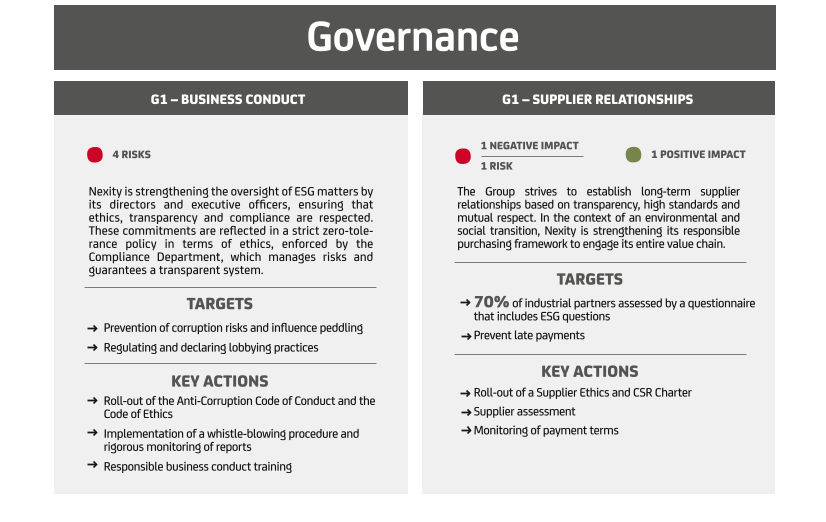 Visual dedicated to Nexity’s governance challenges, which are presented subsequently. It introduces topics related to business ethics and supplier relationships (G1). The visual describes the strengthening of ESG oversight by governing bodies, based on principles of transparency, compliance, and zero tolerance for unethical behavior. It highlights the role of the Compliance Department in identifying, preventing, and managing risks—particularly in relation to corruption and influence peddling—as well as the whistleblowing and training systems in place. The slide also emphasizes the Group’s responsible purchasing policy, built on sustainable supplier relationships, partner evaluation incorporating ESG criteria, the rollout of an ethical and CSR supplier charter, and the monitoring of payment terms, with quantified targets for value chain coverage.
The information on Governance within Nexity presented here will cover, on the one hand, topics related to business conduct (relevant strategic issues, corporate culture, policies and procedures in place and topics covered), and, on the other hand, the responsible management of supplier relationships.
3.4.1Business conduct (ESRS G1)
Business conduct is a major concern within Nexity group. It is a key driver of trust in relations with stakeholders and a key source of economic performance. As a major player in real estate development, the Company has a responsibility to conduct business in an appropriate way and therefore strives to keep its policies up to date with existing laws on this subject.
3.4.1.1Material impacts, risks and opportunities and their interaction with the strategy and business model (SBM-3)
The table below presents the characteristics of the impacts, risks and opportunities identified by the double materiality assessment as material in terms of business conduct.
IROs
Description
Policies
Targets
Shares
Risk
[Lack of corporate culture on good business conduct]
A corporate culture without ethics and compliance rules can lead to poor professional practices, posing reputational and financial risks for Nexity.
Responsible business conduct policy
- •Spreading a common corporate culture for all employees, brought to the attention of stakeholders
- •Anti-Corruption Code of Conduct
- •Code of Ethics
- •Supplier Ethics Charter
- •Conflicts of interest procedure
- •Gifts and invitations procedure
- •Training and awareness-raising campaigns
Risk
[Failure to protect whistle-blowers]
The Sapin II Law guarantees confidentiality, a lack of civil and criminal liability, and protection against reprisals for whistle-blowers. Non-compliance with these requirements may pose financial and reputational risks for Nexity.
Policy for the protection of whistle-blowers
- •Reporting breaches of the law, defining a secure framework and protecting whistle-blowers
- •Whistle-blowing procedure
- •Information campaigns on the whistle-blowing procedure
Risk
[Non-compliance with transparency requirements and the regulation of lobbying practices]
Nexity’s involvement in non-regulatory lobbying activities could present legal, financial and reputational risks for the Group.
Policy to combat and prevent influence peddling
- •Regulating and declaring lobbying practices
- •Inventory of lobbying actions
- •Declaration of lobbying actions and expenses to the HATVP
Risk
[Non-compliance with anti-corruption laws]
Corrupt practices would expose Nexity to legal, financial and reputational risks.
Anti-corruption policy
- •Prevention of corruption risks and influence peddling
- •Anti-Corruption Code of Conduct
- •Training and awareness-raising campaigns
- •Sponsorship / patronage procedure
- •Gifts and invitations procedure
3.4.1.2.Role of the administrative, management and supervisory bodies (GOV-1)
The Board of Directors is kept informed, using all possible means, of the Company’s financial position and commitments as well as any significant events and projects concerning the Company, as well as business conduct risks to which the Group is exposed. These risks are regularly presented (at least once a year) to the members of the Audit and Accounts Committee. The Executive Committee and the Management Committee are also kept regularly informed of these risks and the means implemented within the Group to deal with them.
3.4.1.3Corporate culture and business conduct policies (G1-1)
Nexity applies a zero-tolerance policy to corruption, influence peddling and any breach of probity or ethics. The Group has adopted a normative framework for these various aspects.
As soon as the "Sapin II" law came into force in 2016, the Nexity group introduced a compliance system. The Compliance Department is responsible for developing a culture of trust and integrity within Nexity group. It is tasked with creating, rolling out, managing and organising this compliance system. The Compliance Department, which has the required skills and independence, develops and implements the Group’s compliance programme in the following four areas:
- •Prevention of corruption risks and influence peddling;
- •Combating money laundering and the financing of terrorism;
- •Representation of interests (lobbying); and
- •Business ethics.
All these systems are detailed on Nexity’s intranet site, providing all employees with access to all of the information concerning the Group’s governance and business conduct initiatives.
The Compliance Department, composed of four employees, is part of the Corporate Legal, M&A and Compliance Department. It reports to the Group's Legal Department, which in turn reports directly to Executive Management.
The Compliance Department provides functional support to the Group's Chief Ethics Officer, who performs his duties independently and reports to Executive Management. It deals with and manages the follow-up on ethics-related alerts and non-compliance with the Group’s internal rules and regulations.
The Group’s executives attach particular importance to compliance with laws and regulations, whether national or international, as well as the Group’s internal rules, regulations and values. To this end, the Group has developed, with the support of its stakeholders, a set of policies and procedures, reflecting its core values, embodied by the executive team. These policies and procedures are regularly updated and disseminated within the Group by various communications methods (intranet site, specific emails, training campaigns, seminars, etc.).
The effectiveness of this system is also regularly assessed to ensure its practicality, its level of dissemination and its application in line with its principles. These regular assessments allow for constant improvement.
The adoption by the Group’s employees of integrity and exemplary conduct in the performance of their professional duties, all the principles of which are reiterated and described in Nexity’s Anti-Corruption Code of Conduct and its Code of Ethics, is vital. Details of these two codes are presented in the following paragraphs.
Corruption prevention and compliance awareness-raising are included in the training courses for all Nexity group employees and governing bodies.
Each year, Nexity's Audit and Accounts Committee and Board of Directors receive a presentation on the measures implemented within the Group to prevent corruption-related risks.
Members of the Executive Committee, the Management Committee, as well as the top executives and the Legal Department, are regularly made aware of these issues through specific presentations by the Compliance Department at Committee meetings.
In 2025, the Compliance Department also met with the Management Committees of the Group's various divisions to present the new Anti-Corruption Code of Conduct and the associated procedures that make up the Group's compliance system.
A comprehensive training and awareness-raising scheme has been put in place for all employees. Previously intended for the most exposed employees only, the two mandatory e-learning modules must be completed by all employees from 2025:
- •PCTI(1) certification: training on the risks of corruption and influence peddling, completed by 50% of all employees at 31 December 2025 (updated to 69.3% of all employees at 1 March 2026); and
- •AML-CFT(2) certification: training on anti-money laundering and combating the financing of terrorism, completed by 61% of all employees at 31 December 2025 (updated to 75.4% of all employees at 1 March 2026).(3)
These training modules are regularly updated to ensure that regulatory changes and emerging risks are taken into account. The Nexity group is targeting a training rate of 100% of its employees present (excluding long-term leave for various reasons) on these two training courses by 2026.
Anti-corruption and influence peddling certification (PCTI)
Anti-Money Laundering and Combating the Financing of Terrorism certification
(AML-CFT)Target employees
- •CEO/Deputy CEO/Managing Director
- •Development Department
- •Programme Department
- •Sales/Client Relations Department
- •CEO/Deputy CEO/Managing Director
- •Sales/Client Relations Department
- •Operational Marketing Department
3.4.1.4Prevention and detection of corruption and bribery (G1-3)
The management of corruption risks within the Nexity group is based on a structured system combining up-to-date risk mapping, clear internal policies and procedures, appropriate training, appropriate third-party assessment and a mechanism for the reporting, processing and remediation of issues.
The Compliance Department conducts an annual review of the risks of corruption and influence peddling to which the Group is exposed. This risk mapping is based on the identification and analysis of scenarios specific to the real estate sector, with the aim of defining relevant and proportionate action plans. This mapping is formalised in accordance with the recommendations of the French Anti-corruption Agency (AFA) and is based on the assessment of the risks specific to each of the Group's entities.
A report on the risk assessment campaign is presented annually to the governing bodies as well as to the Audit and Accounts Committee.
Anti-Corruption Code of Conduct
The Nexity group adopted a Code of Conduct in 2018, which was updated in 2025 to meet regulatory requirements and internal changes. This latest version split the system into two separate documents: an "Anti-Corruption Code of Conduct", dedicated exclusively to the fight against corruption and influence peddling, and a "Code of Ethics", published in early 2026, which covers other aspects of professional conduct, such as relations with third parties, respect for property and people, the environment, fairness, competition and CSR. These codes apply to all Nexity group subsidiaries.
The Anti-Corruption Code of Conduct will be updated regularly in line with regulatory and/or organisational changes. Its appendability to the internal rules and regulations of Nexity group entities is in progress, in order to strengthen its enforceability. It is accessible by all employees via the Group's intranet, and can also be consulted on Nexity's corporate website, in French and English.
The entry into force of the new Anti-Corruption Code of Conduct was the subject of an official communication from the Chairwoman and Chief Executive Officer, sent individually to all employees and posted on the Company's intranet. Acceptance of the terms of the Code was confirmed digitally, and this Code was also sent to all new employees as part of their onboarding.
Lastly, the Anti-Corruption Code of Conduct is part of an ongoing approach to transparency and training: all employees are made aware of their obligations, regular communication and training campaigns are organised, and implemented through the use of dedicated digital tools and centralised monitoring by the Compliance Department.
This system enables Nexity to guarantee a robust anti-corruption policy, adapted to legal requirements and the expectations of stakeholders, while ensuring the traceability, transparency and accountability of all its employees.
The Anti-Corruption Code of Conduct details all of the Group's commitments in terms of preventing and detecting corruption. It is based on operational procedures covering, in particular:
- •Gifts and invitations,
- •The management of conflicts of interest,
- •Patronage and sponsorship, and
- •The framework for lobbying activities.
The Anti-Corruption Code of Conduct also includes appendices setting out other procedures such as the whistle-blowing procedure and the policy on relations with third parties, and specifies that certain principles are included in additional documents accessible on the intranet. It thus constitutes the one and only standard for the entire Group and its subsidiaries in terms of the fight against corruption and influence peddling.
Gifts and invitations policy
As part of its commitment to ethics and compliance, Nexity has introduced a gifts and invitations policy applicable to all employees and company officers working for the Group. Any offer or receipt of a gift or invitation must be declared on a dedicated platform, accessible directly via the Group's intranet.
This policy, revised in 2025, sets an approval threshold of €150, meaning that prior approval from a line manager is required for any gifts or invitations representing a value higher than this amount. Rules relating to the context of the business relationship may lead to refusals.
Procedure for managing conflicts of interest
The Nexity group's procedure for managing conflicts of interest, updated in 2025, applies to all employees.
Any situation likely to represent a conflict of interest must be declared via the dedicated platform, accessible on the Group's intranet. The declaration is analysed by the line manager and then validated by the Compliance Department or the Human Resources Department.
- 1.1The employee declares any situation that could create a conflict of interest via the platform.
- 2.The line manager analyses the declaration and proposes measures to avoid any risk.
- 3.The Compliance Department and/or the Human Resources Department validate the proposed measures.
- 4.The measures are applied and monitored, and any changes must be reported.
- 5.Everything is confidential, in accordance with the provisions of the GDPR.
Failure to comply with this procedure, in particular failure to make a declaration, may lead to disciplinary action.
Commitment to local democracy
Nexity maintains close and lasting relationships with local authorities in the context of its development and development activities. However, Nexity has not implemented any specific actions to promote citizen involvement in local democracy. However, Nexity ensures that any local election mandates held by some of its employees are carried out in strict compliance with the ethics and compliance rules applicable within the Group. As such, any exercise of a public office or a local elective mandate by an employee must follow the Group's procedure for managing conflicts of interest so that specific measures are, if necessary, put in place internally to avoid any proven situation of conflicts of interest (Article L.22-10-35, 3rd paragraph, of the French Commercial Code).
Sponsorship / patronage procedure
Nexity's sponsorship and patronage procedure, updated in 2025, is based on a strict framework designed to guarantee the transparency, fairness and regulatory compliance of all actions undertaken. Since 2025, all application must be submitted via a dedicated platform, accessible on the intranet, where the project leader (who must be an external legal entity, domiciled for tax purposes in France and able to issue tax receipts) fills in a detailed form about their application, the relevant budget and schedule, and provides any supporting documentation.
- •The Nexity Foundation, which is responsible exclusively for socially useful actions to benefit social inclusion in three areas: equal opportunities, the protection of people facing hardship, particularly women and young people, and integration through sport; and
- •The Sponsorship Committee deals with all other projects, each body ruling within its scope, made up five members (including the Chief Ethics Officer, the two Deputy Managing Directors, the Director of Communications and the Legal Director).
The process for analysing applications sent to the Sponsorship Committee is as follows: once submitted on the platform, the applications are first analysed by the Compliance Department, which verifies the completeness of the file, its lawfulness, and assesses the associated level of risk. Complete and compliant applications are then examined by the Sponsorship Committee, who meet quarterly and make a decision on each application (acceptance, adjustments or rejection). Lastly, an annual presentation of the actions and the system is made to the Audit and Accounts Committee, in order to ensure transparency and overall supervision.
The policies and procedures are accessible to all employees via the Group's intranet and are also emailed individually to those for whom they are particularly relevant. They are also mentioned in the e-learning module on preventing corruption risks and influence peddling.
Confirmed cases of corruption or bribery (G1-4)
3.4.1.5Political influence and lobbying activities (G1-5)
As part of their duties, some Nexity group employees may need to interact with public decision-makers, as defined by the HATVP (High Authority for Transparency in Public Life). These procedures fall within a strictly defined framework designed to ensure the transparency and compliance of relations with public players, without seeking undue advantages or exerting pressure on public decisions.
Nexity relies on a Head of Public Affairs, who is responsible for overseeing relations between the Group and the various public institutions. His/her role is to support and advise Nexity's executives in their discussions with ministers, the administration and nationally elected representatives, as well as to maintain relations between Nexity and the federations, in particular the Fédération des Promoteurs Immobiliers (FPI).
The Compliance Department is responsible for overseeing the declaration of lobbying activities to the HATVP. It is tasked with identifying for the Group all actions representing interests with public decision-makers. The Nexity group conducts its lobbying actions through its employees but also externally through the membership of several subsidiaries and the holding company Nexity SA in professional associations.
Internal and external lobbying expenses
With regard to the declaration schedule set up by the HATVP, the data below are for the 2024 financial year, declared during the year 2025. The amount declared to the HATVP for internal and external lobbying expenses in 2025 was in the €100,000 to €200,000 bracket (approximately €130,000).
The amounts paid for membership of professional associations that are likely to carry out lobbying activities in 2025 were as follows: €128,274.
Declared lobbying actions
Since 2018, Nexity has annually declared the lobbying actions carried out each calendar year in its name and in the name and on behalf of its subsidiaries. In 2025, Nexity declared 33 actions for the year 2024, which related to the following topics:
- •Discussions on the draft 2025 Housing Finance Bill;
- •The Interest-Free Loan (PTZ) scheme: discussions on the potential reinstatement of this scheme;
- •Prospecting meetings in connection with building permit filing procedures;
- •Presentation of deliverables relating to projects in various territories; and
- •Ongoing litigation: meeting with local elected officials to consider an amicable resolution.
For the Edouard Denis group (declared separately to Nexity since 2024), there were 5 such actions in 2024.
No member of the Board of Directors, the Executive Committee or the Management Committee has held a comparable position in public administration during the two years preceding this appointment.
Nexity representation in professional organisations
- •Fédération des Promoteurs Immobiliers (FPI) on a national and regional level;
- •Entreprises pour l’Environnement (EPE);
- •Association pour le développement bas carbone (BBCA);
- •Syndicat National des Professionnels de l’Aménagement et du Lotissement (SNAL); and
- •Association Nationale des Sociétés par Actions (ANSA).
Nexity’s relationships with its partners
The Nexity group maintains relations with various third parties: intermediaries, suppliers, developers, institutions and public officials. Collaboration with these third parties may expose the Group to reputational and criminal risks in the event of any potential breaches by them of the principles of good conduct. It is therefore imperative to select partners that respect the Group's rules and values.
Nexity group employees must therefore respect the principles of independence and impartiality when selecting third parties.
The Supplier Ethics Charter, updated in 2025, and the third-party assessment are essential tools for ensuring that partners comply with the Group's principles, in accordance with internal policies.
The Compliance Department assists and advises on any questions about the risks related to relationships with third parties, conducts research on such parties, including partners, associates and co-developers (for whom a compliance opinion is systematically required before any commitment is made) and also issues advisory opinions.
As the number of Nexity group employees at 31 December 2024 was less than 5,000, the Group is no longer subject to the provisions of the Law of 27 March 2017 known as the “Duty of Care Law”.
Whistle-blowing procedure
Since 2018, the Nexity group has had an internal whistle-blowing system, which has been regularly updated (in 2020, 2023 and 2025) to ensure its compliance with regulatory changes, in particular those of the CNIL and the Waserman law. This system, which is incorporated into the Anti-Corruption Code of conduct, is accessible by all employees via the intranet and is also available on the Nexity group website, under the Ethics and Compliance section, for external stakeholders.
The whistle-blowing system precisely defines the reporting by and the status of the whistle-blower, the eligibility conditions, the methods for making a report, the processing stages of such reports, the protection guarantees offered to the person making the report, as well as the rights relating to the personal data collected.
The Group's whistle-blowing procedure thus provides that any employee or third party involved, directly or indirectly, in Nexity group’s business can alert the Group's Chief Ethics Officer of a proven or potential breach of the law, regulations or the Group’s internal rules and regulations on ethics and compliance. The whistle-blowing procedure is covered as part of an employee information campaign. It is also mentioned in the training module on the prevention of corruption and influence peddling.
- 1.Acknowledgement of receipt: the Chief Ethics Officer confirms receipt of the report within 7 working days.
- 2.Verification: they verify the admissibility of a report.
- 3.Investigation: if the report is admissible, an investigation is conducted, potentially with the help of other Departments. The confidentiality of the whistle-blower is guaranteed.
- 4.Report: a report presents the facts, conclusions and recommendations.
- 5.Decision: the Departments concerned decide on the follow-up steps to be taken (actions, sanctions, etc.).
- 6.Closure: the whistle-blower is informed within 5 working days of the issue of the report. The total duration of the investigation may not exceed 3 months from the acknowledgement of receipt of the report.
Guarantees of confidentiality and protection against reprisals are clearly defined within the procedure. The system is based on the strict confidentiality of the information processed (identity of the whistle-blower, persons concerned, third parties mentioned). Only those people strictly involved in the processing of the report have access to it, and any breach of this obligation may lead disciplinary and criminal sanctions.
-
3.5Appendices to the Sustainability Statement
Table of disclosure requirements arising from other European Union legislation
Disclosure requirements and related data point
SFDR reference
Pillar 3 reference
Benchmark reference
European Climate Law reference
ESRS 2 GOV-1
Administrative, management and supervisory bodies’ gender diversity
paragraph 21 (d)
Indicator 13,
Table 1, Annex IAnnex II of Delegated Regulation (EU) 2020/1816
ESRS 2 GOV-1
Percentage of independent directors
paragraph 21 (e)
Annex II of Delegated Regulation (EU) 2020/1816
ESRS 2 GOV-4
Statement on sustainability due diligence
paragraph 30
Indicator 10,
Table 3, Annex IESRS E1-1
Transition plan to reach climate neutrality by 2050
paragraph 14
Article 2 (1) of Regulation (EU) 2021/1119
ESRS E1-1
Undertakings excluded from Paris-aligned Benchmarks paragraph 16 (g)
Article 449a Regulation (EU) No. 575/2013, Commission Implementing Regulation (EU) 2022/2453, Template 1: Banking book - Climate change transition risk: Credit quality of exposures by sector, emissions and residual maturity
Article 12.1 (d) to (g) and Article 12.2 of Delegated Regulation (EU) 2020/1818
ESRS E1-4
Greenhouse gas emission reduction objectives
paragraph 34
Indicator 4,
Table 2, Annex IArticle 449a Regulation (EU) No. 575/2013, Commission Implementing Regulation (EU) 2022/2453, Template 3: Banking book - Climate change transition risk: alignment metrics
Article 6 of Delegated Regulation (EU) 2020/1818
ESRS E1-5
Energy consumption from fossil fuels by energy source (only sectors with a high impact on the climate)
paragraph 38
Indicator 5,
Table 1, and
Indicator 5,
Table 2, Annex IESRS E1-5
Energy consumption and mix paragraph 37
Indicator 5,
Table 1, Annex IESRS E1-5
Energy intensity associated with activities in high climate impact sectors
paragraphs 40 to 43
Indicator 6,
Table 1, Annex IESRS E1-6
Gross Scopes 1, 2 or 3
and Total greenhouse gas emissions paragraph 44Indicators 1 and 2,
Table 1, Annex IArticle 449a of Regulation (EU) No. 575/2013; Commission Implementing Regulation (EU) 2022/2453, Template 1: Banking book - Climate change transition risk: Credit quality of exposures by sector, emissions and residual maturity
Articles 5 (1), 6 and 8 (1) of Delegated Regulation (EU) 2020/1818
ESRS E1-6
Gross greenhouse gas emissions intensity
paragraphs 53 to 55
ESRS E1-6
Gross greenhouse gas emissions intensity paragraphs 53 to 55
Article 449a of Regulation (EU) No. 575/2013; Commission Implementing Regulation (EU) 2022/2453, Template 3: Banking book - Climate change transition risk: alignment metrics
Article 8 (1) of Delegated Regulation (EU) 2020/1818
ESRS 2- IRO 1 - E4
paragraph 16 (a) i
Indicator 7,
Table 1, Annex IESRS 2- IRO 1 - E4
paragraph 16 (b)
Indicator 10,
Table 2, Annex IESRS 2- IRO 1 - E4
paragraph 16 (c)
Indicator 14,
Table 2, Annex IESRS E4-2
Sustainable land / agriculture practices or policies
paragraph 24 (b)
Indicator 11,
Table 2, Annex IESRS E4-2
Sustainable oceans / seas practices or policies
paragraph 24 (c)
Indicator 12,
Table 2, Annex IESRS E4-2
Policies to address deforestation paragraph 24 (d)
Indicator 15,
Table 2, Annex IESRS E5-5
Non-recycled waste
paragraph 37 (d)
Indicator 13,
Table 2, Annex IESRS E5-5
Hazardous waste and radioactive waste
paragraph 39
Indicator 9,
Table 1, Annex IESRS S1-1
Human rights policy commitments
paragraph 20
Indicator 9,
Table 3, and
Indicator 11,
Table 1, Annex IESRS S1-1
Due diligence policies on issues addressed by the fundamental International Labour Organization Conventions 1 to 8
paragraph 21
Annex II of Delegated Regulation (EU) 2020/1816
ESRS S1-1
Workplace accident prevention policy or management system paragraph 23
Indicator 1,
Table 3, Annex IESRS S1-3
Grievance / complaints handling mechanisms
paragraph 32 (c)
Indicator 5,
Table 3, Annex IESRS S1-14
Number of fatalities and number and rate of work-related accidents
paragraph 88 (b) and (c)
Indicator 2,
Table 3, Annex IAnnex II of Delegated Regulation (EU) 2020/1816
ESRS S1-16
Unadjusted gender pay gap paragraph 97 (a)
Indicator 12,
Table 1, Annex IAnnex II of Delegated Regulation (EU) 2020/1816
ESRS S1-16
Excessive CEO pay ratio paragraph 97 (b)
Indicator 8,
Table 3, Annex IESRS S1-17
Incidents of discrimination paragraph 103 (a)
Indicator 7,
Table 3, Annex IESRS S1-17
Violations of the Guiding Principles on Business and Human Rights and
of the OECD guidelinesparagraph 104 (a)
Indicator 10,
Table 1, and
Indicator 14,
Table 3, Annex IAnnex II of Delegated Regulation (EU) 2020/1816, Article 12 (1) of Delegated Regulation (EU) 2020/1818
ESRS S2-1
Human rights policy commitments
paragraph 17
Indicator 9,
Table 3, and
Indicator 11,
Table 1, Annex IESRS S2-1
Policies related to value chain workers
paragraph 18
Indicators 11 and 4,
Table 3, Annex IESRS S2-1
Violations of the Guiding Principles on Business and Human Rights and
of the OECD guidelinesparagraph 19
Indicator 10,
Table 1, Annex IAnnex II of Delegated Regulation (EU) 2020/1816, Article 12 (1) of Delegated Regulation (EU) 2020/1818
ESRS S2-1
Duty diligence policies on issues addressed by the fundamental International Labour Organization Conventions 1 to 8
paragraph 19
Annex II of Delegated Regulation (EU) 2020/1816
ESRS S2-4
Human rights issues and incidents connected to its upstream or downstream value chain
paragraph 36
Indicator 14,
Table 3, Annex IESRS S4-1
Policies related to consumers and end-users
paragraph 16
Indicator 9,
Table 3, and
Indicator 11,
Table 1, Annex IESRS S4-1
Violations of the Guiding Principles on Business and Human Rights and
of the OECD guidelinesparagraph 17
Indicator 10,
Table 1, Annex IAnnex II of Delegated Regulation (EU) 2020/1816, Article 12 (1) of Delegated Regulation (EU) 2020/1818
ESRS S4-4
Human rights issues and incidents
paragraph 35
Indicator 14,
Table 3, Annex IESRS G1-1
United Nations Convention against Corruption
paragraph 10 (b)
Indicator 15,
Table 3, Annex IESRS G1-1
Protection of whistle-blowers paragraph 10 (d)
Indicator 6,
Table 3, Annex I
ESRS G1-4
Fines for violation of anti-corruption and anti-bribery laws paragraph 24 (a)
Indicator 17,
Table 3, Annex IAnnex II of Delegated Regulation (EU) 2020/1816
ESRS G1-4
Standards of anti-corruption and anti-bribery
paragraph 24 (b)
Indicator 16,
Table 3, Annex I -
3.6Report on the certification of sustainability information
Report on the certification of sustainability information and verification of the disclosure requirements under Article 8 of Regulation (EU) 2020/852, relating to the year ended 31 December 2025
This is a translation into English of the statutory auditors report on the certification of sustainability information and verification of the disclosure requirements under Article 8 of Regulation (EU) 2020/852 of the Company issued in French and it is provided solely for the convenience of English speaking users.
This report should be read in conjunction with, and construed in accordance with, French law and the H2A guidelines on “Limited assurance engagement - Certification of sustainability reporting and verification of disclosure requirements set out in Article 8 of Regulation (EU) 2020/852".This report is issued in our capacity as statutory auditors of Nexity SA. It covers the sustainability information and the information provided for in Article 8 of Regulation (EU) 2020/852, relating to the year ended 31 December 2025 and included in Section 3 of the Universal Registration Document (hereinafter the “Sustainability report”).
Our procedures, which relate to this information, have been performed in an evolving context characterized by uncertainties regarding the interpretation of the laws and regulations, and the development of established practices.
Pursuant to Article L.233-28-4 of the French Commercial Code, Nexity is required to include the above-mentioned information in a separate section of the group management report.
This information enables an understanding of the impact of the activity of the group on sustainability matters, as well as the way in which these matters influence the development of its business, its performance and position. Sustainability matters include environmental, social and corporate governance matters.
Pursuant to II of Article L.821-54 paragraph II of the aforementioned Code our responsibility is to carry out the procedures necessary to issue a conclusion, expressing limited assurance, on:
- •compliance with the requirements set out in the sustainability reporting standards adopted by the European Commission pursuant to Article 29b of Directive (EU) 2013/34 of the European Parliament and of the Council of 26 June 2013, as amended by Directive (EU) 2022/2464 of the European Parliament and of the Council of 14 December 2022 (hereinafter ESRS for European Sustainability Reporting Standards) of the process implemented by Nexity to determine the information reported, including, where applicable, the obligation to consult the social and economic committee provided for in the sixth paragraph of Article L. 2312-17 of the French Labour Code;
- •compliance of the sustainability information included in Section 3 "Sustainability report" of the Group’s management report with the provisions of Article L.233-28-4 of the French Commercial Code, including ESRS; and
- •compliance with the reporting requirements set out in Article 8 of Regulation (EU) 2020/852.
This engagement is carried out in compliance with the ethical rules, including independence, and quality control rules prescribed by the French Commercial Code.
It is also governed by the H2A guidelines on “Limited assurance engagement - Certification of sustainability reporting and verification of disclosure requirements set out in Article 8 of Regulation (EU) 2020/852".
In the three separate sections of the report that follow, we present, for each of the sections of our engagement, the nature of the procedures that we carried out, the conclusions that we drew from these procedures and, in support of these conclusions, the elements to which we paid particular attention and the procedures that we carried out with regard to these elements. We draw your attention to the fact that we do not express a conclusion on any of these elements taken individually and that the procedures described should be considered in the overall context of the formation of the conclusions issued in respect of each of the three sections of our engagement.
Finally, where deemed necessary to draw your attention to one or more disclosures of sustainability information provided by Nexity in the group management report, we have included an emphasis of matter paragraph hereafter.
Limits of our engagement
As the purpose of our engagement is to express limited assurance, the nature (choice of techniques), extent (scope) and timing of the procedures are less than those required to obtain reasonable assurance.
This engagement does not provide guarantee regarding the viability or the quality of the management of Nexity, in particular it does not provide an assessment of the relevance of the choices made by Nexity in terms of action plans, targets, policies, scenario analyses and transition plans, which would go beyond compliance with the ESRS reporting requirements.
Furthermore, as forward‑looking information is inherently uncertain, actual future outcomes may differ, sometimes significantly, from the forward‑looking information presented in the management report.
Our engagement does, however, allow us to express conclusions regarding the entity’s process for determining the sustainability information to be reported, the sustainability information itself, and the information reported pursuant to Article 8 of Regulation (EU) 2020/852, as to the absence of identification or, on the contrary, the identification of errors, omissions or inconsistencies of such importance that they would be likely to influence the decisions that readers of the information subject to this engagement might make.
Sustainability information and the information required under Article 8 of Regulation (EU) No 2020/852 may be subject to inherent uncertainty arising from the state of scientific knowledge and from the quality of the external data used. Certain information is sensitive to the methodological choices, assumptions and/or estimates applied in preparing it and presented in the group management report.
-
4Corporate Governance Report
- 4.1 Governance of the Company
- 4.2 The Board of Directors
- 4.3 Executive Management
- 4.4 Remuneration and benefits paid to executive company officers and directors
- 4.5 Pensions and other benefits
- 4.6 Related-party transactions
- 4.7 Interests of executive company officers and members of the Board of Directors in the Company's share capital
- 4.8 Transactions in securities
- 4.9 Stock options and free shares awarded to executive compagny officers
- 4.10 Major shareholders
- 4.11 Information on the share capital
- 4.12 Statutory provisions
-
4.1Governance of the Company
4.1.1Governance principles and code
Pursuant to Article L.225-37 of the French Commercial Code, the Board of Directors must present at the Shareholders’ Meeting a Corporate Governance Report, appended to the management report, containing information about governance, remuneration and factors likely to have an impact in the event of a takeover bid.
This report is prepared with reference to the Afep-Medef Corporate Governance Code for listed companies (the “Afep-Medef Code”), to which the Company adheres. The sections of this report relating to its composition, the conditions of preparation and organisation of the Board of Directors have been prepared on the basis of contributions from various Group departments, in particular the Finance Department, the Human Resources Department and the Legal Department. It was presented to the Remuneration and Appointments Committee.
This report describes the work of the Board of Directors, which is also governed by the Board’s internal rules and regulations. These reiterate that directors are required to maintain discretion and confidentiality and that, for all transactions in securities, they must comply with the Insider Trading Prevention Guide adopted by the Company. The Board of Directors' internal rules and regulations and the Insider Trading Prevention Guide are available on the Group's website:
The internal rules and regulations of the Board of Directors were last amended on 22 May 2025. These changes were made following the approval by the Shareholders' Meeting of the same day on the compliance upgrade of Article 14 of the Company's Articles of Association, in accordance with the so-called "Attractiveness Law" No. 2024-537 of 13 June 2024 aimed at increasing the financing of businesses and the attractiveness of France, by enabling meetings and all decisions of the Board of Directors to be held by a means of telecommunication, including for the approval of the Parent Company financial statements and the approval of the Management Report, as well as the option to use written consultation for any type of decision to be made by the Board of Directors. Article 2.3 "Deliberations of the Board" of the internal rules and regulations has consequently been updated, notably to set out the main terms and conditions for holding meetings and written consultations.
-
4.2The Board of Directors
A brief description of the main provisions of the Company’s Articles of Association and the Board of Directors’ internal rules and regulations can be found in this section, and in Section 4.12 "Statutory provisions" of this chapter.
4.2.1Composition of the Board of Directors and its Committees
4.2.1.1Summary of the composition of the Board of Directors at 31 December 2025
The members of the Board of Directors can be contacted at the Company’s registered office: 67 rue Arago - 93400 Saint-Ouen- sur-Seine - France.
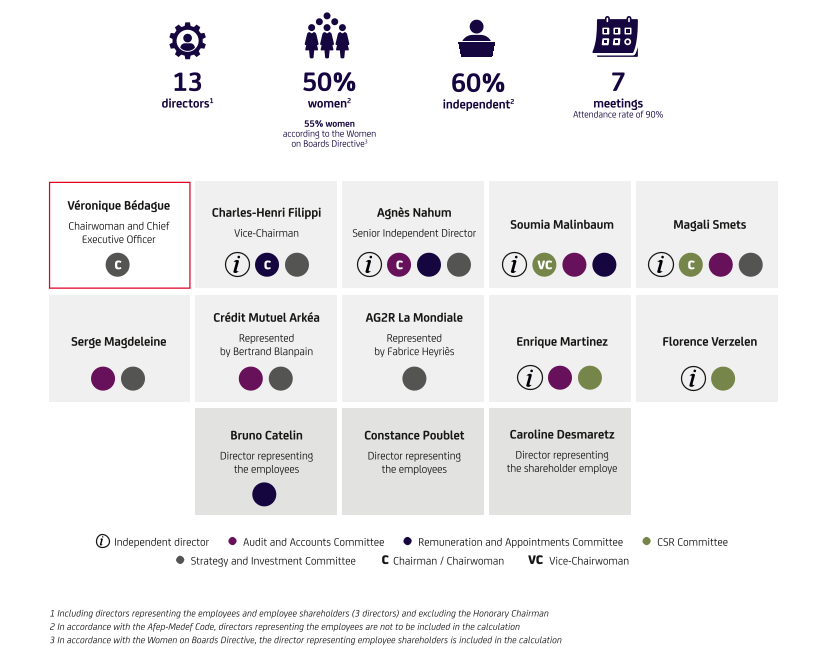 Infographic summarizing the composition of the Board of Directors. The Board comprises 13 directors, including 3 employee representatives and employee shareholder representatives, excluding the Honorary Chairman. Women represent 50% of the Board, rising to 55% under the European “Women on Boards” directive. Independent directors account for 60% of members, excluding employee representatives. The Board met 7 times during the financial year, with an attendance rate of 90%. The Chairwoman and Chief Executive Officer is Véronique Bédague, and the Vice Chairman is Charles Henri Filippi. Members also serve on specialized committees: the Remuneration and Nomination Committee, the Audit and Accounts Committee, the Strategy and Investment Committee, and the CSR Committee.
4.2.1.2Changes in the composition of the Board of Directors and its Committees during the fiscal year ended 31 December 2025
Leaving
Appointment
Renewal
Comments
Executive Management
Véronique Bédague
22/05/2025
Renewal of directorship
Board of Directors
Florence Verzelen
22/05/2025
Soumia Malinbaum
22/05/2025
Crédit Mutuel Arkéa
22/05/2025
Renewal of directorship
Renewal of directorship
Renewal of directorship
Jérôme Grivet
16/06/2025
Serge Magdeleine
24/07/2025
Resignation
Co-option
Bruno Angles
(AG2R La Mondiale)
08/01/2025
Benoit Courmont
(AG2R La Mondiale)
15/07/2025
Benoit Courmont
(AG2R La Mondiale)
17/01/2025
Fabrice Heyriès
(AG2R La Mondiale)
15/07/2025
Change of permanent
representative
of AG2R La Mondiale
Change of permanent
representative
of AG2R La Mondiale
Caroline Demaretz
22/05/2025
Director representing
the shareholder employees
Audit and Accounts Committee
Jérôme Grivet
16/06/2025
Serge Magdeleine
24/07/2025
Remuneration and Appointments Committee
N/A
N/A
N/A
N/A
CSR Committee
Soumia Malinbaum
02/04/2025
Vice-Chairwoman
of the Committee
Strategy and Investment Committee
Jérôme Grivet
16/06/2025
Serge Magdeleine
24/07/2025
- •Serge Magdeleine, Chief Executive Officer of LCL, was co-opted on 24 July 2025, to replace Jérôme Grivet, who resigned, for the remainder of his predecessor's term of office, i.e. until the end of the Annual Shareholders' Meeting held in 2028 to approve the financial statements for the fiscal year ending 31 December 2027. He represents Crédit Agricole Assurances, shareholder holding 6.4% of the share capital at 31 December 2025; and
- •Two changes to the permanent representative of AG2R La Mondiale: in 2025, the permanent representation of AG2R La Mondiale on Nexity's Board of Directors changed, following changes in the executive management of the AG2R La Mondiale group. The departure of Bruno Angles from his position as Chief Executive Officer at the beginning of the year led to the appointment of Benoît Courmont as Interim Chief Executive Officer on 8 January 2025, who has acted as permanent representative of AG2R La Mondiale on the Nexity Board since 17 January 2025. This period of transition ended with the appointment of Fabrice Heyriès as Chief Executive Officer of the Group. Consequently, following a letter received from AG2R La Mondiale on 15 July 2025, the permanent representative is now Fabrice Heyriès.
4.2.1.3Members of the Board of Directors at 31 December 2025
PERSONAL
INFORMATION
EXPERIENCE POSITION
WITHIN THE BOARD
PARTICIPATION IN BOARD COMMITTEES
Age*
Gender
Nationality
Number of shares held directly and indirectly
Number of appointments in other listed companies
Independence
Date first appointed
Term of office expiry date
Length of service on the Board
Audit and Accounts Committee
Remuneration and Appointments Committee
CSR Committee
Strategy and Investment Committee
Executive company officer / Chairwoman of the Board
Véronique Bédague
62
F

89,197
1
19/05/21
SM 2029
4.6
C
Directors
Charles-Henri Filippi
Vice-Chairman
73
M
3,000
✓
15/12/16
SM 2027
9.0
C
Agnès Nahum
Senior Independent Director
65
F
200
✓
19/05/15
SM 2027
9.5
C
Soumia Belaidi-Malinbaum
64
F
300
✓
24/03/15
SM 2029
9.5
VC
Magali Smets
52
F
600
✓
31/05/16
SM 2028
8.5
C
Serge Magdeleine
54
M
200
24/07/25
SM 2028
0.4
Crédit Mutuel Arkéa
represented by Bertrand Blanpain
63
M
2,653,597
19/05/21
SM 2029
4.6
AG2R La Mondiale
represented by Fabrice Heyriès (1)
57
M
2,806,487
18/05/22
SM 2026
3.6
Florence Verzelen
48
F
200
1
✓
03/04/24
SM 2029
0.5
Enrique Martinez
55
M

200
1
✓
23/05/24
SM 2028
0.5
Jérôme Grivet - until 16 June 2025 (2)
-
M
-
23/07/15
16/06/25
Director representing the shareholder employees
Caroline Desmaretz
52
F
10,305
22/05/25
SM 2028
0.6
Directors representing employees
Bruno Catelin
60
M
1,160
01/01/17
31/10/28
8.9
Constance Poublet
41
F
5,301
22/04/24
31/10/28
1.7
- *At 1 April 2026
C: Chairman/woman of the Committee
VC: Vice-Chairman/woman of the Committee
- (1)Bruno Angles was the permanent representative of AG2R La Mondiale on Nexity's Board of Directors until 8 January 2025. Following a letter received from AG2R La Mondiale on 17 January 2025, Benoit Courmont became permanent representative of AG2R La Mondiale from that date until 15 July 2025, the date on which, following a letter received from AG2R La Mondiale, Fabrice Heyriès became the permanent representative
- (2)Resignation from his role as director on 16 June 2025
Furthermore, following the appointment of a director representing the employees by the Economic and Social Committee of UES Nexity Promotion Construction, in accordance with the provisions of Article L.2323-65 of the French Labour Code, a single representative of this Committee, Emmanuel Brie, attends Board of Directors' meetings.
As of the date of this Universal registration document, Alain Dinin, founding Chairman of Nexity, retains his role as Honorary Chairman of the Board of Directors, and may attend Board meetings only at the request of the Chairwoman. The role of the Honorary Chairman is explained in the internal rules and regulations of the Board of Directors and in Section 4.3.1 "Executive Management approach" of this chapter. He did not attend any Board of Directors' meetings in 2024 or 2025.
The tables below show the members of the Company’s Board of Directors as well as each member’s main position held within the Company, their primary activities outside of the Company, where material, as well as any other offices and positions held over the past five years, all as of 31 December 2025.
Véronique Bédague
Chairwoman and Chief Executive Officer and Director

Nationality: French
Age: 62
Business address: 67 rue Arago - 93400 Saint-Ouen-sur-Seine - France
Date first appointed: 19/05/2021
Term of office expiry date: at the end of the Company’s Shareholders’ Meeting called to approve the financial statements for the fiscal year ending 31/12/2028
Number of shares at 31 December 2025: 89,197 held directly
- >Chairwoman and Chief Executive Officer since 1 January 2023
- >Chairwoman of the Strategy and Investment Committee
Véronique Bédague has been Chairwoman and CEO of Nexity since 1 January 2023, having been a Director and Chief Executive Officer from 19 May 2021 until 31 December 2022. A graduate of IEP Paris, ESSEC and a former student of ENA, Véronique Bédague joined the Nexity group in 2017 as General Secretary and member of the Executive Committee. Between 2018 and 2020, she successively held the positions of Chairwoman and CEO of Nexity lmmobilier d’Entreprise, Deputy Managing Director of the Nexity group, in charge of the “Commercial and Local Authority Clients” and later "Institutional Clients" divisions. She has worked at the Ministry of the Economy and Finance, the International Monetary Fund, and the City of Paris. Before joining Nexity, she was Chief of Staff to the Prime Minister.
Expertise
Finance, Real Estate, Strategy and Investment, Governance, IT and digital systems, CSR (excluding Climate), Ethics & Compliance
Current appointments
- >Outside the Group
- •Director and Vice-Chairwoman of the Fédération des Promoteurs Immobiliers
- •Member of the Conseil d’État integration commission
- •Director and member of the Audit and Accounts Committee of Véolia Environnement(1)
- •Member of the Executive Board of Medef
- >Within the Group
- •Legal representative of Nexity, President of SAS Lilas Paul Meurice
- •Legal representative of Nexity, Chief Executive Officer of En Invalides Gestion SAS
- •Legal representative of Nexity, Chief Executive Officer, Vice-Chairwoman of the Board of Directors, Director of SAS Eco-campus À Châtillon
- •In her capacity as the legal representative of Nexity, Véronique Bédague is also the legal representative of various non-trading companies and partnerships.
Terms of office expired during the past five years
- •Member of the Supervisory Board of Ægide (until 14/02/2025)
- •President of SIG 30 Participations (until 08/11/2024)
- •Legal representative of SIG 30 Participations, Director of SAS Eco-campus À Châtillon (until 08/11/2024)
- •Legal representative of SAS Eco-campus À Châtillon, Chairwoman of SAS Mercedes (until 24/06/2024)
- •Legal representative of SIG 30 Participations, Chairwoman of Neximmo 19, Neximmo 41, Neximmo 60, Neximmo 71, Neximmo 75, Neximmo 90, Neximmo 96, Neximmo 97, Neximmo 101, Neximmo 102, Neximmo 103, Neximmo 104, Neximmo 106, Neximmo 107, Neximmo 108, Neximmo 109, Neximmo 110, Neximmo 112, Neximmo 113, Neximmo 114, Neximmo 116, Neximmo 117, Neximmo 118, Neximmo 119, Neximmo 120, Neximmo 121, Neximmo 124, Neximmo 125, Neximmo 126, Neximmo 127, Neximmo 128, Neximmo 129, Neximmo 130, Neximmo 131, Neximmo 132, Nexprom, La Cité, Sari Investissement, Terrae Novae 1, Terrae Novae 2, SAS Porte de Montreuil (until 08/11/2024)
- •Legal representative of SIG 30 Participations, Chief Executive Officer of Aqueduc, SAS Bagneux Briand, SAS Bagneux Victor Hugo (until 08/11/2024)
- •Legal representative of SIG 30 Participations, Manager of Terrae Novae, Toulouse Bow, Montpellier Cambacérès, Garenne Développement, Toulouse Jolimont Bureaux (until 08/11/2024)
- •Legal representative of SIG 30 Participations, Chairwoman of Neximmo 51, Neximmo 85 (until 26/10/2024)
- •Deputy Chief Executive Officer of VP Participations (until 10/10/2024)
- •Legal representative of VP Participations, Chairwoman of Nexiville 1, Nexiville 2, Nexiville 4, Nexiville 5, Pontault Louvetière, Nexiville 8, Nexiville 9, Garenne Aménagement, Nexiville 11, Nexiville 14, Nexiville 19, Nexiville 20, Neximmo 42, Axioparc (until 10/10/2024)
- •Deputy Chief Executive Officer of Villes et Projets (until 10/10/2024)
- •Legal representative of Villes et Projets, Manager of SNC Aménagement Charras (until 10/10/2024)
- •Legal representative of Villes et Projets, Chairwoman of Presqu'Île Hérouvillaise (until 10/10/2024)
- •Director of Nexity Immobilier d’Entreprise (until 05/06/2024)
- •Legal representative of SIG 30 Participations, Chairwoman of Neximmo 136 (until 28/07/2023)
- •Legal representative of SIG 30 Participations, Chairwoman of Neximmo 134, Neximmo 137 (until 27/07/2023)
- •Legal representative of SIG 30 Participations, Chairwoman of Neximmo 38, Neximmo 44, Neximmo 91, Neximmo 100 (until 12/07/2024)
- •Legal representative of SIG 30 Participations, Chairwoman of Neximmo 139 (until 12/06/2024)
- •Legal representative of SIG 30 Participations, Chairwoman of Neximmo 138 (until 24/08/2023)
- •Legal representative of SIG 30 Participations, Chairwoman of Neximmo 49 (until 15/05/2023)
- •Director of Edouard Denis Développement (until 24/04/2023)
- •Legal representative of SIG 30 Participations, liquidator of SCI Boulogne Ville A3B (until 24/04/2023)
- •Legal representative of SIG 30 Participations, Chairwoman of Neximmo 65 (until 24/04/2023)
- •Legal representative of SIG 30 Participations, Chairwoman of Neximmo 133 (until 30/01/2023)
- •Legal representative of SIG 30 Participations, Chairwoman of Neximmo 82 (until 27/11/2022)
- •Chairwoman of the Board of Directors of Nexity Immobilier d’Entreprise (until 28/10/2022)
- •Legal representative of SIG 30 Participations, Chairwoman of Neximmo 54, Neximmo 72, Neximmo 73, Neximmo 80, Neximmo 81, Neximmo 86, Neximmo 87, Neximmo 88, Neximmo 111 (until 24/10/2022)
- •Legal representative of SIG 30 Participations, Chairwoman of Neximmo 48 (until 21/10/2022)
- •Chairwoman of Nexity Logement (until 28/07/2022)
- •Legal representative of SIG 30 Participations, Chairwoman of Neximmo 122 (until 30/06/2022)
- •Legal representative of VP Participations, President of Immocash 1, Immocash 2, Immocash 3 (until 20/05/2022)
- •Legal representative of SIG 30 Participations, Chairwoman of Terrae Novae 3 (until 10/02/2022)
- •Legal representative of Nexity, President of SAS Nexity Franchises (until 12/01/2022)
- •Director of Électricité de France (1) (until 12/05/2022), and of the BBCA association (until 29/11/2021)
- •Chairwoman and Chief Executive Officer of Nexity Immobilier d’Entreprise (until 25/11/2021)
- •Member of the Supervisory Committee of Bureaux à Partager (until 12/10/2021)
- •Chief Executive Officer of SIG 30 Participations (until 19/05/2021)
- •Chairwoman of the Board of Directors and Director of Nexity Property Management (until 04/03/2021)
- •President of Neximmo 78 (until 08/01/2021)
- •Legal representative of Neximmo 78, Chairwoman of Service Personnel, Accessite, Hiptown, Nexity Solutions Digitales, Costame, Moreau Experts, Nexity Contractant Général, L’Étoile Property Management (until 08/01/2021)
- (1)Listed company
Charles-Henri Filippi
Vice-Chairman
Independent director

Nationality: French
Age: 73
Business address: EVERCORE - 90 rue de Courcelles - 75008 Paris - France
Date first appointed: 15/12/2016
Term of office expiry date: at the end of the Company’s Shareholders’ Meeting called to approve the financial statements for the fiscal year ending 31/12/2026
Number of shares at 31 December 2025: 3,000 held directly
- >Chairman of the Remuneration and Appointments Committee
- >Member of the Strategy and Investment Committee
Charles-Henri Filippi has been Chairman of Evercore France since 1 September 2024. He was previously Co-Chairman France of Banque Lazard (2018-2024) and Chairman of Citigroup France (2011-2018). After holding several positions in French government agencies and ministerial departments, he joined CCF in 1987 and became its Chief Executive Officer in 1998. In 2001, he was appointed to HSBC’s Executive Committee, with responsibility for major client activities across the entire group. He was named Chairman and CEO of HSBC France in March 2004, then non-executive Chairman from August 2007, a position he held until 31 December 2008. He was also Senior Advisor at CVC Capital Partners France until 31 December 2010, Partner at Weinberg Capital Partners until 31 December 2011, and founded the asset management companies Octagones and Alfina, serving as Chairman of both from 2008 to 2012.
Expertise
Finance, Financial Services (banking and insurance), Real Estate, Strategy and Investment, Governance, CSR (excluding Climate), Ethics & Compliance
Current appointments
- •Chairman of Octagones
- •Vice-Chairman of the Association des Amis du Domaine de Chaumont/Loire
- •Director of Piasa, Fondation des Treilles (non-profit organisation), Fondation Bettencourt-Schueller (non-profit organisation)
Terms of office expired during the past five years
None
Agnès Nahum
Senior Independent Director
Independent director

Nationality: French
Age: 65
Business address: 42 rue de Washington - 75008 Paris - France
Date first appointed: 19/05/2015
Term of office expiry date: at the end of the Company’s Shareholders’ Meeting called to approve the financial statements for the fiscal year ending 31/12/2026
Number of shares at 31 December 2025: 200 held directly
- >Chairwoman of the Audit and Accounts Committee
- >Member of the Remuneration and Appointments Committee
- >Member of the Strategy and Investment Committee
Agnès Nahum has, since December 1998, been the Co-Founder and Chairwoman of the Management Board of investment company Access Capital Partners, which specialises in managing European private equity and infrastructure funds. Previously, she was Senior Vice-President of Business Development at BNP Paribas Private Equity, Business Development Director at Financière Saint Dominique and Head of Investment and Development at MAAF.
Expertise
Finance, Financial Services (banking and insurance), Strategy and Investment, International, Governance, CSR (excluding Climate), Ethics and Compliance
Current appointments
- >In France
- •Chairwoman of the Management Board of Access Capital Partners SA
- •Managing Director of Monirouz
- >Outside France
- •Director of Access Capital SA (Belgium), Access Capital Partners Group SA (Belgium), Access Capital Private Assets US, Access Capital Partners II Ltd. (Guernsey), Access Co-Investissement Europe (Luxembourg), Access Capital Advisors Finland Oy, ACL 2 Sarl (Luxembourg), Castle SA (Luxembourg), ACF II SICAV-SIF (Luxembourg), Marigold ACP Sàrl (Luxembourg), Bruegel ACP Sàrl (Luxembourg), Chrysanthenum Sàrl (Luxembourg), Havre Infrastructure Sarl (Luxembourg)
Terms of office expired during the past five years
None
Soumia Belaidi-Malinbaum
Independent director

Nationality: French
Age: 64
Business address: 9 place Jeanne Bassot - 92300 Levallois-Perret - France
Date first appointed: 24/03/2015
Term of office expiry date: at the end of the Company’s Shareholders’ Meeting called to approve the financial statements for the fiscal year ending 31/12/2028
Number of shares at 31 December 2025: 300 held directly
- >Member of the Audit and Accounts Committee
- >Member of the Remuneration and Appointments Committee
- >Member of the CSR Committee
Since March 2024, Soumia Belaidi-Malinbaum has been Chief Executive Officer in charge of Business Development and CSR at JEMS Group. She was VP in charge of development and ESG at Keyrus from 2006 until 2024. Between 1991 to 2006, she founded and chaired Specimen, a digital services company. Prior to this, from 1986 to 1991, she was an Account Manager in Financing and Leasing at International Brokerage Leasing.
In November 2021, she was appointed Chairwoman of the Paris Chamber of Commerce and Industry.
She has been Vice-Chairwoman of the Paris Chamber of Commerce and Industry since September 2025.
Expertise
Finance, Strategy and Investment, Governance, IT and digital systems, CSR (excluding Climate), Climate, Ethics and Compliance
Current appointments
- •First Vice-Chairwoman of the Paris Chamber of Commerce and Industry
- •Member of the Board of Directors of the EDF Foundation
Terms of office expired during the past five years
- •Chairwoman of the Paris Chamber of Commerce and Industry (until September 2025)
- •Director and member of the Appointments Committee of the Lagardère SCA group (1)
- •Director and Chairwoman of the Audit Committee of France Média Monde
- (1)Listed company
Magali Smets
Independent director

Nationality: French
Age: 52
Business address: France Chimie - Le Diamant A - 14, rue de la République - 92800 Puteaux - France
Date first appointed: 31/05/2016
Term of office expiry date: at the end of the Company’s Shareholders’ Meeting called to approve the financial statements for the fiscal year ending 31/12/2027
Number of shares at 31 December 2025: 600 held directly
- >Chairwoman of the CSR Committee
- >Member of the Audit and Accounts Committee
- >Member of the Strategy and Investment Committee
Magali Smets is Chief Executive Officer of France Chimie (professional organisation). She began her career in 1999 as a consultant at McKinsey & Company. In 2001, she joined the Strategy Department of Alstom T&D, later becoming Chief Strategy Officer of Areva T&D. In 2007, she represented Areva at the European Union. In January 2013, she became Director, reporting to the Chairman, and Executive Secretary of Areva’s Management Board, before she became Areva’s Chief Strategy Officer in 2015. She actively contributes to the work of Medef, France Industrie, the Conseil national de l’industrie and the CEFIC (European Chemical Industry Council).
Expertise
Finance, Strategy and Investment, Governance, CSR (excluding Climate), Climate
Current appointments
- •Member of the French National Ecological Transition Council for Medef
- •Chairwoman of Syndicat des Activités et Produits divers en relation avec la Chimie et la Parachimie (APROCHIM)
- •Vice-Chairwoman of Groupement des Industries Chimiques pour les Études et la Recherche (GICPER)
- •Manager of SCI Immochim
- •Director of CEFIC, CP Chimie Promotion, Universcience Partenaires
Terms of office expired during the past five years
None
Enrique Martinez
Independent director

Nationality : Spanish
Age : 55
Business address: Fnac Darty head office - 9 rue des Bateaux-Lavoirs - 94200 Ivry-sur-Seine
Date first appointed: 23/05/2024
Term of office expiry date: At the end of the Company’s Shareholders’ Meeting called to approve the financial statements for the fiscal year ending 31/12/2027
Number of shares at 31 December 2025: 200 held directly
- >Member of the Audit and Accounts Committee
- >Member of the CSR Committee
A graduate in economics from IESE Business School in Madrid, Enrique Martinez began his career at Toys 'R' Us. In 1998, he joined Groupe Fnac with the mission of establishing and developing the brand in Portugal. He then went on to hold various positions within the Group between Spain and Portugal. In 2004, he became a member of the Executive Committee as Chief Executive Officer for the Iberian region. In 2012, he was called to France to lead the France and Northern Europe region (France, Belgium, Switzerland). Over a total period of 19 years, Enrique Martinez made a significant contribution to the development of Groupe Fnac. In July 2016, he was entrusted with the task of integrating the Fnac and Darty brands in France, which in just a few months would lead to the creation of the first synergies between the two brands.
He has been Chief Executive Officer of Fnac Darty since July 2017 (1).
Expertise
Finance, Financial Services (banking and insurance), Real Estate, Strategy and Investments, International, Governance, Information Systems and Digital, CSR (excluding climate), Climate, Ethics and Compliance
Current appointments
- •Managing Director of Fnac Darty (1)
- •Independent Director of Nuxe
- •Chairman of SAS Beltaine Groupe
- •Chairman of UNIEURO Group - Italy
Terms of office expired during the past five years
- •Director of Shaker group, a company listed on the Riyadh Stock Exchange (Tadawul)
- (1)Listed company
Serge Magdeleine
Director

Nationality: French
Age: 54
Business address: 20 avenue de Paris - 94800 Villejuif - France
Date first appointed: 24/07/2025
Term of office expiry date: at the end of the Company’s Shareholders’ Meeting called to approve the financial statements for the fiscal year ending 31/12/2027
Number of shares at 31 December 2025: 200 held directly
- >Member of the Audit and Accounts Committee
- >Member of the Strategy and Investment Committee
After starting his career in consulting at Mercer Oliver Wyman from 1996 to 1999, then as founding Chairman of Empruntis.com from 1999 to 2001, Serge Magdeleine joined Crédit Agricole S.A. as Head of Online Banking before being appointed Head of Multimedia Marketing. In 2006, he joined the Paris and Ile-de-France Regional Bank as Head of the Distribution and Multichannel Division, then, in 2007, the Centre-Est Regional Bank as Head of Corporate and International. In 2010, he became Deputy Managing Director of the Alpes Provence Regional Bank, in charge of development, and Chief Executive Officer of GIE e-Immo. In November 2015, he was appointed Group Marketing and Digital Director of Crédit Agricole SA.
In 2016, he became Head of Digital Transformation and IT at the Crédit Agricole Group and Chief Executive Officer of Crédit Agricole Technologies & Services. He is a member of the Executive Committee of Crédit Agricole SA. He is also Chief Executive Officer of e-Immo, Vice-Chairman of Crédit Agricole Group Infrastructure Platform and member of the Board of Directors of the Crédit Agricole Investment and Research Fund.
In 2020, he joined Crédit Agricole Alpes Provence as Chief Executive Officer of the Regional Bank and became Permanent Representative of the FNCA and Chairman of CA e-Développement.
He was appointed Chief Executive Officer of LCL in January 2024.
In January 2021, he was appointed to the rank of Knight of the National Order of the Legion of Honour.
Current appointments
- •Chief Executive Officer of LCL
- •Director of Prédica
- •Director of Crédit Agricole Assurance Retraite
- •Director of Crédit Agricole Assurances
- •Director of Pacifica
- •Director of CA Indosuez
Terms of office expired during the past five years
- •Chairman of Crédit Agricole Creditor Insurance (until 2025)
- •Director of Blank (until 2025)
- •Director of CA Bank Polska (until 2024)
- •Chief Executive Officer of CRCAM Alpes Provence (until 2023)
- •Director of CA Payment Services (until 2023), CAGIP (until 2023), SOFIPACA (until 2023)
Crédit Mutuel Arkéa
Director

Date first appointed: 19/05/2021
Term of office expiry date: at the end of the Company’s Shareholders’ Meeting called to approve the financial statements for the fiscal year ending 31/12/2028
Number of shares at 31 December 2024: 2,653,597 held directly
Biography
Crédit Mutuel Arkéa is a cooperative banking group, bringing together the Crédit Mutuel de Bretagne and Sud-Ouest federations, as well as around 30 subsidiaries specialising in financial services. Crédit Mutuel Arkéa is a national player with strong regional roots, with a total equity of €8 billion, with around 11,000 employees serving nearly 5 million customers. Crédit Mutuel Arkéa has been a majority shareholder in Nexity since 2015.
Bertrand Blanpain (permanent representative of Crédit Mutuel Arkéa)

Nationality: French
Age: 63
Business address: Arkéa Banque Entreprises et Institutionnels - CS 96856 - 3 avenue d'Alphasis - 35760 Saint-Grégoire - France
- >Member of the Audit and Accounts Committee
- >Member of the Strategy and Investment Committee
A graduate of ESCP Europe, with a Master's degree in economics and a DEA in political economy, Bertrand Blanpain joined Crédit Mutuel Arkéa in June 2015 as a member of the Management Board of Arkéa Banque and Commercial Director of Arkéa Banque Entreprises et Institutionnels, becoming Chairman of the Management Board in 2016. He has also been a member of the Executive Committee of Crédit Mutuel Arkéa and Director of the Corporate and Institutional Division since 2016. In 2021, he was appointed Deputy Managing Director of Crédit Mutuel Arkéa. Bertrand Blanpain began his professional career at Drouot Assurances (1986-1987) before moving on to the Caisse d’Épargne group (1987-2015) where he held various general management positions in the areas of sales, human resources, banking and finance.
Expertise
Finance, Financial Services (banking and insurance), Real Estate, Strategy and Investment, Governance,
Information systems and digital, CSR (excluding climate), Climate, Ethics and Compliance
Current appointments
- •Chairman of the Management Board of Arkéa Banque Entreprises et Institutionnels
- •Deputy managing director of Crédit Mutuel Arkéa
- •Representative of Arkéa Capital on the Supervisory Board of Aquiti Gestion
Terms of office expired during the past five years
- •Permanent representative of Crédit Mutuel Arkéa on the Board of Directors of Sofiouest (until July 2024)
- •Permanent representative of Crédit Mutuel Arkéa on the Supervisory Board of New Port SAS (until 27/12/2022)
- •Permanent representative of Crédit Mutuel Arkéa on the Supervisory Board of Clearwater (until 2021)
- •Permanent representative of Arkéa Banque Entreprises et Institutionnels on the Board of Directors of Arkéa Public Sector SCF (until 2021)
- •Member of the Supervisory Board of Budget Insight (until 2021)
- •Permanent representative of Crédit Mutuel Arkéa on the Board of Directors of Aquiti Gestion SAS (until 2021)
LA MONDIALE
Director
Renewal of the term of office proposed to the Shareholders' Meeting of 21 May 2026

Date first appointed:
18/05/2022
Term of office expiry date:
At the end of the Company’s Shareholders’ Meeting called to approve the financial statements for the fiscal year ending 31/12/2025
Number of shares at 31 December 2025:
2,806,487 held directly
Biography
La Mondiale is a mutual insurance company governed by the French Insurance Code, the constituent company of AG2R LA MONDIALE. It was created in 1905 in Lille and its registered office is located at 32 avenue Émile Zola in Mons-en-Baroeul, France. With its subsidiaries La Mondiale Partenaire, La Mondiale Europartner, La Mondiale Retraite Supplémentaire, ARIAL CNP ASSURANCES (joint venture with CNP Assurances, 60%-owned) and Ægide-Domitys, La Mondiale covers the supplementary, individual and collective pension, savings, personal protection insurance and senior residences business lines.
In 2024, it generated consolidated life insurance revenue of €7.8 billion. Leader in its three major markets, its main target markets are professionals in individual pension schemes (€0.9 billion), large companies in collective pension schemes (€1.3 billion mainly via ARIAL CNP ASSURANCES) and high net-worth savings customers (€2.7 billion via La Mondiale Partenaire in France and €2.8 billion via La Mondiale Europartner in Luxembourg).
Its products are distributed by an internal network of a thousand advisors and via private banking partners. At the end of 2024, La Mondiale’s assets under management represented €109.5 billion, of which 37% were unit-linked and 63% were funds.
Fabrice Heyriès (permanent representative of AG2R LA MONDIALE)*

Nationality: French
Age: 57
Business address: 14 boulevard Malesherbes - 75008 Paris - France
- >Member of the Strategy and Investment Committee
Fabrice Heyriès is a graduate of the Institut d'études politiques d'Aix-en-Provence and a former student of the ENA. He began his career at the Ministry of the Interior, before becoming a Magistrate of the Court of Auditors. He joined the cabinet of the Minister of Labour and Solidarity in 2007 as an advisor on budgetary and social affairs before being appointed Deputy Chief of Staff to the Minister in 2008. In 2009, he became Director General of Social Action at the Ministry of Social Affairs, where he played a key role in the creation of the Directorate General for Social Cohesion (DGCS), becoming its first Director General. In 2011, he joined Groupama as Director of Public Affairs, Economics and Sustainable Development. He then held various positions within the group eventually becoming Deputy Managing Director in 2015. In September 2020, he was appointed Chief Executive Officer of MGEN and Director of Strategy, Influence and Audit for the VYV Group.
On 25 February 2025, Fabrice Heyriès was appointed Chief Executive Officer of AG2R LA MONDIALE by the Board of Directors of the Association Sommitale and the Board of Directors of La Mondiale, on the joint proposal of their Remuneration and Appointments Committees. He joined the Group on 7 April 2025.
Expertise
Finance, Financial Services (banking and insurance), Real Estate, Strategy and Investments, Governance, Ethics and Compliance
Current appointments
- •Chief Executive Officer of the AG2R LA MONDIALE Group
- •Chief Executive Officer of the AG2R LA MONDIALE Association Sommitale
- •Chief Executive Officer of GIE AG2R
- •Chief Executive Officer of AG Mut
- •Chief Executive Officer of AG2R Agic-Arrco
- •Chief Executive Officer and Executive Director of AG2R LA MONDIALE REASSURANCE
- •Chief Executive Officer and Executive Director of AG2R Prévoyance
- •Chief Executive Officer and Executive Director of La Mondiale
- •Chief Executive Officer and Executive Director of SGAM AG2R LA MONDIALE
- •Chief Executive Officer and Executive Director of SGAPS AG2R LA MONDIALE
- •Deputy Managing Director of VIASANTE Mutuelle
- •Chairman of GIE La Mondiale Groupe
- •Chairman of La Mondiale Grands Crus
Terms of office expired during the past five years
- •Director of Mutex (until 19/03/2025)
- •Chairman and Director of MGEN Technologies (until April 2025)
- •Director of UMR (until October 2025)
- •Chief Executive Officer of MGEN Union, MGEN, MGEN Actions Sanitaire et sociale, MGEN Centres de santé, MGEN Partenaires (until April 2025)
- *Bruno Angles was the permanent representative of AG2R La Mondiale on Nexity's Board of Directors until 8 January 2025. Following a letter received from AG2R La Mondiale on 17 January 2025, Benoit Courmont became permanent representative of AG2R La Mondiale from that date until 15 July 2025, the date on which, following a letter received from AG2R La Mondiale, Fabrice Heyriès became the permanent representative
Florence Verzelen
Independent director

Nationality: French
Age: 48
Business address: Dassault Systèmes, 10, rue Marcel Dassault, 78 640 Velizy - France
Date first appointed: 03/04/2024 (co-option)
Term of office expiry date: at the end of the Company’s Shareholders’ Meeting called to approve the financial statements for the fiscal year ending 31/12/2028
Number of shares at 31 December 2025: 200 held directly
- >Member of the CSR Committee
A graduate of École Polytechnique and Corps des Mines, Florence Verzelen has spent more than 20 years working for international organisations in various sectors including energy and software. In 2007, she held the position of Advisor in the Office of the Secretary of State for European Affairs where she managed issues related to trade and industry. From 2008 to 2017, she held executive positions within the Engie group, initially as Head of Acquisitions for the Exploration and Production business, before moving to Qatar to take over the General Management of GDF Suez Qatar. She then returned to a corporate function as Head of the group’s purchasing performance plan. Lastly, she was Chief Operating Officer for Europe and Russia at Engie. From 2018 to 2024, she served as Deputy Managing Director of Dassault Systèmes (1), in charge of Industry, Marketing and Sustainability. Since 2025, she has been Deputy Managing Director in charge of Europe, the Middle East and Africa.
Expertise
Finance, Strategy and Investment, International, Governance, IT and digital systems, CSR (excluding Climate), Climate
Current appointments
- •Director of CNES since 2021
- •Director of LISI (1)
- •Chairwoman of the Board of Dassault Systèmes Israel
- •Chairwoman of the Board of Dassault Systèmes Belgium
- •Chairwoman of the Board of Dassault Systèmes Italy
- •Member of the Board of Dassault Systèmes AB
- •Member of the Board of Dassault Systèmes Deutschland
- •Member of the Board of Dassault Systèmes UK
Terms of office expired during the past five years
- •Director of Air France (until 2024)
- (1)Listed company
Constance Poublet
Director representing the employees

Nationality: French
Age: 41
Business address: 67 rue Arago - 93400 Saint-Ouen-sur-Seine - France
Date first appointed: 22/04/2024
Term of office expiry date: 31/10/2028 – Resignation from her directorship on 2 March 2026
Number of shares at 31 December 2025: 5,301 held directly
Holder of a DESS in urban construction law, Constance Poublet has been employed by the Nexity group since January 2015. Today, she is the Chief Executive Officer of SEERI, a Group subsidiary specialising in the conversion /reactivation of abandoned or obsolete real estate assets in the Paris region.
She has previously held operational positions with other developers.
She is a member of the Management Committee of the Heritage Division.
Expertise
Real estate
Current appointments
- •Manager of SNC Nexity Régions 26
Terms of office expired during the past five years
None
Bruno Catelin
Director representing the employees

Nationality: French
Age: 60
Business address: 25 Allée Vauban, 59562 La Madeleine Cedex - France
Date first appointed: 01/01/2017
Term of office expiry date: 31/10/2028
Number of shares at 31 December 2025: 1,160 held directly
- >Member of the Remuneration and Appointments Committee
Bruno Catelin is the director representing the Group’s employees. He has been an employee of Nexity group since March 1991. He holds the position of Project Manager in the Property Management Control Department. He is a member of the Remuneration and Appointments Committee.
Expertise
Real estate, IT and digital systems
Current appointments
None
Terms of office expired during the past five years
None
Caroline Desmaretz
Director representing the shareholder employees

Nationality: French
Age: 52
Business address: 25 Allée Vauban, 59562 La Madeleine Cedex - France
Date first appointed: 22/05/2025
Term of office expiry date: at the end of the Company’s Shareholders’ Meeting called to approve the financial statements for the fiscal year ending 31/12/2027
Number of shares at 31 December 2025: 10,305 held directly
Holder of a degree in Information and Communication Technology Engineering, Caroline Desmaretz has been an employee of the Nexity group since July 1996. She is currently in charge of the Employee Digital Solutions Department within the Group's Digital Solutions and Innovations Department. She previously held various positions in the management of the Group's information systems.
Expertise
Real estate, IT and digital systems
Current appointments
None
Terms of office expired during the past five years
None
4.2.1.4Renewal of the term of office proposed to the Shareholders' Meeting of 21 May 2026
On the recommendation of the Appointments Committee, the Board of Directors, at its meeting of 18 December 2025, decided to propose to the Combined Shareholders' Meeting of 21 May 2026 the renewal of the term of office of AG2R La Mondiale as a director for a period of four years, expiring at the end of the Shareholders' Meeting called in 2030 to approve the financial statements for the fiscal year ending 31 December 2029. Following its acquisition of a majority stake in Ægide-Domitys in June 2021, AG2R La Mondiale joined Nexity's Board of Directors on 18 May 2022. As at 31 December 2025, AG2R La Mondiale held 5.00% of Nexity's capital. This renewal ensures continuity in the Board of Directors as well as the representation of long-standing major shareholders. AG2R La Mondiale has informed the Company that, in the event of the renewal of his term of office, Fabrice Heyriès will continue to represent it on the Board of Directors.
4.2.1.5Skills of the members of the Board of Directors at 31 December 2025
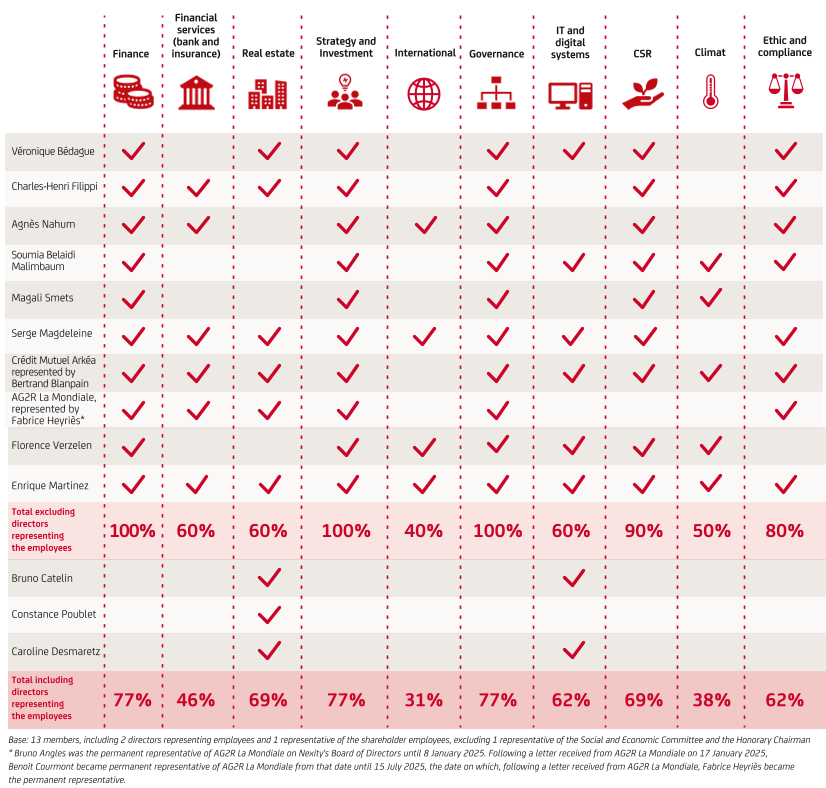 Table presenting the skills of the members of the Board of Directors. Rows correspond to directors and columns to areas of expertise: finance, financial services, real estate, strategy and investments, international, governance, information systems and digital, CSR, climate, ethics and compliance. Checkmarks indicate each member’s areas of expertise. Excluding employee representative directors, 100% of directors have expertise in finance, strategy and investments, and governance; 60% in financial services, information systems and digital, and real estate; 40% in international; 90% in CSR; 50% in climate; and 80% in ethics and compliance. Including employee representative directors, these percentages are adjusted downward. The total number of members is 13, including 2 employee representative directors and 1 employee shareholder representative.
4.2.1.6Independence of directors
Generally speaking, a director is considered independent when he or she has no relationship with the Company, the Group or management (other than a non-significant shareholding) that could compromise his or her freedom of judgement. The criteria for directors’ independence laid down in the Board of Directors’ internal rules and regulations are aligned with the following criteria set out in the Afep-Medef Code, under which an independent director may not:
- 1.Be an employee or executive company officer of the Company, or an employee executive company officer or a director of a parent company, i.e. any company that has sole or joint control over the Company, or any company consolidated by such a parent company, or any company consolidated by the Company and may not have been such at any time during the previous five years;
- 2.Be an executive company officer of an entity in which the Company holds a directorship, whether directly or indirectly, or in which an employee designated as such or an executive company officer of the Company (in office at any time during the last five years) serves as a director;
- 3.Be a client, supplier, commercial banker, advisor, a banker with significant investment in the Company or one for which the Company represents a significant part of its business.
- When a business relationship exists, the Board of Directors assesses on a case-by-case basis whether or not the relationship between the director in question and the Company or Group is significant. The Board of Directors reviews the business relationship taking into account (i) a quantitative criterion of the extent of the relationship and (ii) qualitative criteria such as whether the relationship is one of economic dependence, the role played by the director in question in the business relationship (e.g. whether the director has executive responsibilities; whether he or she personally receives financial compensation, and if so, how much; whether he or she has decision-making powers over the contract(s) on which the business relationship is based; whether he or she is involved in managing the relationship on a day-to-day basis), as well as the duration and current length of the business relationship (in particular whether the business relationship predated the appointment of the director in question);
- 4.Be a close relative of a company officer;
- 5.Have been a legal or contractual auditor of the Company at any time during the last five years; or
- 6.Not to have been a member of the Company's Board of Directors for more than twelve years. A director is no longer considered independent after twelve years;
- 7.Moreover, the Board may consider that, although a director meets the above independence criteria, he or she cannot be qualified as independent in view of his or her particular situation or that of the Company, considering his or her shareholding (in particular if said director or his or her group owns 5% or more of the Company’s share capital) or for any other reason; and
- 8.Lastly, in accordance with the Afep-Medef Code, to which the Company is a member, a non-executive company officer cannot be considered independent if he or she receives variable remuneration in cash, securities, or any Company performance-related remuneration.
The table below presents a summary of the position of each of the directors at 31 December 2025, with regard to the aforementioned independence criteria and numbered from 1 to 8, it being specified that the Chairwoman and Chief Executive Officer, an executive company officer, is not considered independent and receives performance-related remuneration from the Company.
Independence criterion number satisfied (✓)
1
2
3
4
5
6
7
8
Independent
Véronique Bédague
✓
✓
✓
✓
N/A
N/A
no
Charles-Henri Filippi
✓
✓
✓
✓
✓
✓
N/A
N/A
yes
Agnès Nahum
✓
✓
✓
✓
✓
✓
N/A
N/A
yes
Soumia Belaidi-Malinbaum
✓
✓
✓
✓
✓
✓
N/A
N/A
yes
Magali Smets
✓
✓
✓
✓
✓
✓
N/A
N/A
yes
Serge Magdeleine
✓
✓
-
✓
✓
✓
N/A
N/A
no
Crédit Mutuel Arkéa (Bertrand Blanpain)
✓
✓
-
✓
✓
✓
✓
N/A
no
AG2R La Mondiale (Fabrice Heyriès)
✓
-
-
✓
✓
✓
✓
N/A
no
Enrique Martinez
✓
✓
✓
✓
✓
✓
N/A
N/A
yes
Florence Verzelen
✓
✓
✓
✓
✓
✓
N/A
N/A
yes
Bruno Catelin
-
✓
✓
✓
✓
✓
N/A
N/A
no
Constance Poublet
-
✓
✓
✓
✓
✓
N/A
N/A
no
Caroline Desmaretz
-
✓
✓
✓
✓
✓
N/A
N/A
no
The Board of Directors assesses directors’ independence annually after consulting the Remuneration and Appointments Committee.
At its meeting held on 19 February 2026, the Remuneration and Appointments Committee discussed the independence criteria for members of the Board of Directors. The Committee analysed each director’s circumstances in light of these criteria, and in particular the materiality of any business relationships that they may have with the Company.
In a letter sent to Nexity on 26 September 2025, and as part of the preparation of its 2025 Corporate Governance Report, the French Financial Markets Authority (Autorité des marchés financiers – AMF) made reference to the Company's classification of Charles-Henri Filippi as independent.
The AMF indicates that, although he has only been a director for eight years, Charles-Henri Filippi has been a member of Nexity's Board of Directors for more than 12 years, counting his role as a non-voting Board member and his term of office as a director. In view of this particular situation, the AMF asked Nexity to reassess the classification of Charles-Henri Filippi as independent, and to specify the analysis adopted by the Board of Directors in the Corporate Governance Report.
In its response letter dated 6 October, Nexity indicated that this classification is in line with the Afep-Medef Code, since Charles-Henri Filippi has been a director for less than 12 years. Nexity has not identified any interpretation of Article 10.5.6 of the Afep-Medef Code by the HCGE involving the inclusion of a non-voting Board member mandate in this term. In addition, Nexity pointed out that there had been a gap of two years and six months between the end of Mr Filippi's term of office as non-voting Board member and his co-option as director.
Consequently, and in light of these factors, the Remunerations and Appointments Committee recommended that Charles-Henri Filippi remain independent.
The Committee also noted that none of the independent directors had any relationships with Nexity that could be qualified as significant business relationships within the meaning of independence criterion number 3 detailed above.
On the basis of this discussion, the Board of Directors, at its meeting of 25 February 2026, considered the following 6 directors to be independent as at 31 December 2025: Charles-Henri Filippi, Agnès Nahum, Soumia Belaidi-Malinbaum, Magali Smets, Florence Verzelen and Enrique Martinez.
The percentage of independent directors on the Board of Directors at 31 December 2025 is therefore 60%(2).
4.2.1.7Gender balance on the Board of Directors
At 31 December 2025, the Board of Directors had 5 female and 5 male members. The percentage of women represented at that date was thus 50%, in line with the recommendations of the Afep-Medef Code, to which the Company adheres.
In accordance with legal provisions and the recommendations of the Afep-Medef Code since their entry into force, the directors representing employees, whether or not they are shareholders, are not included in the calculation of this percentage.
Including the director representing shareholder employees, the percentage of women on the Board of Directors is 55% (6 women, 5 men), in line with the proportions required under the transposition of the Women on Boards Directive in force since 1 January 2026.
4.2.1.8Diversity on the Board of Directors
Although nationality is not a relevant criterion given that the Company’s activity is mainly located in France, the Board of Directors, since the appointment of Enrique Martinez at the Shareholders' Meeting of 23 May 2024, has one director of Spanish nationality.
The Board of Directors has also had a majority of independent directors since 2015. The same year, the Company organised a staggering schedule of director terms to allow for progressive replacement of the Board of Directors.
In order to meet the Company’s strategic challenges and promote quality exchanges, the Board seeks to maintain balance and complementarity between the profiles of the various directors. As such, it appoints new directors or renews those already present, ensuring the diversity of career paths and skills and based on the work carried out by the Remuneration and Appointments Committee as well as on the annual assessment of the Board and Committees.
Following the internal assessment of the Board of Directors carried out in February 2026, through a questionnaire sent to the directors under the oversight of the Senior Independent Director and described in Section 4.2.4 “Assessment of the functioning of the Board of Directors” below, it was deemed that the varied professional experiences of the members of the Board of Directors enable them to combine their skills to respond to the opportunities and understand the risks faced by Nexity.
-
4.3Executive Management
4.3.1Executive management approach
The choice of Executive Management approach is discussed every year as part of the Board of Directors’ meeting.
Since its creation, the Company was managed by a Chairman and Chief Executive Officer, Alain Dinin, its Founder, until 22 May 2019, when Jean-Philippe Ruggieri was appointed Chief Executive Officer of the Company.
After a period of separation of the functions of Chairman of the Board of Directors and Chief Executive Officer, the Board of Directors, at its meeting of 25 April 2020 had to decide, as a matter of urgency, to reunify these functions following the death of Jean-Philippe Ruggieri and to enable Alain Dinin to oversee the transition of Executive Management.
At the end of this transition phase, the functions of Chairman and Chief Executive Officer were again separated. Véronique Bédague was appointed Chief Executive Officer on 19 May 2021 and Alain Dinin retained his position as Chairman of the Board of Directors.
Upon the resignation of Alain Dinin from his term of office as Director and Chairman of the Board of Directors, on the recommendation of the Remuneration, Appointments and CSR Committee, decided to once again combine the functions of Chairman and Chief Executive Officer with effect from 1 January 2023.
By reunifying these functions, the Board of Directors intended to ensure the stability of the Company's governance and the speed of decision-making, in the context of a historic real estate crisis, by entrusting the chairwomanship to its Chief Executive Officer, Véronique Bédague. It believes that her knowledge of the real estate market, the Group and its business lines enable her to respond with agility to the challenges facing the Group.
This mode of governance proved to be relevant in 2024 in an environment characterised by persistent crisis in the real estate sector, enabling Nexity to quickly and efficiently adopt a transformation plan and maintain agility and speed in the decision-making essential to the implementation of the new organisation of New Nexity (see Section 1.4 "Strategy and objectives" of this Universal registration document).
In addition, the Shareholders' Meeting of 23 May 2024 separated the functions of Vice-Chairman of the Board of Directors and Senior Independent Director, in order to strengthen the counter-power within the Board of Directors with regard to the Chairwoman and Chief Executive Officer.
In the context of this combination of the functions of Chairwoman of the Board of Directors and Chief Executive Officer, the balance within the Board of Directors and its proper functioning are guaranteed by:
- •An independent, experienced Vice-Chairman, also Chairman of the Remuneration and Appointments Committee (Charles-Henri Filippi), who has been a member of the Board for 9 years;
- •An independent and experienced Senior Independent Director, also Chairwoman of the Audit and Accounts Committee (Agnès Nahum), member of the Board for 11 years, with the ability to convene Board of Directors' meetings;
- •The clarification of the role of the Senior Independent Director in relation to that of the Vice-Chairman in the update of the Board of Directors’ internal rules and regulations, made on 2 April 2025, strengthens the counter-power with regard to the Chairwoman and Chief Executive Officer;
- •An Audit and Accounts Committee and a Remuneration and Appointments Committee, composed mainly of independent members;
- •Length of service on the Board of Directors (average length of service 5.4 years) with mainly independent directors (60%) possessing a wide variety of expertise;
- •At Board meetings, the review of certain subjects is performed strictly without the presence of executive members, notably including the independence of directors, the Executive Management approach, and parity within the bodies;
- •A meeting of non-executive directors ("executive sessions") is held each year to assess the performance of the executive company officers; and
- •Independent directors may meet at the initiative of any one of them, with such meetings chaired by the Senior Independent Director.
The Shareholders' Meeting of 22 May 2025 renewed, with an approval rate of 88%, the term of office of Véronique Bédague as director for a period of four years, i.e. until the end of the Shareholders' Meeting held in 2029 to approve the financial statements for the fiscal year ended 31 December 2028.
In order to ensure the smooth implementation of the in-depth transformation plan launched by the Group in 2024, and the implementation of New Nexity in 2025, in the context of the ongoing crisis in the real estate sector, the Board of Directors considered it appropriate to keep the Group's governance unchanged for the coming years, maintaining the unified functions of Chairwoman of the Board of Directors and Chief Executive Officer, held by Véronique Bédague.
Consequently, at the end of this Shareholders' Meeting, the Company's Board of Directors, which met on the same day, approved the maintenance of the Group's governance as it stands. As a result, it has:
- •Renewed Véronique Bédague’s appointment as Chairwoman of the Board of Directors and Chief Executive Officer of the Company, for the duration of her term of office as director, as well as her term of office as Chairwoman of the Strategy & Investment Committee; and
- •Renewed Jean-Claude Bassien’s appointment as Deputy Chief Executive Officer, for the same duration as the Chief Executive Officer’s appointment.
Restrictions on the powers of the Chairman and the Chief Executive Officer
The Chairman is elected by the Board of Directors from amongst its individual members for a duration not exceeding the elected’s term of office.
The Chairman of the Board of Directors must be under the age of 75. When this age limit is reached during the term of office, the latter is automatically deemed to have resigned at the end of the next Annual Ordinary Shareholders’ Meeting. The Board of Directors determines the Chairman’s remuneration. It may also dismiss the Chairman at any time.
The Chairman organises and directs the Board’s activities and reports on them at Shareholders’ Meetings. The Chairman oversees the proper functioning of the Company’s corporate bodies and specifically ensures that the directors are in a position to fulfil their duties.
The Chief Executive Officer must be under the age of 72, including when he/she also serves as Chairman of the Board of Directors. When this age limit is reached during the term of office, the Chief Executive Officer is automatically deemed to have resigned at the end of the next Annual Ordinary Shareholders’ Meeting.
The Chief Executive Officer is vested with the broadest possible powers to act in all circumstances on behalf of the Company. He/she exercises his/her powers within the confines of the corporate purpose and subject to any powers expressly assigned by law to the shareholders or the Board of Directors. He/she represents the Company in its dealings with third parties.
The Articles of Association and the Board of Directors do not provide for any particular limitation on the powers of the Chief Executive Officer or the Deputy Managing Directors, which are exercised in accordance with the laws and regulations in force, the Articles of Association, the internal rules and regulations, and the guidelines approved by the Board of Directors.
Since 19 May 2021, Jean-Claude Bassien has assumed the duties of Deputy CEO with the same executive powers as the Chief Executive Officer.
Vice-Chairman and Senior Independent Director
The Board may, if it deems it useful, appoint one or more Vice-Chairmen from among its individual members, for a term that may not exceed that of their term of office as director. The Board may dismiss any or all of the Vice-Chairmen at any time.
In the event of the absence or incapacity of the Chairman, the Board will be chaired by one or more of the Vice-Chairmen.
In the event of the absence or incapacity of the Vice-Chairman/men, the Board will appoint, at each meeting, a member present to chair it.
The Board appoints from its individual members a Senior Independent Director for a term that may not exceed that of his or her term of office as director. This appointment is mandatory if the functions of Chairman of the Board of Directors and Chief Executive Officer are held by the same person. The Board may dismiss the Senior Independent Director at any time.
One or more of the Vice-Chairmen may be appointed as “Senior Independent Director” by the Board for the duration of their term of office as Vice-Chairman.
The Senior Independent Director must be independent per the criteria laid down in the Board’s internal rules and regulations. He/she ensures the proper functioning of the governance bodies, the absence of conflicts of interest and the proper consideration of shareholders’ concerns in terms of governance. His/her duties, resources and prerogatives are specified in the internal rules and regulations. As such, he or she has the right to submit additional agenda items to the Chairman and to require the Chairman to convene a Board meeting on a specific agenda. In this capacity, he or she coordinates meetings of independent directors as well as "executive sessions", supervises the formal assessment of the work of the Board and is the point of contact for Board members in the event of a conflict of interest. Lastly, he or she is informed of questions asked by shareholders on social, environmental and governance matters and ensures that they are answered.
Independent directors may meet at the initiative of any one of them, with such meetings chaired by the Senior Independent Director. He or she is responsible for gathering and passing on to the Board of Directors the opinions and positions of the independent directors.
The Shareholders' Meeting of 23 May 2024 separated the functions of Vice-Chairman of the Board of Directors and Senior Independent Director, in order to strengthen the counter-power within the Board of Directors with regard to the Chairwoman and Chief Executive Officer.
- •Charles-Henri Filippi, independent director and Chairman of the Remuneration and Appointments Committee, was appointed Vice-Chairman of the Board of Directors; and
- •Agnès Nahum, independent director and Chairwoman of the Audit and Accounts Committee, was appointed Senior Independent Director.
The internal rules and regulations notably allow the Vice-Chairman (Vice-Chairmen) or Senior Independent Director, to respond to requests of shareholders who want a direct dialogue with members of the Board of Directors.
Honorary Chairman
In accordance with the internal rules and regulations of the Board of Directors, the Board may appoint a natural person, former Chairman of the Board, as Honorary Chairman. If the Honorary Chairman is not a director, he or she may attend the meetings of the Board of Directors without voting rights and, in this case, is bound by the same obligations of confidentiality and abstention on securities as the directors. The Honorary Chairman may, at the request of the Chief Executive Officer share his experience of running the Company with his or her employees and/or partners.
-
4.4Remuneration and benefits paid to executive company officers and directors
In determining and presenting the remuneration of Nexity’s executive company officers, the Company applies the Afep-Medef Code (available on the website www.medef.fr), as well as referring to recommendation DOC-2012-02 of the French Financial Markets Authority (Autorité des Marchés Financiers – AMF) on corporate governance and executive remuneration of listed companies.
Any decision relating to the remuneration of executive company officers in respect of their terms of office complies with the legal say on pay procedure, enacted pursuant to Law No. 2019-486 of 22 May 2019 on the growth and transformation of companies, known as the “Pacte Law”.
Pursuant to Article L.22-10-9 of the French Commercial Code, the information relating to the remuneration of company officers is presented in Section 4.4.1 “Remuneration of Nexity's executive company officers and directors paid in respect of or during the 2025 fiscal year (ex-post)” of this Universal registration document.
In accordance with Article L.22-10-34 of the French Commercial Code, the Shareholders’ Meeting of 21 May 2026 will be asked to approve, under the ex-post say on pay principle, draft resolutions on the disclosures thus presented, mentioned in Article L.22-10-9-I of the same Code.
Under the ex-post say on pay principle, and in accordance with Article L.22-10-34 of the French Commercial Code, the Shareholders’ Meeting of 21 May 2026 will also be asked to approve the components of the total remuneration and benefits of any kind paid during or awarded in respect of the 2025 fiscal year to the Chairwoman and Chief Executive Officer and to the Deputy CEO.
General principles applicable to the remuneration of executive company officers and directors
In accordance with the provisions of the Afep-Medef Code, the Board of Directors, on the recommendation of its Remuneration and Appointments Committee, undertook to review the remuneration policy for company officers, as approved by the Shareholders’ Meeting held on 22 May 2025, in its 14th to 16th resolutions. In particular, the Board of Directors and the Remuneration and Appointments Committee have ensured that the remuneration of company officers contributes, in accordance with the applicable remuneration policy, to the long-term performance of the Company. In this respect, some of the remuneration criteria for executive company officers are measured over several fiscal years and the remuneration of directors depends on their attendance.
Pursuant to Article L.22-10-8 of the French Commercial Code, the remuneration policy for company officers for the 2026 fiscal year, determined by the Board of Directors and approved at its meeting of 1 April 2026, is presented in Section 4.4.2 "Remuneration policies applicable to Nexity's executive company officers and directors for fiscal year 2026 (ex-ante)" of this Universal registration document. The remuneration policies applicable, respectively, to the members of the Board of Directors, the Chairwoman and CEO, and the Deputy CEO for fiscal year 2026 will be subject to the approval of the Shareholders’ Meeting of 21 May 2026, in accordance with Article L.22-10-8 of the French Commercial Code under the ex-ante say on pay principle.
-
4.5Pensions and other benefits
At 31 December 2025, there were no contractual agreements (apart from those, as the case may be, recognised in provisions for employee benefit obligations) relating to pensions or similar benefits for the members of the Board of Directors, the Chairwoman and Chief Executive Officer or the Deputy Chief Executive Officer.
-
4.6Related-party transactions
Information about related parties can be found in Note 35 of Section 5.1 “Consolidated financial statements at 31 December 2025” of this Universal registration document.
The charter on related-party and current agreements was updated by the Board of Directors on 26 March 2020. It sets out the procedure for evaluating said agreements. This charter is available on the Group's website at the following address:
4.6.1Statutory Auditors’ Special Report on Regulated Agreements
This is a free translation into English of the Statutory Auditors’ Special Report on related party agreements issued in French and is provided solely for the convenience of English-speaking readers. This report should be read in conjunction and construed in accordance with French law and professional auditing standards applicable in France.
In our capacity as auditors of your company, we present you with our report on regulated agreements.
It is our responsibility to communicate to you, on the basis of the information given to us, the characteristics, the main terms and conditions, the purpose and benefits to the Company of the agreements brought to our attention or which we identified during our engagement. It is not our role to determine whether they are beneficial or appropriate or to ascertain whether any other agreement exist. It is your responsibility, under the terms of Article R. 225-31 of the French Commercial Code, to assess the interests attached to these agreements with a view to their approval.
In addition, it is up to us, where applicable, to provide you with the information provided for in Article R. 225-31 of the French Commercial Code relating to the execution, during the past financial year, of the agreements already approved by the Shareholders’ Meeting.
We have implemented the due diligence that we considered necessary with regard to the professional doctrine of the National Company of Statutory Auditors relating to this mission. This diligence consisted of verifying the concordance of the information given to us with the basic documents from which it is derived.
AGREEMENTS SUBMITTED TO THE GENERAL ASSEMBLY FOR APPROVAL
Agreements authorised and entered into during the past financial year
Pursuant to Article L. 225-40 of the French Commercial Code, we have been notified of the following agreements entered into during the past financial year which have been subject to the prior authorization of your Board of Directors.
The agreement concerns the assistance provided by Nexity SA, as a holding company, to its subsidiary in various areas.
On 18 December 2025, the Council authorised the conclusion of the new assistance agreement provided to the company Bureaux à Partager for an indefinite period of time as of 1 January 2026.
The amount of the fee invoiced under the agreement will be calculated on the basis of a cost price plus a margin of 5%.
The basis of the price will be made up of the actual costs of the services provided to the Subsidiary based on the working time spent by the employees assigned by the Parent Company to projects directly benefiting the Subsidiary for the past financial year as well as all the costs incurred and/or borne in this respect by the Parent Company.
Agreements Authorized and Entered into Since Closing
We have been notified of the following agreements, which have been authorised and entered into since the end of the previous financial year, which have been subject to the prior approval of your Board of Directors.
The purpose of the protocol is to define the conditions for the termination by Mr. Jean-Claude Bassien of all his functions within the Nexity Group.
On February 25, 2026, the Board of Directors authorized the conclusion, on the same date, of a protocol aimed at setting the financial conditions related to the termination by Mr. Jean-Claude Bassien of all his functions within the Nexity Group.
- •the extension to 24 months of Mr. Jean-Claude Bassien’s non-compete agreement, initially set at twelve months;
- •the setting of a non-competition indemnity of a gross amount of 390,500 euros gross for the additional 12 months.
In light of Mr. Jean-Claude Bassien’s experience within Nexity and his in-depth knowledge of the Nexity Group’s strategic orientations, ongoing projects and commercial relationships, the Board of Directors considered that the conclusion of the Protocol and the extension of Mr. Jean-Claude Bassien’s non-compete agreement were necessary in order to protect the Company’s interests in the context of the cessation of his duties.
AGREEMENTS ALREADY APPROVED BY THE SHAREHOLDERS’ MEETING
Agreements approved in previous financial years whose implementation has continued during the financial year
Pursuant to Article R. 225-30 of the French Commercial Code, we have been informed that the execution of the following agreements, already approved by the Shareholders’ Meeting in previous financial years, has continued during the past financial year.
The Board of 18 December 2024 authorised the continuation in 2025 of the assistance agreement provided to the company below:
-
4.7Interests of executive company officers and members of the Board of Directors in the Company's share capital
As specified in the internal rules and regulations of the Board of Directors: “Each Director must hold, throughout his or her term of office, the minimum number of shares required by the Articles of Association (200). All shares owned by a Director must be held in pure registered or administered form. This obligation for each member of the Board to hold at least two hundred (200) shares does not apply to the Director representing the employees. "
For Véronique Bédague and Jean-Claude Bassien, the Board of Directors has set a minimum threshold of 10% of free shares to be held in registered form.
In addition, in accordance with Article 26.3.3 of the Afep-Medef Code, the Company's executive company officers have made a formal commitment not to hedge their risk on options or on shares resulting from the exercise of options or on performance-based shares until the end of the lock-up period set by the Board of Directors.
At 31 December 2025, the members of the Board of Directors directly or indirectly held the following shares:
Members of the Board of Directors
Number of shares (1)
Percentage of capital
Véronique Bédague
89,197
NS
Charles-Henri Filippi
3,000
NS
Agnès Nahum
200
NS
Soumia Belaidi-Malinbaum
300
NS
Magali Smets
600
NS
Florence Verzelen
200
NS
Enrique Martinez
200
NS
Serge Magdeleine
200
NS
Crédit Mutuel Arkéa
2,653,597
4.73%
AG2R La Mondiale
2,806,487
5.00%
Caroline Desmaretz
10,305
NS
Bruno Catelin
1,160
NS
Constance Poublet
5,301
NS
Total
5,570,747
9.92%
- (1)According to statements made to the AMF and/or the Company
-
4.8Transactions in securities
4.8.1Transactions in securities carried out by members of the Board of Directors and the top executives
The table below provides an exhaustive list of securities transactions carried out by members of the Board of Directors and the Executive Committee of the Group in 2025.
First name/Surname
Capacity
Nature of the
transaction
Description of the financial instrument
Number of securities
Unit price average
(in euros)
Véronique Bédague
Chairwoman and Chief Executive Officer
Acquisition
Shares
10,000
9.41
Véronique Bédague
Chairwoman and Chief Executive Officer
Free share acquisition
Shares
13,800
N/A
Jean-Claude Bassien
Deputy CEO
Acquisition
Shares
8,000
9.44
Jean-Claude Bassien
Deputy CEO
Free share acquisition
Shares
9,200
N/A
Fabrice Aubert
Group Deputy Managing Director
Free share acquisition
Shares
2,760
N/A
Pierre-Henry Pouchelon
Group Deputy Managing Director
Free share acquisition
Shares
1,380
N/A
Joris Delapierre
Managing Director of the Paris region
Free share acquisition
Shares
690
N/A
Lionel Seropian
Managing Director of the Southern region
Free share acquisition
Shares
30
N/A
Source: statements made to the AMF and/or the Company as at 31 December 2025
-
4.10Major shareholders
4.10.1Breakdown of share capital at 31 December 2025
The following table shows the number of shares and the percentage of share capital and voting rights held by all of the Company’s shareholders at 31 December 2025, as reported to the AMF and/or to the Company at that date, it being specified that there are no double voting rights.
Shareholders (at 31 December 2025)
Number
of shares
% of share capital and theoretical voting rights
% of actual
voting rights
Nexity managers and employees
1,015,568
1.81%
1.82%
FCPE Nexity Actions
1,301,242
2.32%
2.34%
Subtotal - Nexity managers and employees including FCPE
2,316,810
4.13%
4.16%
Crédit Agricole Assurances (Predica + Spirica)
3,603,925
6.42%
6.47%
Crédit Mutuel Arkéa + Suravenir (1)
3,756,432
6.69%
6.74%
La Mondiale
2,806,487
5.00%
5.04%
ACM Vie
2,834,495
5.05%
5.09%
T-Rowe Price Associates Inc.
2,970,260
5.29%
5.33%
Subtotal - Shareholders holding more than 5% of the share capital
15,971,599
28.45%
28.68%
Free float
37,409,788
66.65%
67.17%
Treasury shares
431,527
0.77%
-
Total
56,129,724
100.00%
100.00%
- (1)Based on the email sent to the Company and including the shares held by Suravenir
To the Company’s knowledge, there is no other shareholder holding, directly or indirectly, alone or in concert, more than 5% of the share capital or voting rights.
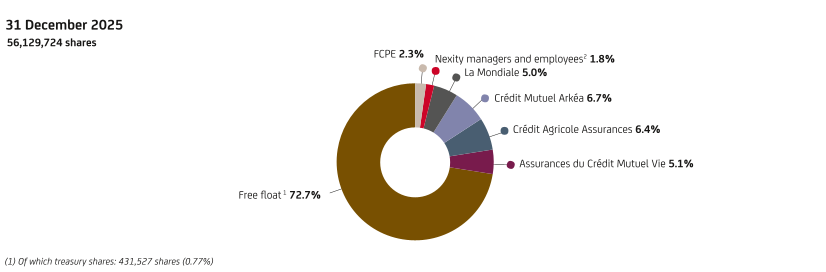 Pie chart presenting the breakdown of Nexity’s share capital as of December 31, 2025, based on 56,129,724 shares. The free float represents the majority share, accounting for 72.7% of the capital. The main institutional shareholders are Crédit Mutuel Arkéa with 6.7%, Crédit Agricole Assurances with 6.4%, La Mondiale with 5.0%, and Assurances du Crédit Mutuel Vie with 5.1%. Employee shareholding funds (FCPE) hold 2.3% of the capital. Nexity’s managers and employees hold 1.8%. Treasury shares represent 431,527 shares, i.e. 0.77% of the capital. The chart illustrates a shareholder structure largely composed of free float, complemented by several long-term institutional investors.
 -
4.12Statutory provisions
The Company's Articles of Association, described below, were updated at the Combined Shareholders' Meeting of 22 May 2025, to ratify the relocation of the registered office and, in accordance with the so-called "Attractiveness Law" No. 2024-537 of 13 June 2024 aimed at increasing the financing of businesses and the attractiveness of France, to amend the procedures for Board of Directors' meetings and decisions. It is also proposed to the General Meeting called to approve the 2025 financial statements to amend the Articles of Association to bring them in line with Decree No. 2026-94 of 13 February 2026.
In accordance with Article L.225-96 of the French Commercial Code, the Extraordinary Shareholders’ Meeting alone is authorised to amend the Articles of Association in all their provisions. Any clause to the contrary is deemed unwritten. However, it may not increase shareholders’ commitments, subject to transactions resulting from a regularly carried out reverse stock split. It may only validly deliberate if the shareholders present or represented hold at least one quarter of the shares with voting rights on the first Notice of Meeting and one fifth on the second Notice of Meeting. Failing this, the second meeting may be extended to a date no later than two months after the date on which it was due to be held. It rules by a two-thirds majority of the votes cast by the shareholders present or represented. The votes cast do not include those attached to shares for which the shareholder did not take part in the vote, abstained or submitted a blank or invalid vote.
The sections presented below are excerpts from the Articles of Association. The full version is available on Nexity's website at the following address:
4.12.1Share capital and shares
Form of shares and identification of shareholders and bondholders (Article 8 of the Articles of Association)
Shareholders may choose to hold their fully paid-up shares in either registered or bearer form, subject to applicable legal and regulatory requirements and the Company’s Articles of Association. Shares must be held in registered form until they are fully paid up.
The shares are freely tradable. Shares are transferred from account to account, in accordance with the terms and conditions defined by law and regulations.
Ownership of the shares is established by registration in an account with the Company in accordance with the regulations in force.
When the owner of the securities is not domiciled in France, an intermediary may be registered on behalf of this owner. This registration may be made in the form of a collective account or in several individual accounts each corresponding to an owner. The registered intermediary is required, at the time of opening an account with either the Company or the authorised financial intermediary holding an account, to declare that it is an intermediary holding securities on behalf of third parties, in accordance with the legal and regulatory provisions in force.
With a view to identifying holders of bearer shares, the Company or a third party appointed by it is entitled to request, at any time and in return for remuneration at its expense, under the conditions set by law, that the information concerning the owners of its shares and securities conferring immediate or future voting rights at its own Shareholders’ Meetings be transferred to the Company.
Any intermediary mentioned in paragraph I, 1° to 4° of Article L.228-1 of the French Commercial Code who receives the request for information provided for in the first paragraph of the same article shall provide the information requested concerning the owners of securities and the intermediaries registered in its books, to the person named for this purpose in the application. In addition, it shall forward the request for information to the intermediaries registered in its books, unless expressly opposed by the Company or the third party appointed by the latter at the time of the request.
Any intermediary mentioned in paragraph I, 1° to 4° of Article L.228-1 of the French Commercial Code shall send to the Company or the third party appointed by the latter, at its request, the contact details of the intermediaries registered in its books who hold shares or securities conferring immediate or future voting rights at Shareholders’ Meetings of the issuing company.
In the case of registered securities giving immediate or future access to the share capital, the registered intermediary is required to disclose the information concerning the owners of these securities, at the simple request of the Company or its agent, which may be presented at any time.
As long as the Company or the third party appointed by it considers that certain holders whose identities have been communicated to them are acting on behalf of third-party owners of the securities, they are entitled to ask these holders to disclose the information concerning the owners of these securities, either under the conditions provided for in Article L.228-2 of the French Commercial Code for bearer securities or under the conditions provided for in the first paragraph of Article L.228-3 for registered securities. Following this request, the Company may ask any legal entity that owns its shares and holds more than 2.5% of the share capital or voting rights, to inform it of the identity of the persons holding, directly or indirectly, more than one third of the share capital or voting rights of the legal entity owning the Company’s shares.
In the event of a breach in the obligations referred to above, the shares or securities giving access, immediately or in the future, to the share capital and for which these obligations have not been complied with, will be deprived of voting rights for any Shareholders’ Meeting held until the date of settlement of the identification, and the payment of the corresponding dividend will be deferred until that date.
In addition, should the registered person knowingly disregard these obligations, the court in whose jurisdiction the Company has its head office may, at the request of the Company or one or more shareholders holding at least 5% of the share capital, announce the total or partial deprivation, for a total period not exceeding five years, of the voting rights attached to the shares that have been the subject of a request for information from the Company and, possibly and for the same period, of the right to payment of the corresponding dividend.
Unless there is a clause to the contrary in the bond issue agreement, the Company may request the identification of the holders of these securities, when they were issued on or after 3 August 2014, under the conditions set out in this article, it being specified that the provisions referring to the Shareholders' Meetings will be read as referring to the Annual Meetings of bondholders.
Threshold crossings (Article 10 of the Articles of Association)
Pursuant to the provisions of the French Commercial Code, any natural or legal person, acting alone or in concert, who holds a number of shares representing, in accordance with the calculation methods and conditions provided for by the General Regulation of the Autorité des Marchés Financiers (“AMF”), more than 5%, 10%, 15%, 20%, 25%, 30%, 33.33%, 50%, 66.66%, 90% and 95% of the existing share capital and / or voting rights of the Company, must inform the Company and the AMF of such by letter, notably stating the percentage of the share capital and voting rights that it holds, within four trading days from the threshold crossing. Threshold crossings declared to the AMF are made public by the latter. This disclosure must also be made, within the same deadlines and conditions, when the shareholding falls below the aforementioned thresholds.
Unless properly reported, any shares over and above the threshold that should have been reported in accordance with the aforementioned legal requirements will have no voting rights at any Shareholders’ Meeting for a period of two years after the date on which the notification is received.
Furthermore, pursuant to the Company’s Articles of Association, any natural or legal person, acting alone or in concert, who comes to hold, either directly or indirectly, according to the same calculation methods and conditions as those laid down in Articles L.233-7 et seq. of the French Commercial Code and in the AMF’s General Regulation, a number of shares representing over 3% of the Company’s share capital and/or voting rights, and subsequently to this each additional 1% of the Company’s share capital and/or voting rights including beyond the 5% threshold and all legal and regulatory reporting thresholds, shall notify the Company by registered post with acknowledgement of receipt within four trading days of the date on which the aforementioned threshold is exceeded, indicating the percentage of share capital and voting rights held and any securities that give or may in the future give the shareholder access to the share capital and the associated potential voting rights. This information is also reported, subject to the same requirements, whenever the percentage of the share capital or voting rights held falls below one of these thresholds.
At the request of one or more shareholders holding at least 3% of the Company’s share capital or voting rights and duly recorded in the minutes of a Shareholders’ Meeting, failure by a shareholder to observe these provisions may be sanctioned by the revocation of that shareholder’s right to exercise the voting rights attached to the excess shares over and above the reporting threshold at any Shareholders’ Meeting for a period of two years after the date on which the reporting requirement is met.
Subject to the exceptions laid down in legal provisions, any person who holds, either individually or in concert, in respect of one or more temporary sales of those shares or any transaction conferring the right or giving rise to the obligation to resell those shares or return them to the seller, a number of shares representing more than 0.5% of total voting rights, shall notify both the Company and the AMF of the total number of shares temporarily held no later than 00:00 hours (Paris time) two business days before the date of the Shareholders’ Meeting, provided that the contract arranging that transaction remains in force at that date. As well as the number of shares acquired under the terms of one of the aforementioned transactions, the notification must include the identity of the seller, the date and maturity of the contract governing the transactions and, where applicable, the voting agreement. The Company will publish this information under the terms and conditions laid down in the AMF’s General Regulation.
-
5.1Consolidated financial statements at 31 December 2025
5.1.1Condensed consolidated financial statements
Consolidated statement of financial position
ASSETS
(in thousands of euros)
Notes
Balance at 31/12/2025
Balance at 31/12/2024
Non-current assets
Goodwill
7
1,145,660
1,151,694
Other intangible assets
8
92,445
101,567
Right-of-use assets
8
734,583
768,081
Property, plant and equipment
8
95,919
87,864
Equity-accounted investments
9
61,540
123,376
Other financial assets
10
47,099
49,227
Deferred tax assets
31
121,635
58,613
Total non-current assets
2,298,881
2,340,422
Current assets
Inventories and work in progress
12
1,271,248
1,669,110
Trade and other receivables
13
581,320
799,402
Tax receivables
31
10,100
10,104
Other current assets
14
576,667
671,374
Other financial receivables
22
294,005
339,508
Cash and cash equivalents
23
421,462
667,613
Total current assets
3,154,802
4,157,111
TOTAL ASSETS
5,453,683
6,497,533
LIABILITIES AND EQUITY
(in thousands of euros)
Notes
Balance at 31/12/2025
Balance at 31/12/2024
Equity
Share capital
16
280,649
280,649
Additional paid-in capital
521,060
521,060
Treasury shares held
19
(5,013)
(8,983)
Reserves and retained earnings
1,001,090
1,080,589
Net profit/(loss) for the period
(188,388)
(62,226)
Equity attributable to equity holders of the parent company
1,609,398
1,811,089
Non-controlling interests
17
9,800
59,663
Total equity
1,619,198
1,870,752
Non-current liabilities
Long-term borrowings and financial debt
21
397,560
564,345
Non-current lease liabilities
21
711,724
744,774
Employee benefits
26
6,750
8,038
Deferred tax liabilities
31
2,054
8,873
Total non-current liabilities
1,118,088
1,326,030
Current liabilities
Short-term borrowings, financial liabilities and operating liabilities
21
645,689
772,330
Current lease liabilities
21
144,924
140,771
Current provisions
26
92,406
69,254
Trade and other payables
1,100,340
1,590,192
Current tax liabilities
31
6,736
8,219
Other current liabilities
15
726,302
719,985
Total current liabilities
2,716,397
3,300,751
Total liabilities and equity
5,453,683
6,497,533
Consolidated income statement
(in thousands of euros)
Notes
31/12/2025
(12-month period)31/12/2024
(12-month period)Revenue
4
2,821,010
3,332,952
Purchases
(2,049,885)
(2,557,404)
Employee benefits expense
27
(334,999)
(432,549)
Other operating expenses
28
(202,219)
(249,564)
Taxes (other than income tax)
(26,517)
(32,089)
Depreciation, amortisation and impairment of non-current assets
29
(192,352)
(201,659)
Current operating profit/(loss)
15,038
(140,313)
Non-current operating profit/(loss)
3
(128,404)
131,920
Operating profit/(loss)
(113,366)
(8,393)
Share of net profit from equity-accounted investments
9
(37,917)
4,884
Operating profit after share of net profit from equity-accounted investments
(151,283)
(3,509)
Financial expenses
30
(112,823)
(152,046)
Financial income
30
23,505
22,428
Net financial income/(expense)
(89,318)
(129,618)
Pre-tax recurring profit/(loss)
(240,601)
(133,127)
Income tax income/(expense)
31
64,545
73,192
Share of net profit/(loss) from other equity-accounted investments
9
(7,484)
(1,203)
Net profit/(loss)
(183,540)
(61,138)
Of which attributable to equity holders of the parent company
(188,388)
(62,226)
Of which attributable to non-controlling interests
4,848
1,088
(in euros)
Net earnings per share
32
(3.40)
(1.12)
Diluted earnings per share
32
(3.40)
(1.12)
Consolidated statement of comprehensive income
(in thousands of euros)
Notes
31/12/2025 (12-month period)
31/12/2024 (12-month period)
Net profit/(loss)
(183,540)
(61,138)
Change in value of derivative instruments for hedging
1,876
(993)
Foreign currency translation gains and losses
(3)
(49)
Gains and losses that may be recycled to net profit
1,873
(1,042)
Actuarial gains and losses on retirement benefits
1,792
1,877
Deferred tax on actuarial gains and losses
(448)
(485)
Gains and losses that may not be recycled to net profit
1,344
1,392
TOTAL OTHER COMPREHENSIVE INCOME (NET OF TAX)
3,217
350
Total comprehensive income
(180,323)
(60,788)
Of which attributable to equity holders of the parent company
(185,171)
(61,876)
Of which attributable to non-controlling interests
4,848
1,088
Change in consolidated equity
(in thousands of euros)
Share capital
Additional paid-in capital
Treasury shares held
Reserves and retained earnings
Other comprehensive income
Equity attributable to equity holders of the parent company
Non-
controlling interestsTotal
equityMovements in FY 2024
At 1 January 2024
280,649
548,489
(16,633)
1,055,779
9,182
1,877,466
63,380
1,940,846
Treasury shares
-
-
7,650
(8,244)
-
(594)
-
(594)
Share-based payments
-
-
-
921
-
921
-
921
Impact of acquisitions or disposals of non-controlling interests after acquisition of control
-
-
-
(4,828)
-
(4,828)
-
(4,828)
Dividends paid by Nexity
-
-
-
-
-
-
-
-
Total movements linked to relationships with shareholders
-
-
7,650
(12,151)
-
(4,501)
-
(4,501)
Net profit/(loss) for the period
-
-
-
(62,226)
-
(62,226)
1,088
(61,138)
Other comprehensive income
-
-
-
-
350
350
-
350
Total comprehensive income
-
-
-
(62,226)
350
(61,876)
1,088
(60,788)
Dividends paid by subsidiaries
-
-
-
-
-
-
(5,292)
(5,292)
Impact of changes in scope
-
(27,429)
-
27,429
-
-
487
487
At 31 December 2024
280,649
521,060
(8,983)
1,008,831
9,532
1,811,089
59,663
1,870,752
Movements in FY 2025
At 1 January 2025
280,649
521,060
(8,983)
1,008,831
9,532
1,811,089
59,663
1,870,752
Treasury shares
-
-
3,970
(6,624)
-
(2,654)
-
(2,654)
Share-based payments
-
-
-
2,184
-
2,184
-
2,184
Impact of acquisitions or disposals of non-controlling interests after acquisition of control
-
-
-
(16,050)
-
(16,050)
-
(16,050)
Dividends paid by Nexity
-
-
-
-
-
-
-
-
Total movements linked to relationships with shareholders
-
-
3,970
(20,490)
-
(16,520)
-
(16,520)
Net profit/(loss) for the period
-
-
-
(188,388)
-
(188,388)
4,848
(183,540)
Other comprehensive income
-
-
-
3,217
3,217
-
3,217
Total comprehensive income
-
-
-
(188,388)
3,217
(185,171)
4,848
(180,323)
Dividends paid by subsidiaries
-
-
-
-
-
-
(16,247)
(16,247)
Impact of changes in scope
-
-
-
-
-
-
(38,464)
(38,464)
At 31 December 2025
280,649
521,060
(5,013)
799,953
12,749
1,609,398
9,800
1,619,198
Consolidated statement of cash flows
(in thousands of euros)
Notes
31/12/2025 (12-month period)
31/12/2024 (12-month period)
Net profit attributable to equity holders of the parent company
(188,388)
(62,226)
Net profit attributable to non-controlling interests
4,848
1,088
Consolidated net profit/(loss)
(183,540)
(61,138)
Elimination of non-cash income and expenses:
Elimination of depreciation, amortisation and provisions
57,771
44,197
Elimination of depreciation of right-of-use assets
154,675
159,496
Elimination of gains and losses on asset disposals
20,044
(240,547)
Elimination of net profit from equity-accounted investments
37,917
(3,681)
Elimination of net profit from other equity-accounted investments
7,484
-
Elimination of the impact of share-based payments
2,184
921
Cash flow from operating activities after interest and tax expenses
96,535
(100,752)
Elimination of net interest expense/(income)
67,526
92,375
Elimination of tax expense, including deferred taxes and tax credits
(66,196)
(74,336)
Cash flow from operating activities before interest and tax expenses
97,865
(82,713)
Change in operating working capital requirement
11
145,049
371,872
Dividends received from equity-accounted investments
9
15,866
22,918
Interest paid
(29,434)
(63,087)
Tax paid
(6,806)
(17,541)
Net cash from/(used in) operating activities
222,540
231,449
Purchase of subsidiaries, net of cash acquired
3.5
-
(2,896)
Proceeds from sale of subsidiaries, net of cash divested
3.6
34,625
374,803
Other changes in scope
(34,160)
121
Purchase of property, plant, equipment and intangible assets
(45,185)
(47,148)
Purchase of financial assets
(5,782)
(20,644)
Proceeds from sale of property, plant, equipment and intangible assets
-
1,070
Proceeds from sale and redemption of financial assets
6,260
11,070
Net cash from/(used in) investing activities
(44,242)
316,376
Dividends paid to minority shareholders of consolidated companies
(16,247)
(5,292)
Net disposal/(acquisition) of treasury shares
(1,886)
(1,833)
(Acquisitions)/disposals of non-controlling interests with no gain or loss of control
-
(12,500)
Proceeds from issuance of bonds
195,736
74,299
Redemption of bonds
(400,747)
(546,867)
Repayment of lease liabilities
(180,232)
(177,436)
Decrease in receivables and increase in short-term financial debt
90,306
7,629
Net cash from/(used in) financing activities
(313,070)
(662,000)
Impact of changes in foreign currency exchange rates
3
(9)
Change in cash and cash equivalents
(134,769)
(114,184)
Cash and cash equivalents at beginning of period
536,323
650,507
Cash and cash equivalents at end of period
20
401,554
536,323
-
5.2Parent Company financial statements at 31 December 2025
5.2.1Condensed consolidated financial statements
Statement of financial position
ASSETS
(in thousands of euros)
Notes
31/12/2025
31/12/2024
Gross amount
Amortisation, depreciation and impairments
Net amount
Net amount
Intangible assets
Concessions, patents and similar rights
6.1
163,349
(35,204)
128,145
139,805
Goodwill
6.1
-
-
-
-
Intangible assets in progress
6.1
19,402
-
19,402
34,277
Property, plant and equipment
Technical installations, equipment and tools
6.2
31,370
(8,689)
22,681
11,182
Property, plant and equipment in progress
347
-
347
9,838
Financial investments
Equity investments
6.3
2,157,775
(455,385)
1,702,390
1,805,227
Receivables from equity investments
6.4
57,620
(56,864)
756
39,806
Other equity securities
6.5
22,693
(12,377)
10,316
12,041
Loans
6.6
308,122
(67,602)
240,520
253,414
Other financial investments
6.7
83,462
-
83,462
116,870
Non-current assets
6.8
2,844,140
(636,121)
2,208,019
2,422,460
Inventories and work in progress
Advances and deposits paid on orders
-
552
-
552
1,096
Receivables
Trade and other receivables
7.1
35,815
(725)
35,090
38,017
Other receivables
7.2
770,727
(129,797)
640,930
888,474
Prepaid expenses
7.5
5,161
-
5,161
4,272
Other
Marketable securities
-
-
-
-
-
Treasury shares held
7.3
5,013
-
5,013
8,789
Cash and cash equivalents
7.4
82,376
-
82,376
279,722
Current assets
-
899,644
(130,522)
769,122
1,220,370
Bond issue expenses
7.6
7,093
-
7,093
3,928
Translation differences assets
-
-
-
-
-
TOTAL ASSETS
3,750,877
(766,643)
2,984,234
3,646,758
LIABILITIES AND EQUITY
(in thousands of euros)
Notes
31/12/2025
31/12/2024
Equity
Share capital (o/w €280,649K paid)
8.1
280,649
280,649
Share issue, merger, contribution premiums
1,130,173
1,130,173
Legal reserve
28,065
28,065
Other reserves (o/w purchase of original works)
-
-
Retained earnings
403,195
443,079
Profit (loss) for the period
(292,322)
(39,885)
Regulated provisions
5,808
5,692
Total equity
8
1,555,568
1,847,773
Provisions for contingencies
5,523
18,238
Provisions for losses
3,268
3,444
Total provisions
9
8,791
21,682
Financial debt
Convertible bonds
10.1
240,420
421,788
Euro PP bonds
10.1
240,293
362,816
Loans and borrowings from financial institutions
10.2
150,668
-
Borrowings and financial liabilities
10.3
678,940
816,713
Operating liabilities
Advances and deposits received on orders in progress
276
512
Trade payables
47,321
62,660
Tax payable and social security contributions
41,457
96,791
Other liabilities
Liabilities on non-current assets and related accounts
1,335
1,993
Other liabilities
16,293
10,712
Adjustment account
Deferred income
2,872
3,318
Total payables
1,419,875
1,777,303
Translation differences liabilities
-
-
Total liabilities and equity
2,984,234
3,646,758
Income statement
(in thousands of euros)
Notes
31/12/2025
31/12/2024
Production sold
126,178
140,101
Revenue
126,178
140,101
Capitalised production
10,087
10,812
Grants
161
9
Reversals of depreciation, amortisation, impairments and provisions
3,555
10,222
Proceeds from the sale of property, plant, equipment and intangible assets
45
-
Other income
379
7,527
Operating income
11
140,405
168,671
Purchase of raw materials and other supplies
(47)
(40)
Other purchases and external expenses
(104,567)
(144,508)
Taxes, duties and other levies
(1,850)
(7,807)
Wages
(43,256)
(46,893)
Social security contributions
(16,512)
(16,650)
Operating additions
On non-current assets: depreciation, amortisation and impairment
(21,867)
(18,562)
On non-current assets: provisions
-
-
On current assets: provisions
(83)
-
For risks and charges: provisions
(3,567)
(2,064)
Carrying amounts of P, P & E and intangible assets sold or discontinued
(24,437)
-
Other expenses
(9,977)
(7,545)
Operating expenses
12
(226,163)
(244,069)
Operating results
13
(85,758)
(75,398)
Financial income from investments
74,652
200,709
Income from other securities and receivables from non-current assets
12,788
10,883
Other interest and equivalent
939
4,279
Reversals on provisions and transfers of charges
42,283
37,374
Positive exchange rate differences
4
-
Income from disposals of financial investments
14,772
14
Net income on disposals of marketable securities
5,959
-
Financial income
15
151,397
253,259
Financial additions to depreciation, amortisation and provisions
(237,529)
(121,462)
Interest and equivalent expenses
(65,832)
(71,250)
Negative exchange rate differences
(1)
(2)
Carrying amounts of financial investments sold
(87,626)
(4)
Financial expenses
16
(390,988)
(192,718)
Net financial income/(expense)
17
(239,591)
60,541
Current profit/(loss) before tax
(325,349)
(14,857)
Exceptional income
36
382,647
Exceptional expenses
(153)
(446,287)
Non-recurring profit/(loss)
18
(117)
(63,640)
Employee profit-sharing
19
-
-
Income tax income/(expense)
20
33,144
38,613
Total income
291,838
804,577
Total expenses
(584,160)
(844,461)
PROFIT/(LOSS) FOR THE PERIOD
21
(292,322)
(39,884)
-
5.3Additional information
5.3.1Payment terms
In accordance with Article L.441.6.1 of the French Commercial Code and its implementing decree No. 2015-1553 of 27 November 2015, the following table shows the invoices received and issued whose term has expired at the reporting date. Invoices whose due date is exactly that of the reporting date are excluded from the table.
77 supplier invoices representing €214 thousand excluding taxes and 0.18% of purchases are past due.
(in thousands of euros)
Article D.441 I.-1°: invoices received, past due and unpaid at the reporting date
Article D.441 I.-2°: invoices issued, past due and unpaid at the reporting date
1 to 30 days
31 to 60 days
61 to 90 days
91 days and more
Total (1 day and more)
1 to 30 days
31 to 60 days
61 to 90 days
91 days and more
Total (1 day and more)
(A) Late payment categories
Number of invoices concerned
-
2
2
73
77
-
60
7
239
306
Total amount of invoices concerned excl. tax
-
11
-7
210
214
-
6,322
40
2,662
9,025
Percentage of the total amount of purchases excl. tax for the fiscal year
-
0.01%
-0.01%
0.18%
0.18%
-
-
-
-
-
Percentage of revenue excl. tax for the fiscal year
-
-
-
-
-
5.01%
0.03%
2.11%
7.15%
(B) Invoices excluded from (A) relating to disputed or unrecognised payables and receivables
Number of invoices excluded
-
-
-
-
-
-
-
-
-
Total amount of excluded invoices
-
-
-
-
-
-
-
-
-
(C) Reference payment terms used (contractual or legal terms - Article L.441-6 or L.443-1 of the French Commercial Code)
Payment terms used to calculate late payments
Contractual terms: 30 days end of month
Contractual terms: up to 30 days
PM: payables and receivables due on the reporting date are not included in the total of payables and receivables whose term has expired
-
5.4Trends
5.4.1Uncertainties related to the economic environment
The Group’s business activity and its results will remain subject to the uncertainties related to the possible occurrence of the various risks relating to its economic, legislative, tax and competitive environment as set out in Chapter 2 - Risk Factors and Management of this Universal registration document, and in particular:
-
6Information about the issuer
- 6.1 General disclosures
- 6.2 Organisation of the Group
- 6.3 Stock market information
- 6.4 Relations with shareholders and the financial community
- 6.5 Documents available to the public
- 6.6 Person responsible for the Universal registration document
- 6.7 Legal account controllers
- 6.8 Glossary
- 6.9 Cross-reference tables
-
6.2Organisation of the Group
The organisation chart below presents the Company’s main subsidiaries (and percentage of share capital held) at 31 December 2025. Voting rights correspond to the percentage of share capital held.
A list of the main consolidated companies is provided in Note 37 to the Group’s consolidated financial statements, presented in Section 5.1 “Consolidated financial statements at 31 December 2025” of this Universal registration document. The full list is available on request from the Investor Relations Department (investorrelations@nexity.fr).
The parent company pools the cash from a majority of the Group’s subsidiaries and manages the Group’s central functions. It also holds the Nexity trademark. As part of its management assistance agreements, Nexity charges its subsidiaries management fees. It also charges them royalties for using the Nexity trademark, where applicable. Intra-Group agreements are signed under market conditions.
Where a lease is taken up for an office building occupied by more than one subsidiary, the lease is generally signed by the company that occupies the largest surface area. Annually renewable subleases are signed with the various subsidiaries occupying the premises, and rental payments and charges are re-invoiced in proportion to each company’s actual usage.
For more information on the regulated agreements between the Company and its significant subsidiaries, see Section 4.6 “Related-party transactions” of this Universal registration document.
Certain real estate development operations may be carried out in partnership. A prior financial analysis of associates is made in accordance with the size of the project (see Section 1.9 “Material contracts” of this Universal registration document).
The Group does not hold any subsidiaries where the presence of non-controlling interests would represent a risk for its overall business or financial structure. See Section 4.11.8 “Conditional or unconditional options or agreements regarding the share capital of any Group member” of this Universal registration document.
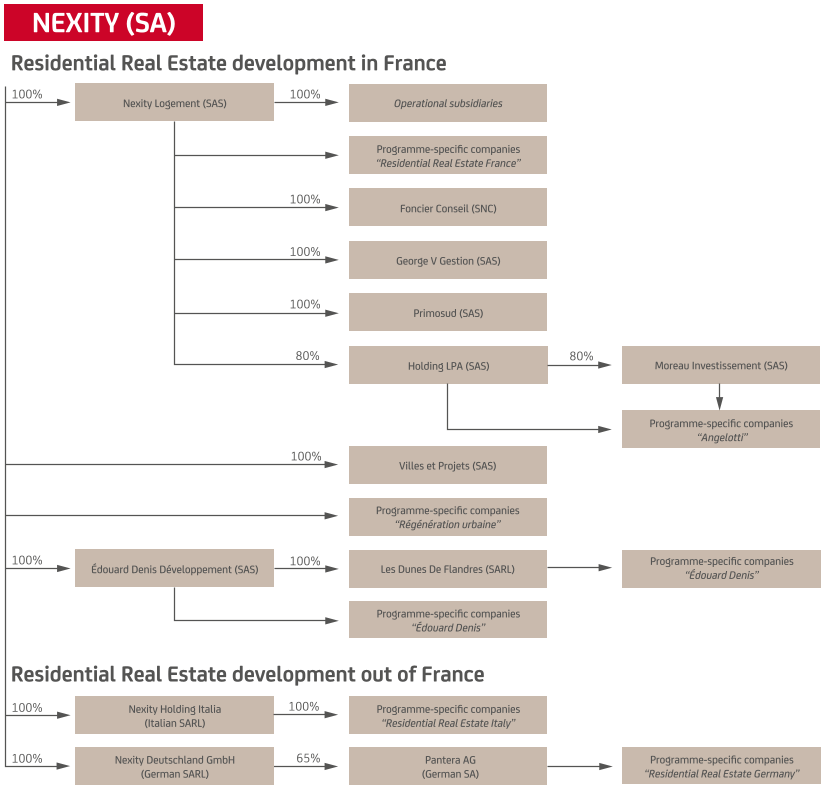 Diagram presenting Nexity’s legal and operational organization. The parent company, Nexity SA, holds all residential and commercial real estate development and services activities. In France, the residential real estate development division is structured around holding companies and wholly owned operating subsidiaries, including Foncier Conseil (SNC), George V Gestion (SAS), Édouard Denis Développement (SAS), Primosud (SAS), and Les Dunes de Flandres (SARL). Internationally, Nexity operates in residential real estate in Italy and Germany through dedicated holding companies, including Nexity Holding Italia and Nexity Deutschland GmbH, as well as a majority stake of 65% in Pantera AG and 80% stakes in certain entities related to Édouard Denis and Angelotti.
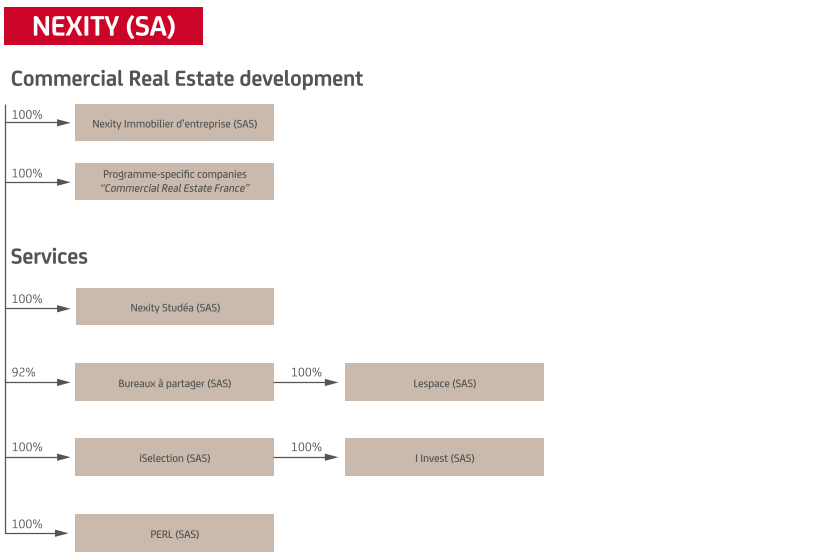 The commercial real estate development division is also fully owned by the Group, along with its associated holding companies. The Services division brings together several activities that are majority- or wholly-owned, including Nexity Studéa, iSelection, PERL, Villes et Projets, Lespace, and Bureaux à partager.
 -
6.3Stock market information
Nexity shares
Listing market
Euronext Paris, eligible for the deferred settlement system (SRD)
Initial public offering
21 October 2004 at the price of €17.90 per share
Indices
SBF 80
SBF 120
CAC Mid60
CAC Mid & Small
CAC All Tradable
CAC REAL ESTATE
CAC SBT 1.5
Euronext FAS IAS
Codes
Ticker symbol: NXI
Reuters: NXI. PA
Bloomberg: NXI:FP
ISIN: FR 0010112524
Number of shares outstanding at 31 December 2025
56,129,724
Market capitalisation at 31 December 2025
€504 million
-
6.4Relations with shareholders and the financial community
In addition to its regulated financial reporting obligations, Nexity regularly shares information regarding its activities, strategy and outlook with its individual and institutional shareholders and the financial community, notably including for 2025:
- •The Shareholders’ Meeting approving the 2024 financial statements was held face-to-face on 22 May 2025. The full live webcast of this meeting and its recording could be accessed from the Group's website at the following address: https://nexity.group/en/finance/general-meetings; and
- •Regular meetings were held throughout 2025 between Nexity's management and the Investor Relations Department with analysts and investors, as part of roadshows, conferences and in-person and online meetings. The investor presentations are available on the Group's website: https://nexity.group/en/finance/presentations.
Investor Relations contact:
✉ investorrelations@nexity.fr / Tel: +33 (0)1 85 55 19 12;
-
6.5Documents available to the public
Copies of this Universal registration document may be obtained free of charge from the Company's head office at: Nexity, 67 rue Arago – 93400 Saint-Ouen-sur-Seine – France, and on the Nexity and AMF websites (https://nexity.group/en/finance and www.amf-france.org).
During the term of validity of this Universal registration document, the following documents (or copies of these documents) are also available on request from the Company's head office or on the website at the addresses provided below:
Document type
Accessible from
Company press releases
Nexity website:
- •French version: www.nexity.group/finance/Informations réglementées
- •English version: https://nexity.group/en/finance/regulated-information
Universal registration documents and amendments thereto (including in particular the Company's historical financial information)
Nexity website:
- •French version: www.nexity.group/finance/Informations réglementées
- •English version: https://nexity.group/en/finance/regulated-information
AMF website: www.amf-france.org
Regulated information pursuant to the provisions of Articles 221-1 et seq. of the General Regulation of the AMF
Nexity website:
- •French version: www.nexity.group/finance/Informations réglementées
- •English version: https://nexity.group/en/finance/regulated-information
The most recent version of the Company's Articles of Association and Internal rules and Regulations
Nexity website:
- •French version: https://nexity.group/presentation/notre-gouvernance/conseil-d-administration
- •English version: https://nexity.group/en/about-us/our-governance/board-of-directors
All reports, letters and other documents, assessments and statements prepared by experts at Nexity's request, sections of which are included or referred to in the Universal registration document
Nexity website:
- •French version: www.nexity.group
- •English version: www.nexity.group/en
Registered office: Nexity - 67, rue Arago - 93400 Saint-Ouen-sur-Seine - France
Documents relating to ethics and compliance (Anti-Corruption Code of Conduct and Code of Ethics)
Nexity website:
- •French version: https://nexity.group/presentation/ethique-et-conformite
- •English version: https://nexity.group/en/about-us/ethique-et-conformite
Shareholders' Meeting documents made available to shareholders
Nexity website: https://nexity.group/en/finance/general‑meetings
Minutes of Shareholders' Meetings, Statutory Auditors' reports, and all other corporate documents
Registered office: Nexity - 67, rue Arago - 93400 Saint-Ouen-sur-Seine - France
-
6.7Legal account controllers
6.7.1Statutory Auditors
KPMG Audit IS SAS
Appointed by the Combined Shareholders’ Meeting of 19 May 2020 (first appointed on 16 October 2003), for a term expiring at the end of the Ordinary Shareholders’ Meeting called to approve the financial statements for the fiscal year ending 31 December 2025.
The renewal of the term of office of KPMG Audit IS SAS will be proposed to the next Shareholders' Meeting, due to be held on 21 May 2026. Given the date of first appointment, this renewal will be proposed for a period of two years, i.e. until the Shareholders' Meeting called in 2028 to approve the financial statements for the fiscal year ended 31 December 2027.
Forvis Mazars
-
6.8Glossary
6.8.1Operational and financial terms
Term used
Definition
Planning
(land development)Planning in real estate development refers to all operations aimed at making a plot of land suitable for building and preparing it for a real estate project. This includes preparation of the site, division of the plot, the creation of roads and networks, as well as obtaining the necessary administrative authorisations.
Development backlog
(or order book)
The backlog represents the Group’s already secured future revenue, expressed in euros, for its development businesses (Residential Real Estate Development and Commercial Real Estate Development). The backlog includes reservations for which notarial deeds of sale have not yet been signed and the portion of revenue remaining to be generated on units for which notarial deeds of sale have already been signed (portion remaining to be built).
BEFA off-plan lease
An off-plan lease is a promise to lease a building by a user/lessee even before construction or refurbishment work has been completed.
Working capital requirement (WCR)
WCR corresponds to the amount the company needs to finance its operations due to time differences between its cash outflows and inflows. It is calculated as follows:
WCR = Inventories + Short-term operating receivables - Short-term operating liabilities.
Serviced Properties
The operation of student residences or flexible working spaces.
Operating free cash flow
Corresponds to the cash generated from recurring operations and actually available after payment of the investments necessary to maintain and/or develop the activity (Capex). It is calculated as follows:
Operating free cash flow = EBITDA (after rent) + change in WCR (cash) + Capex (investments during the period).
Free cash flow
Represents the generation of cash by operating activities (operating free cash flow) after payment of taxes and financial expenses, reflected in the change in net financial debt.
Revenue by % of completion
Revenue generated by the development businesses from VEFA off-plan sales and real estate development contracts is recognised using the percentage-of-completion method, i.e. on the basis of notarised sales and pro rata to the percentage of completion of all inventoriable costs.
Reserved revenue including taxes
Represents the revenue from net reservations made during a given period.
Liquidity contract
An agreement (or mandate) between a listed company and an investment services provider (ISP, such as a bank or broker), whereby the ISP undertakes to ensure the liquidity of the company's stock by acting as a market maker. To do this, the issuer provides the ISP with financial resources (an endowment in cash and/or securities), enabling it to operate on the market autonomously, in compliance with the rules of the French Financial Markets Authority (Autorité des marchés financiers – AMF) and European directives (MIFID II, MAR).
Real estate development contract
Document signed with the owner of a piece of land that mandates the developer to carry out the construction of a building and to complete the legal, administrative and financial formalities necessary for the execution of the programme, while remaining the owner of the land. Real estate development contracts are mainly used in commercial projects.
Joint development
Agreement by which two or more real estate developers join forces to design, finance, carry out and market a real estate transaction.
Time to market
Corresponds to the period of time needed to sell, i.e. the period between the commercial launch of a real estate programme and the complete exhaustion of the supply. It is equal to the supply for sale compared to reservations over the last 12 months, expressed in months, for the new homes business in France.
Net financial debt
(or net debt)
Net financial debt is a financial indicator that assesses a company's actual level of debt, taking into account its available cash.
It is reported on an IFRS basis and is defined as follows: Net financial debt = Consolidated gross financial debt – Cash and cash equivalents.
The net financial debt presented in financial communications does not include lease liabilities (IFRS 16).
Distribution (activity of)
Distribution corresponds to two main activities:
- Operator: responsible for the purchase of lots of new off-plan real estate programmes and their off-plan resale via distribution networks (banks, savings banks, etc.)
- Marketer: responsible for the sale of new real estate programmes, generally on behalf of developers or real estate brokerage companies. This activity is remunerated through sales fees.
Adjusted EBITDA
Adjusted EBITDA corresponds to current operating profit before depreciation, amortisation and impairment of non-current assets, net changes in provisions, share-based payment expenses and the transfer from inventory of borrowing costs directly attributable to operations, plus dividends received from equity-accounted companies whose operations are an extension of the Group’s business. Depreciation and amortisation include right-of-use assets calculated in accordance with IFRS 16, together with the impact of neutralising internal margins on the disposal of an asset by development companies, followed by the take-up of a lease by a Group company.
EBITDA after lease payments
EBITDA net of expenses recorded for lease payments that are restated to reflect the application of IFRS 16 Leases.
Supply for sale
Sum of the inventory of housing units available for sale on a given date in number and value including taxes.
New home market share - France
Corresponds to the number of Nexity reservations (retail and bulk sales) compared to the number of reservations (retail and bulk sales) reported by the French Federation of Real Estate Developers (FPI).
Pipeline
Sum of backlog and business potential; may be expressed in months or years of activity (as for backlog and business potential) based on revenue for the previous 12-months.
Business potential
Represents the total volume of potential business at any given moment, expressed as a number of units and/or revenue excluding VAT, within future projects in Residential Real Estate Development (new homes, subdivisions and international) as well as Commercial Real Estate Development, validated by the Group’s Committee, across all structuring phases, including Villes & Projets; this business potential includes the Group’s current supply for sale, its future supply (project phases not yet marketed on purchased land, and projects not yet launched associated with land secured through options).
Order intake - Commercial real estate development
The total sales prices excluding tax as stated in definitive agreements for Commercial Real Estate Development projects, expressed in euros for a given period (notarised sales or development contracts).
Residential real estate development
An activity that consists of designing, financing, building and marketing generally new real estate properties (homes, offices, shops, etc.), with a view to selling or renting them.
Commercial real estate development
An activity by which a developer designs, finances, builds and sells or rents buildings for non-residential use, in response to the needs of businesses or institutional investors.
Debt ratio
The debt ratio is the tool for measuring a company's level of debt. It is calculated as follows: Net debt / Consolidated equity.
Bank leverage ratio
The leverage ratio indicates the company's ability to repay its debt using gross income. It is calculated as follows: Net debt and project payables excluding IFRS 16 / Adjusted EBITDA after lease payments.
Interest coverage ratio (ICR)
The ICR measures the extent to which the cost of debt is covered by gross income and is calculated as follows: EBITDA after lease payments / Cost of net debt excluding IFRS 16.
Reservations by value - Residential real estate
(or reserved revenue)
Sales price including taxes of reservation contracts for real estate development programmes expressed in euros over a given period, net of all reservations cancelled over the period.
Land Bank
The amount corresponding to acquired land development rights for projects in France carried out before obtaining a building permit or, in some cases, planning permissions.
Net finance income (expense)
Corresponds to interest expenses net of interest income, plus financial expenses on lease obligations (IFRS 16) and other financial income and expenses.
Operating profit (loss)
Corresponds to EBITDA + non-cash items (depreciation, amortisation, impairment, provisions, etc.). It includes current operating profit (COP) as well as non-current operating profit such as capital gains on disposals and other non-current operating items.
Current operating profit (loss)
Current operating profit includes all operating profit items with the exception of items resulting from unusual, abnormal and infrequently occurring transactions. In particular, impairment of goodwill is not included in current operating profit.
Net income before non-recurring items
Represents the Group share of net profit restated for non-recurring items such as change in fair value adjustments in respect of the ORNANE bond issue and items included in non-current operating profit (disposal of significant operations, any goodwill impairment losses, remeasurement of equity-accounted investments following the assumption of control).
Inventory of completed units
Number of units on which construction has been completed, offered for sale, and which have not yet been sold as at a given date. This indicator assesses the level of supply immediately available on the new homes market.
VEFA off-plan sales contracts
VEFA off-plan sales contracts were launched following the introduction of the law of 3 January 1967. It is a contract for the sale of a property that has not yet been built or is not fully completed. The buyer becomes the owner of the land and the building as it is built, and pays the price in several stages, depending on the progress of the work.
-
6.9Cross-reference tables
6.9.1Cross-reference table for the Universal registration document in accordance with Regulation (EU) 2017/1129 known as the Prospectus Regulation
Items in Annexes 1 and 2 of Commission Delegated Regulation 2019/980
Section
Page number
Section 1
Persons responsible
1.1
Identity of the persons responsible
§6.6
419
1.2
Declaration by those responsible
§6.6
419
1.3
Statement or report of persons acting as experts
N/A
-
1.4
Third-party information
N/A
-
1.5
Statement on the competent authority
N/A
-
Section 2
Statutory Auditors
§6.7
420
2.1
Identity of the Statutory Auditors
2.2
Changes
Section 3
Risk factors
Chapter 2
55-82
Section 4
Information about the issuer
4.1
Legal and commercial name of the issuer
§6.1
414
4.2
Place of registration of the issuer, registration number and LEI
§6.1
414
4.3
Date of incorporation and length of life of the issuer
§6.1
414
4.4
Registered office, legal form of the issuer, legislation governing its activities, country of origin, address, telephone number of its registered office and website with a disclaimer
§6.1
414
Section 5
Business overview
5.1
Principal activities
§1.6
34-50
5.2
Principal markets
§1.3 §1.6
23-25;34-50
5.3
Important events in the development of the issuer’s business
§5.4.2
412
5.4
Strategy and objectives
§1.4
26-27
5.5
Extent to which the issuer is dependent on patents or licences, industrial, commercial or financial contracts, or new manufacturing processes
N/A
-
5.6
Competitive position
§1.6
34-50
5.7
Investments
5.7.1
Main investments made
§1.7
50-52
5.7.2
Main investments in progress
§1.7
50-52
5.7.3
Information on joint ventures and associates
§1.7
50-52
5.7.4
Environmental issues that may influence the use of property, plant and equipment
§3.2
104-149
Section 6
Organisation structure
6.1
Description of the Group
§6.2
414-416
6.2
List of the major subsidiaries
§5.1.2 Note 37
§6.2
371-373
414-416
Section 7
Operating and financial review
7.1
Financial position
§1.5, §1.6
§5.1
28-33.34-50
330-378
7.2
Operating results
§1.5, §1.6
§5.1
28-33.34-50
330-378
Section 8
Capital resources
8.1
Information concerning the issuer’s capital resources
§5.1
330-378
8.2
Cash flows
§5.1
330-378
8.3
Financing requirements and structure
§1.5.2
§5.1
32-33
330-378
8.4
Restrictions on the use of capital resources
§5.1
330-378
8.5
Anticipated sources of funds
§1.5
§5.1
32-33
330-378
Section 9
Regulatory environment
9.1
Description of the regulatory environment and external influencing factors
§1.8
53
Section 10
Trends
10.1
Description of the most significant trends and any significant changes in the Group's financial performance since the end of the last fiscal year
§5.4
§5.1.2 note 36
412
370
10.2
Events likely to have a material impact on the outlook
§5.4
§5.1.2 note 36
412
370
Section 11
Profit forecasts or estimates
§5.4
412
Section 12
Administrative, management and supervisory bodies and executive management
12.1
Information concerning members of the Board of Directors and Executive Management
§4.1, §4.2, §4.3
220-261
12.2
Conflicts of interest
§4.2.2.5
248
Section 13
Remuneration and benefits
13.1
Remuneration paid and benefits in kind
§4.4
262-310
13.2
Provisions for pensions, retirement and similar benefits
§4.4
262-310
Section 14
Administrative and management bodies practices
14.1
Term of office expiry dates
§4.2.1.3
223-239
14.2
Service contracts binding members of the administrative and management bodies
§4.6
311-313
14.3
Information about the issuer’s Audit Committee and Remuneration Committee
§4.2.3
249-254
14.4
Statement as to whether or not the issuer complies with the applicable corporate governance regime
§4.1.2
220
14.5
Potential significant impacts on corporate governance
§4.2 and §4.3
221-261
Section 15
Employees
15.1
Number and breakdown of employees
§3.3.1.8
171-173
15.2
Shareholdings and stock options
§4.4.1.4
§4.9.1
281-297
315
15.3
Employee profit-sharing agreements
§4.4.1.4
§4.10
281-297
316-318
Section 16
Major shareholders
16.1
Shareholders holding more than 5% of the share capital or voting rights
§4.10
316-318
16.2
Different voting rights
§4.10
316-318
16.3
Control of the issuer
§4.10.5
317
16.4
Agreements whose implementation may result in a change in control
§4.10.6
318
Section 17
Related-party transactions
§4.6
§5.1.2 note 35
§5.2.2 note 28
311-313
370
402
Section 18
Financial information concerning the issuer’s assets and liabilities, financial position and the issuer’s profit (loss)
18.1
Historical financial information
18.2
Interim and other financial information
N/A
-
18.3
Audit of annual historical financial information
§5.1.3
§5.2.3
374-378
405-408
18.4
Pro forma financial information
N/A
-
18.5
Dividend policy
§5.3.3
410
18.6
Legal and arbitration proceedings
§2.1.5.4
64
18.7
Significant change in the financial position
N/A
-
Section 19
Additional information
19.1.
Share capital
§4.11.1
318
19.1.1
Amount of capital issued and authorised capital
§4.11.1
318
19.1.2
Shares not representing capital
§4.11.2
318
19.1.3
Shares held by the issuer or its subsidiaries
§4.11.3
318-319
19.1.4
Convertible securities, exchangeable securities or securities with warrants
§4.11.5
323
19.1.5
Acquisition rights and/or any obligations attached to authorised but unissued capital or an undertaking to increase the share capital
§4.11.6
323
19.1.6
Conditional or unconditional options or agreements regarding any Group member
§4.11.8
324
19.1.7
Share capital history
§4.10.2
317
19.2
Memorandum and Articles of Association
§4.12
324-328
19.2.1
Corporate purpose and trade register
§4.12.1
324-326
19.2.2
Rights, privileges and restrictions attached to shares
§4.12.1
324-326
19.2.3
Requirements that may delay, defer or prevent a change in control
N/A
-
Section 20
Material contracts
§1.9
53-54
Section 21
Available documents
§6.5
418
-

-